 |
|
|
|
|
|
|
|
|
|
 |
|
||||||||
 |
 |
 |
 |
 |
 |
 |
 |
 |
|
 |
 |
 |
 |
|
|||||
Positions and Structures
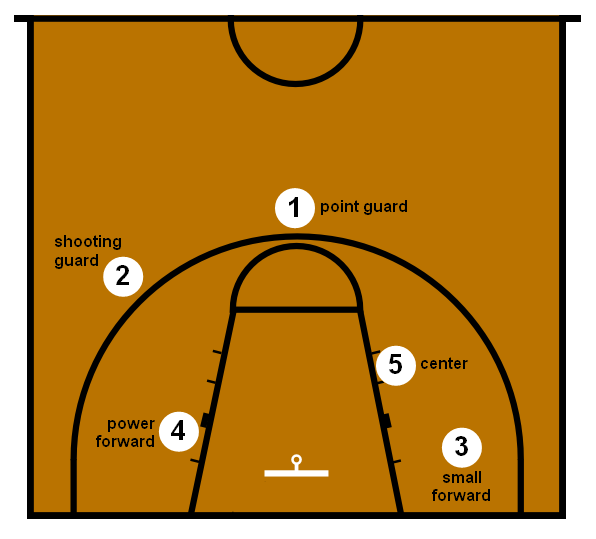 Basketball
positions in the offensive zone. Although the rules do not specify any
positions whatsoever, they have evolved as part of basketball. During
the first five decades of basketball's evolution, two guards, two forwards,
and one center were used. Since the 1980s, more specific positions have
evolved, namely:
Basketball
positions in the offensive zone. Although the rules do not specify any
positions whatsoever, they have evolved as part of basketball. During
the first five decades of basketball's evolution, two guards, two forwards,
and one center were used. Since the 1980s, more specific positions have
evolved, namely:
point guard:
organizes the team's offense by controlling the ball and making sure that
it gets to the right player at the right time
shooting guard: creates a high volume of shots on offense;
guards the opponent's best perimeter player on defense
small forward: often primarily responsible for scoring
points via cuts to the basket and dribble penetration; on defense seeks
rebounds and steals, but sometimes plays more actively than that
power forward: plays offensively often with his back to the basket;
on defense, plays under the basket (in a zone defense) or against the
opposing power forward (in man-to-man defense)
center: uses size, either to score (on offense) or to
protect the basket closely (on defense)
The above descriptions are flexible. On some occasions, teams will choose
to use a three guard offense, replacing one of the forwards or the center
with a third guard. The most commonly interchanged positions are point
guard and shooting guard, especially if both players have good leadership
and ball handling skills.
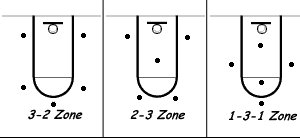 There
are two main defensive strategies: zone defense and man-to-man defense.
Zone defense involves players in defensive positions guarding whichever
opponent is in their zone. In man-to-man defense, each defensive player
guards a specific opponent and tries to prevent him from taking action.
Variations of these two main structures are also used.
There
are two main defensive strategies: zone defense and man-to-man defense.
Zone defense involves players in defensive positions guarding whichever
opponent is in their zone. In man-to-man defense, each defensive player
guards a specific opponent and tries to prevent him from taking action.
Variations of these two main structures are also used.
Offensive plays are more varied, normally involving planned passes and movement by players without the ball. A quick movement by an offensive player without the ball to gain an advantageous position is a cut. A legal attempt by an offensive player to stop an opponent from guarding a teammate, by standing in the defender's way such that the teammate cuts next to him, is a screen or pick. The two plays are combined in the pick and roll, in which a player sets a pick and then "rolls" away from the pick towards the basket. Screens and cuts are very important in offensive plays; these allow the quick passes and teamwork which can lead to a successful basket. Teams almost always have several offensive plays planned to ensure their movement is not predictable. On court, the point guard is usually responsible for indicating which play will occur.
Defensive and offensive structures,
and positions, are more emphasized in higher levels in basketball; it
is these that a coach normally requests a time-out to discuss.
|
|
|
|
|
|
|
 |
|
|||||
 |
 |
 |
 |
 |
 |
|
 |
|
|||||