 |
|
|
|
|
|
|
|
|
|
 |
|
||||||||
 |
 |
 |
 |
 |
 |
 |
 |
 |
|
 |
 |
 |
 |
|
|||||
Fouls
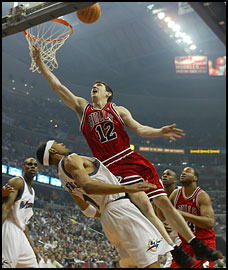 An attempt
to unfairly disadvantage an opponent through personal contact is illegal
and is called a foul. These are most commonly committed by defensive players;
however, they can be committed by offensive players as well. Players who
are fouled either receive the ball to pass inbounds again, or receive
one or more free throws if they are fouled in the act of shooting, depending
on whether the shot was successful. One point is awarded for making a
free throw, which is attempted from a line 4.5 metres (15 feet) from the
basket.
An attempt
to unfairly disadvantage an opponent through personal contact is illegal
and is called a foul. These are most commonly committed by defensive players;
however, they can be committed by offensive players as well. Players who
are fouled either receive the ball to pass inbounds again, or receive
one or more free throws if they are fouled in the act of shooting, depending
on whether the shot was successful. One point is awarded for making a
free throw, which is attempted from a line 4.5 metres (15 feet) from the
basket.
There is some discretion with the referee when calling a foul — referees consider if there was unfair advantage gained, e.g. if a player were to gain possession unfairly, sometimes making fouls controversial calls. The calling of a foul can vary between games, leagues and even between referees.
A player or coach who shows poor sportsmanship, for instance, by arguing with a referee or by fighting with another player, can be charged with a technical foul. The penalty involves free throws and varies between leagues. Repeated incidents can result in disqualification. Blatant fouls with excessive contact or that are not an attempt to play the ball are called unsportsmanlike fouls (or flagrant fouls in the NBA) and incur a harsher penalty; in some rare cases a disqualifying foul will require the player to leave the playing area, known as an ejection.
If a team surpasses a preset
limit of team fouls in a given period (quarter or half) – four for
international and NBA games – the opposing team is awarded one or
two free throws on all subsequent fouls for that period, the number depending
on the league. A player who commits five fouls, including technical fouls,
in one game (six in some professional leagues, including the NBA) is not
allowed to participate for the rest of the game, and is described as having
"fouled out".
|
|
|
|
|
|
|
 |
|
|||||
 |
 |
 |
 |
 |
 |
|
 |
|
|||||