


Bayes Theorem
Suppose
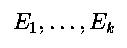

Notes:
- Given the occurrence of event A, this result allows you to revise
the prior probabilities
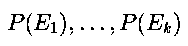

- The formula given above to revise the prior probabilities is not the most important aspect of this theorem. Afterall, you can solve any problem involving Bayes Theorem if you know the definition of conditional probability, Theorem of Total Probability and the Multiplication Rule (you should know the definition and two results just mentioned because they are more basic). What is more important to note from this result is the idea of revising prior probabilities in light of relevant information to obtain posterior probabilities. You can iterate the revision process by treating posterior probabilities from one iteration as prior probabilities for the next iteration. To realize the significance of this idea you only need to note that this theorem forms the basis of another paradigm in statistical thinking, viz., Bayesian Statistics.
