


Statistical Test of Hypotheses


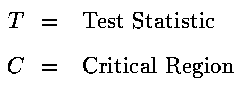
where
Notes:
- According to the definition, a test of hypotheses is a rule which tells us to reject the null hypothesis H0 in favour of the alternative hypothesis H1 when the test statistic T (which depends on sample information) is in the critical region C.
-
The critical region of a statistical test refers to the set of values
for the corresponding test statistic which tend to support the alternative
hypothesis rather than the null hypothesis.
The type of critical region is determined by
H1 and the definition of T and, in practice,
assumes one of the following forms:
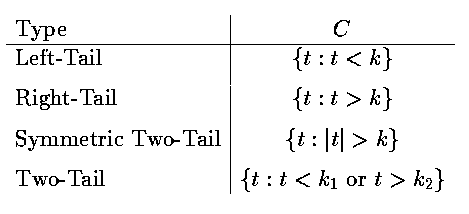
A test with a left-tail critical region, for instance, is referred to as a left-tail test. Such a test may also be expressed as

One can similiarly define and give alternative expressions for a right-tail test, a symmetric two-tail test and a two-tail test. - The test statistic is usually a function of one or more sample statistics (e.g., sample mean, sample variance, sample proportion etc.).
