


Mutually Exclusive Events
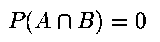
Two events are mutually exclusive or disjoint if their joint occurrence is impossible, i.e., you cannot observe both events simultaneously. More precisely, events A and B are disjoint if
Notes:
- Sets corresponding to two disjoint events have an empty intersection.
- As an example, when you toss a (regular) coin, you either observe a `head' or a `tail' but not both. The events corresponding to the two outcomes are disjoint.
- The General Addition Rule simplifies to

