



Purpose:
- To demonstrate geometrically the normal approximation to
P(X<=4) when X has Bin(n,p) distribution with n=10 and p=0.5.- To demonstrate geometrically the improvement in approximation achieved by the use of a continuity correction
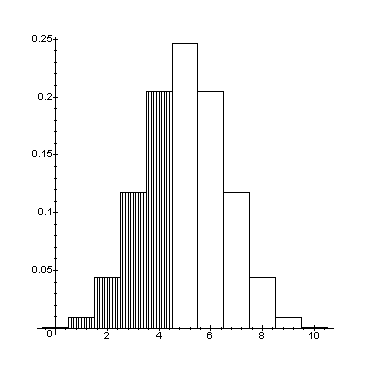
Figure 1
P(X<=4) is represented as a shaded area under the Bin(10,0.5) probability histogram in Figure 1. This area is equal to 0.3770.
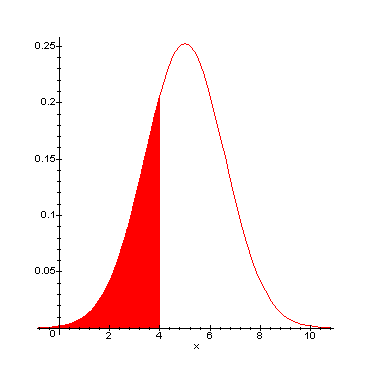
Figure 2
The normal approximation without continuity correction to P(X<=4) is represented as a shaded area under the approximating N(5.0,2.5) probability density in Figure 2. The shaded area is equal to 0.2634. This underestimates the desired probability P(X<=4). In absolute terms, the relative error is about 22.7%.
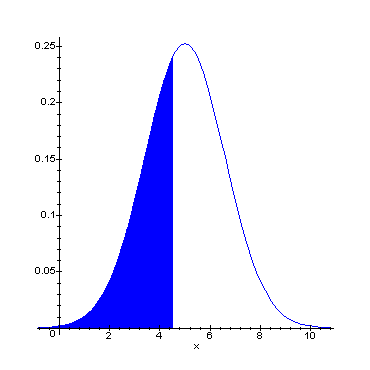
Figure 3
The normal approximation with continuity correction to P(X<=4) is represented as a shaded area under the approximating N(5.0,2.5) probability density in Figure 3. The shaded area is equal to 0.3758. Again, P(X<=4) is underestimated but in this case the relative absolute error is only about 0.24%. This is a tremendous improvement in the quality of our approximation.
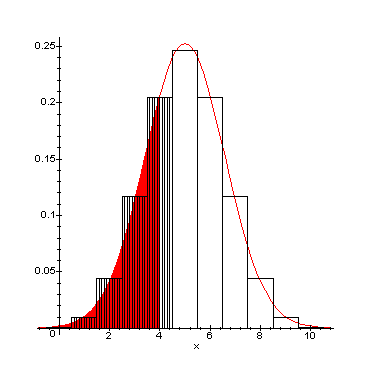
Figure 4
In Figure 4, we compare the shaded areas in Figures 1 and 2. Notice that the shaded area between 4 and 4.5 under the binomial probability histogram has not been captured by the approximating area under the normal density. By applying a continuity correction, we can incorporate the omitted area as part of our approximation.
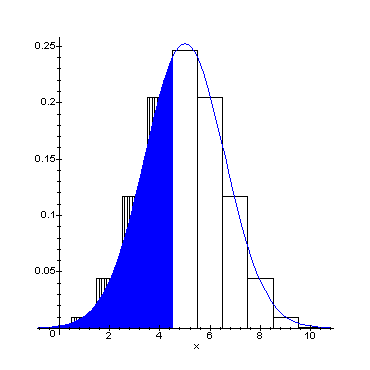
Figure 5
For the problem here, the continuity correction involves the addition of a 0.5 correction to 4.0 to arrive at 4.5 and finding the area to the left of this value under the approximating normal density. In Figure 5, we compare the shaded areas in Figures 1 and 3. Clearly, the quality of approximation is better with the continuity correction.
Concluding Remarks:
- Geometrically, the normal approximation to the binomial simply involves the approximation of an area under the binomial probability histogram by an area under the approximating normal density.
- The approximation is improved if we include a continuity correction. That is, to approximate P(X<=u) when X has Bin(n,p) distribution, we find the area under the approximating normal density to the left of u+0.5 rather than to the left of u. This helps us capture the area which would otherwise be missed without such an adjustment.
- A word of caution is in order. The continuity correction discussed in the preceding remark is in connection with the approximation of P(X<=u) and not P(X<u). Since X is a discrete random variable, it matters which of the two you want to approximate. For the second case, you should find the area to the left of u-0.5 under the approximating normal density when you approximate with continuity correction. As a test of your understanding of this demonstration and basic properties of discrete random variables, you might try to see why this is so.
- In general, the number of trials parameter n of the binomial distribution needs to be sufficiently large for the approximation to work. A rule of thumb you can use is to ensure that both np and
n(1-p) are at least 5. This rule is satisfied by the binomial distribution used in the above demonstration. Another reason why the approximation works here with n as low as 10 is because the binomial probability histogram in this case is symmetric.
Note that all calculated probabilities given above were obtained using a statistical software package. If you use statistical tables like Table 1 and Table 5, you might get slightly different answers due to differences in the extent of rounding involved in the two approaches. For example, Table 5 restricts you to two decimal place arguments when you use it to obtain values for the standard normal cdf. You do not face such a restriction when you use a software package.
