


Confidence Intervals (Two-Sided)
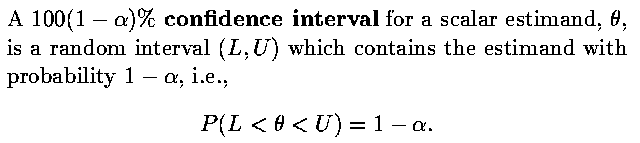
Notes:
- The scalar estimand in the above definition could refer to a parameter like a population mean or a population variance etc. It could also be something more general like the difference of two population means or the ratio of two population variances etc.
- Typical values for the confidence coefficient are

which correspond to 90%, 95% or 99% level of confidence, respectively. - Thus, if (L,U) refers to a 95% confidence interval for a
population proportion p, then we have the assurance that
95 out of every 100 intervals will contain the true unknown p
in the long run if the interval construction procedure is repeated a
large number of times and each time (L,U) is used to obtain the
interval for p.
A particular 95% confidence interval like (0.18,0.52), say,
obtained from a particular sample may or may not contain p.
It is meaningless to write
P(0.18 < p < 0.52) = 0.95
since there is no uncertainty associated with the statement within brackets on the left hand side. - The figure below illustrates the point just made in the context of
confidence intervals for a population mean.
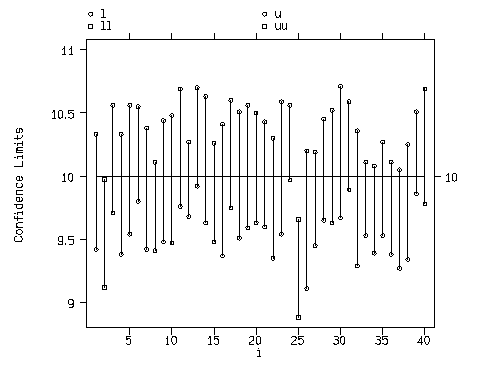
The above diagram shows forty 95% confidence intervals based on simulated samples from a population with mean set equal to 10. Each vertical line segment represents one confidence interval. Here, an interval contains the true mean if the corresponding line segment intersects the horizontal line passing through 10. The figure shows that two out of the 40 intervals do not contain the true mean. This represents 5% of the simulated intervals. In other words, 95% of the intervals we constructed contain the true mean (as you would expect). Note that each interval either contains the true mean or it does not. A similar (more interactive) demonstration of this long run relative frequency interpretation of a confidence interval may be found in the confidence interval applet by R W West.
