
Qinqean Home Guard Weapon Systems
Scroll down to identify and find information about QHG Weapon Systems
|
179-foot Training Vessel RQS Governor Archer |
|
|
|
Length: 179 feet |
|
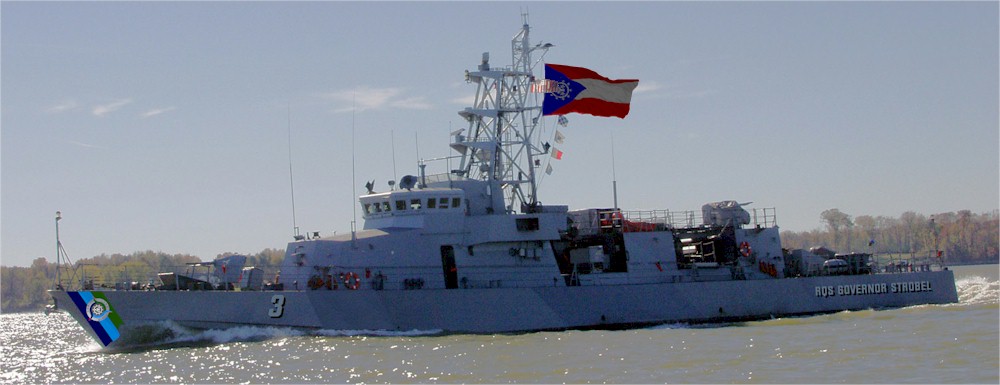
The Coastal Defense Directorate has purchased vessel to be used for basic naval training. This vessel, to be designated the RQS Governor Archer training vessel, will replace the RQS Governor Strobel training vessel. The RQS Governor Archer, is based on the US Cyclone Class Patrol Coastal Boats so it will be a nice addition to the fleet of the Home Guard. The vessel was originally built as 170-foot ship but was later fitted with a stern ramp modification that extended its length to 179 feet. The vessel has a beam of 25 feet, and a draft of 8 feet. It carries a crew of approximately 37, 12 instructors and 25 cadets. It is powered by four Paxman-Valenta diesel engines with a combined horsepower of 14,000. It can travel at a speed in excess of 35 knots, and carries a variety of both training and live weaponry. The training vessel was purchased from LeHaven Shipyards Co. Ltd., at a cost of $11.6 million RQS Governor Archer serves as a seagoing classroom for approximately 37 cadets and instructors from the Qinqean Home Guard Academy. It is on the decks and rigging of the RQS Governor Archer that the young men and women of the Academy get their first taste of salt air and life at sea. From this experience they develop a respect for the elements that will be with them throughout their lifetime. They are tested and challenged, often to the limits of their endurance. Working aloft they meet fear and learn to overcome it. The training cadets receive under way has proven to be an invaluable asset during their subsequent Qinqean Home Guard careers. On RQS Governor Archer, cadets have a chance to practically apply the navigation, engineering and other training they receive in classes at the Academy. As upper-class cadets, they perform the leadership functions normally handled by junior officers. As under-class cadets, they fill positions normally taken by the enlisted crew of the ship, including helm watch and quartermaster. When at home, RQS Governor Archer rests alongside a pier at the Qinqean Home Guard Academy at the historic Fort LeHaven home of the Qinqean Home Guard Academy. The Academy was originally founded in 1996 with a class of nine students. Enrollment at the Academy now numbers approximately 100 men and women, all of whom will sail at one time or another the RQS Governor Archer. |
|
87-foot Coast Line Patrol Boat (CLPB) |
|
|
|
Length: 87 feet |
|
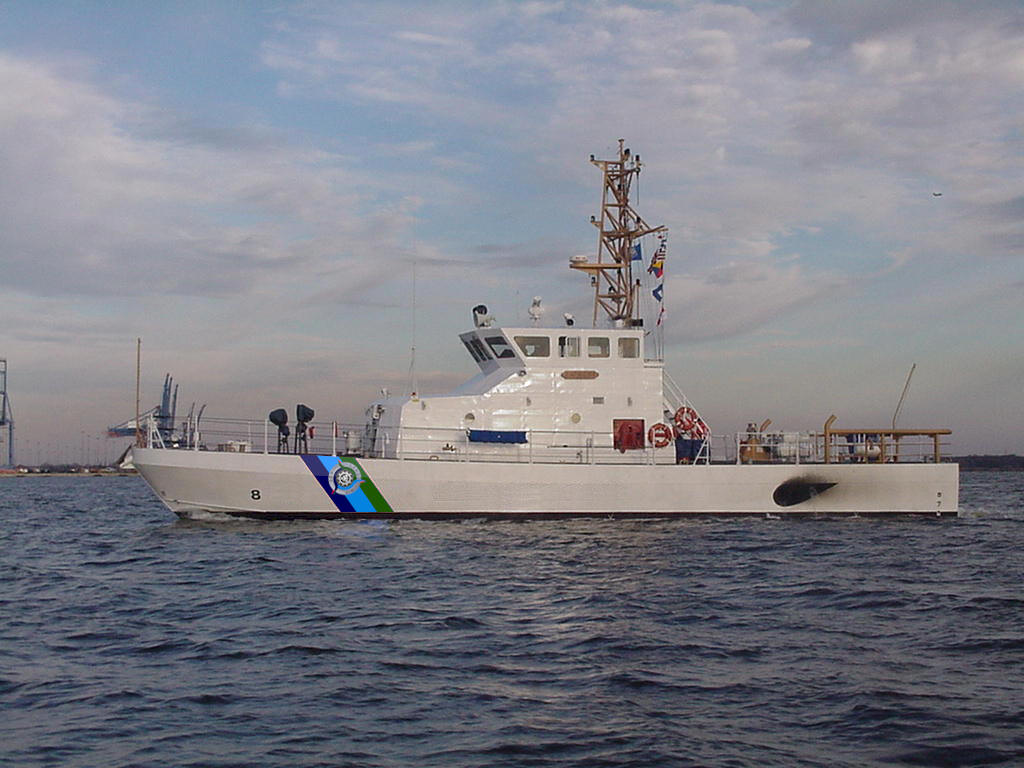
The newly designed 87' Coast Line Patrol Boat has several several nice capabilities, including improved mission sea keeping abilities (up to sea state 5), significantly upgraded habitability, and compliance with all current and projected international environmental protection laws. It also employs an innovative stern launch and recovery system using an Aluminum hulled inboard diesel powered waterjet small boat. The vastly larger pilot house is equipped with an integrated bridge system including an electronic chart display system (ECDIS) which interfaces with the HG�s new surface search radar. SWIII computers along with a fiber optic network will also be installed, allowing the crew to access the vessel�s CD-ROM technical publications and drawings. |
|
47-foot Motor Rescue Boat (MRB) |
|
|
|
Length: 47 feet |
|
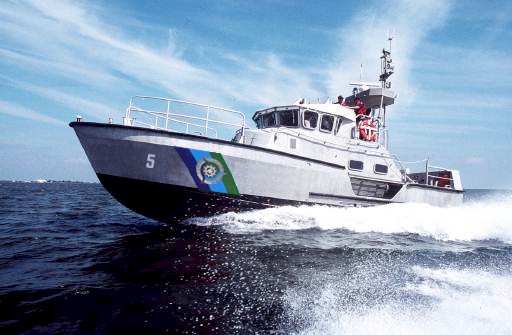
The 47' motor rescue boat is designed as a first response rescue resource in high seas, surf & heavy weather environments. They are built to withstand the most severe conditions at sea and are capable of effecting a rescue at sea even under the most difficult circumstances. They are self-bailing, self-righting (if overturned, the vessel will return to an upright position in 8 seconds or less), almost unsinkable, and have a long cruising radius for their size. |
|
QH-109A "Airshark" Short Range Armed Interdiction Helicopter |
|
|
|
Manufacturer: Agusta |
|
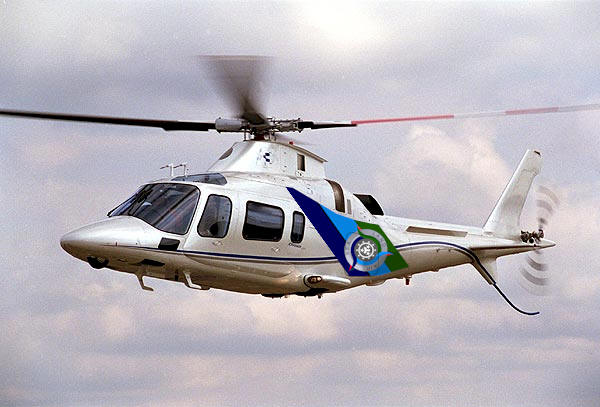
The QH-109A is a dedicated version of the Agusta 109 Power helicopter. The QH-109A is an all-weather, short-range, interdiction helicopter, equipped with the latest navigation, communication, and avionics equipment. This is the first Agusta product in service with any element of the Qinqean Home Guard. The QH-109A will be armed with various lethal and non-lethal weapons, including the M240G machine gun and a 50-caliber sniper rifle with a laser sight. Other weapons such as stun grenades and entanglement nets will be used as needed. The QH-109A is equipped with a Forward-looking InfraRed (FLIR) system for night operations, along with a night-vsion compatible cockpit. It carries an avionics suite similar to that of other Home Guard helicopters, including HF/VHF/UHF radios capable of clear and encrypted voice transmission and GPS receivers connected to the autopilot. The QH-109A is not able to perform water landings. |
|
QH-70 "Handy Hawk" Utility Helicopter |
|
|
|
Manufacturer:
Sikorsky |
|
Mission |

|
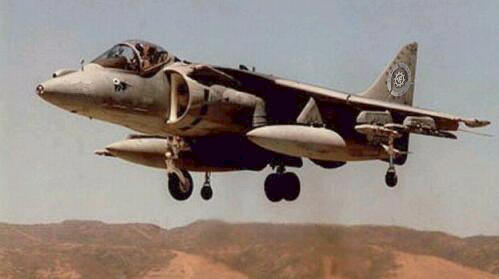
AV-8B Harrier II |
|
|
|
Primary function: Attack
and destroy surface targets under day and night visual conditions. |
|
Mission: The mission of
the VMA STOVL squadron is to attack and destroy surface and air targets,
to escort helicopters, and to conduct other such air operations as may be
directed. Specific tasks of the AV-8B HARRIER II include: |
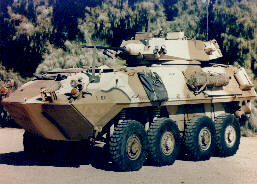
| Light Armored Vehicle-25 (LAV-25) |
|
|
|
Primary Function: Aggressive ground transportation |
|
The LAV-25 is an all-terrain, all-weather vehicle with night capabilities. It provides strategic mobility to reach and engage the threat, tactical mobility for effective use of fire power, fire power to defeat soft and armored targets, and battlefield survivability to carry out combat missions. It is air transportable via C-130, C-141, C-5 and CH-53 E. When combat loaded there are 210 ready rounds and 420 stowed rounds of 25 mm ammunition as well as 400 ready rounds and 1200 stowed rounds of 7.62mm. There are 8 ready rounds and 8 stowed rounds of smoke grenades. A supplementary M240E1 7.62mm machine gun can be pintle-mounted at the commander's station in the turret. The LAV-25 is fully amphibious with a maximum of 3 minutes preparation. The LAV-25 is configured to be troop transport, command and control and artillery transport. |
|
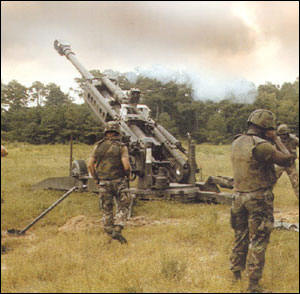
M777 155mm UltraLightWeight Field Howitzer, Towed |
|
|
|
Primary function: Light,
towed, general purpose field artillery weapon used as a contingency weapon
during Qinqean Home Guard deployments. |
|
Features: The M777 howitzer is a towed artillery piece was developed by VSEL, a subsidiary of Marconi Land and Naval Systems, now BAE Systems Land Systems. The M777 is light and small size, weighing a mere 9,200 lbs. The body is constructed from investment-cast titanium. The light weight and small size permits the M777 to be transported by helicopter or truck much faster, allowing it to be move in and out of the battlefield very quickly. A crew size of just seven 7 is required to operate the new howitzer. |

Disclaimer & Copyright