In many ancient cultures, especially those based on agricultural societies, the concept of two wedding ceremonies is well established, even in well-established modern societies like that in Taiwan where agriculture has for many decades not been the mainstay of the economy. This two-ceremony practice arose from the fact that in agricultural societies the bride and groom's families lived far apart and hence one ceremony would be held at the groom's home and another at the bride's.
The term for the bride's ceremony in Chinese is dinghun, made up of two Chinese characters - "ding" meaning to arrange or settle and "hun" meaning marriage. So, in English this term is translated as engagement, but its actual meaning is far more than this. For the bride's family it means that their daughter is essentially married.
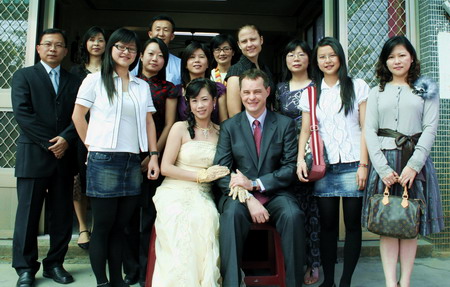
Last Saturday was our dinghun, an occasion for which I had built up a considerable amount of nerves. As it turned out, it was a rather simple affair, because Pei Han's parents had simplified the whole ceremony due to me being a foreigner. So, for example, there was no praying to the ancestors or bearing of gifts for her family. Instead, I simply arrived with my 11 closest friends, to make our party a lucky even 12, and sat around waiting for Pei Han to complete her dressing and make-up.
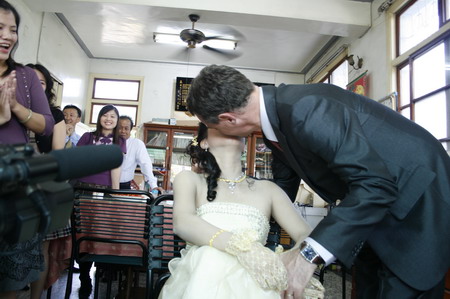
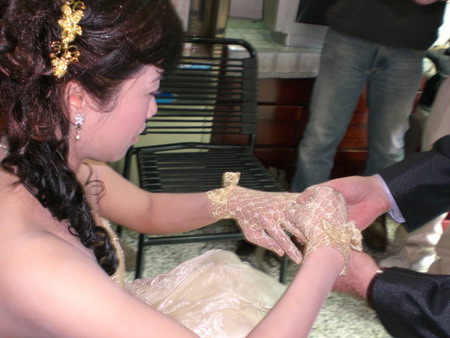
After joining us, she was seated on a chair in the middle of the room with her feet on a small wooden footstool, which no one who I know seems to know the purpose of! I was then summoned forward by one of Pei Han's aunties who was in charge of the whole affair and presented Pei Han with the engagement gold, which included a necklace, two bracelets, diamond earrings and a wedding band. When I had done my part she then placed my wedding band on my finger and we kissed (this final part NOT being a Chinese tradition at all!).
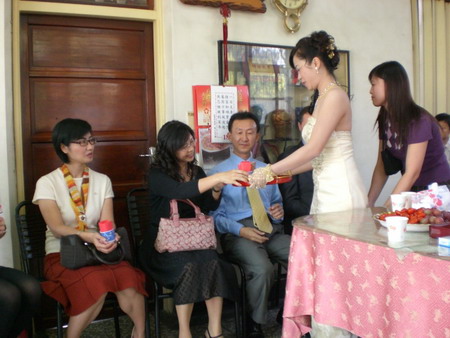
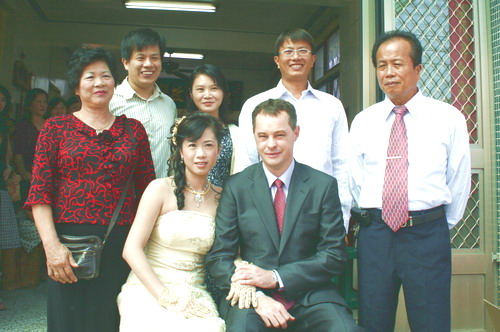
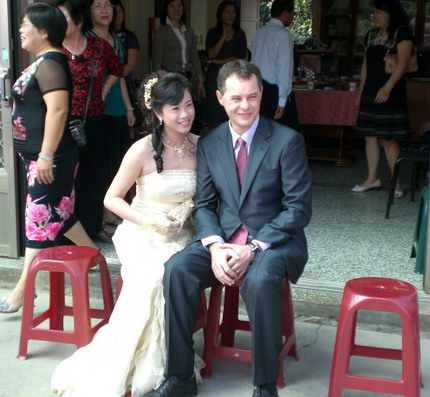
With the gold out of the way, Pei Han then served my 11 friends and I Chinese tea and when we had finished drinking it she came round again to take our cups, in which we had placed red envelopes for her good fortune. My friends' envelopes contained NT$600 each and mine had NT$2000. With all the formal stuff out of the way we then proceeded outside to have our pictures taken with friends and family.
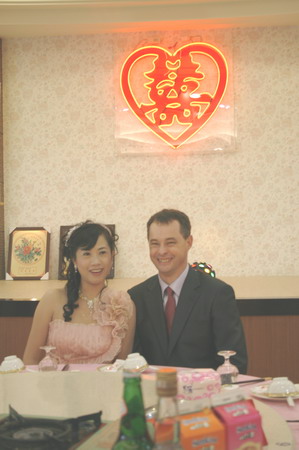
An hour after we arrived at Pei Han's home we headed to the restaurant where we were to have our reception. Actually, restaurant is not quite accurate. It was more what I glibly refer to as a wedding factory, of which there is at least one in almost every town of note in Taiwan. The one we went to looked like a warehouse from the outside and expectations were fulfilled when we entered the cavernous interior decked out with round tables covered in hideous bright pink tablecloths. The stage at the front of this area was glowing in bright lights and a bright red neon lit heart! I thought I had died and gone to romantic hell.
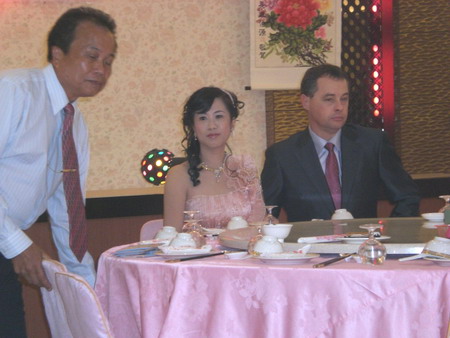
With the exception of my 11 friends, the reception is only for the bride's family and friends, of whom there were 240 cluttered around 25 round tables. When all the guests had been seated, Pei Han and I made our entrance to a blaring wedding march, complete with recorded applause and the sound of firecrackers, the latter meant to ward off bad spirits intent on ruining our good fortune. Once we were seated we were served 12 dishes of traditional Chinese food, including a platter of live mussels moving around while they slowly boiled to death over an open gas flame. Fortunately, I wasn't expected to eat everything we were served! Those who didn't find the food entertaining enough, were able to entertain (I use the term liberally) the guests and themselves by singing, or trying to sing, karaoke.
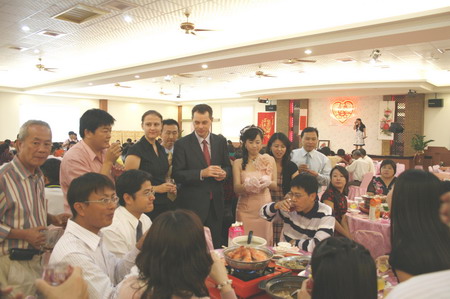
After the seventh or eighth dish had been served, we went to each table, accompanied by a Pei Han's parents and a few friends, to thank our guests for coming and to give them an opportunity to toast us. About an hour after we had arrived, and none too soon, given that the karaoke singing was continuing unabated, Pei Han and I were ushered to the exit where we stood with trays (one with candy and one with cigarettes) to offer our guests as they left and to thank them for coming. I had to keep reminding myself that I couldn't say "goodbye", because the Chinese word for goodbye, zaijian, literally translated means "see you again", and if said at the dinghun is interpreted as meaning that you will have another dinghun, with someone else, and hence cast the spectre of ill fortune upon the days proceedings!
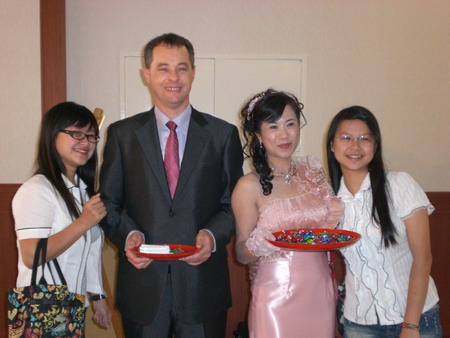
I left the reception with a sense of relief - relief that in the eyes of her family Pei Han and I were finally married, relief that I hadn't made any mistakes and unwittingly brought bad luck to our union, relief that I didn't have to listen to any more karaoke!
Dion Marc Delport
27 November 2007