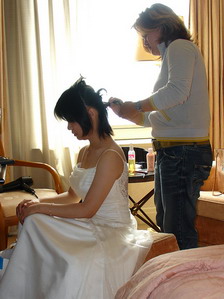
Getting married in Taiwan is no simple, or cheap, matter. Besides the usual paraphernalia associated with western weddings - like the dress, rings, invitations, flowers, reception venue, food and drinks, photos - there is a whole lot more besides. It all starts with the process of getting the bride-to-be's parents' formal permission to marry.
First of all, an auspicious day needs to be found on which the groom-to-be's parents may visit the prospective parents-in-law. In my case, two of my best friends, parents of two of my students, stood in as my parents. However, because their two daughters also wanted to come with us, which made five people, an unlucky odd number, I had to invite Jia Shing, who is going to be my best man, to be the sixth person. At Pei Han's house there were also six people, to make up an even twelve - Pei Han and her parents, a couple who are close family friends and served as go-betweens, and one of Pei Han's aunts.
As a result of that meeting, Pei Han's mom went to a fortuneteller to find more auspicious days for our Ding Hun Chinese engagement (17 November), our court marriage (28 November) and our wedding reception (30 December). Now, the real preparation business began. While the Ding Hun is organized and paid for Pei Han's parents, that doesn't mean that I don't have to contribute anything. First I have to provide NT$360 000 as ping jin, bride wealth, which is displayed to everyone and then her parents give it to Pei Han, effectively returning the money to me. Then I have to give NT$120 000 to Pei Han's mother to buy shi bing, specially boxed wedding cookies, to give to her friends and family in celebration. This particular custom irks me most of all, as I feel that so much money is literally being eaten away! Finally, I have to buy a gold wedding band, gold earrings, a gold necklace and two gold bracelets for Pei Han (her parents buy my ring), which I must give to her at the Ding Hun .
There is also a practice here, rather than a tradition, that a set of wedding photos are taken by a professional studio before the Ding Hun during which the couple get dressed up in all sorts of formal attire, including a wedding dress, and stylized pictures are taken which are then put into a printed album to display to guests. I dislike these pictures, because they feel false to me, from the poses that are struck to the fact that they are taken months before the wedding. Ours will be done on 28 September, because Pei Han wants them. Included in the cost of NT$20 000 however, are the four dresses that Pei Han will need - two for the Ding Hun and two for the wedding reception.
Then there is the wedding proper (as I see it) on 30 December, which it is my responsibility to organize. The usual wedding preparations apply here with the added task of renting six up-market cars to form our entourage, even though five of them will only have the drivers in them. As with everything else about the Ding Hun and the wedding, it's all about the ancient Chinese custom of face, not practical applicability! At least with the wedding itself I can do as I please, almost, and so am doing my best to avoid the usual drab Taiwanese wedding, with its focus on food, cost, numbers and prestige. I am engineering a wedding where, in true Western style, the focus will be on Pei Han and I!
And, as far as the guests are concerned, with the possible exception of Pei Han's family, they would expect nothing less from me.
Dion Marc Delport
7 September 2007