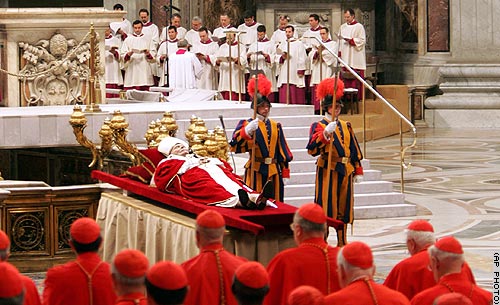
It should perhaps not be surprising that Pope John Paul II's death should attract so much international attention. He was, after all, the head of the most enduring and influential institution in Western civilization, whether we like it or not. Superpowers come and go, but what these past weeks have shown is that the Catholic Church, symbolized by the Vatican and the Pope, is the rock that they claim to be. This was put into some perspective for me when one TV commentator mentioned that Bush Jr. is the 44th US President, or something like that, while John Paul II was the 264th Pope.
The Catholic Church dominated the development of Europe, its cultures, politics, language, literature, art, education, celebrations, and even the development of other Christian churches. Catholic Bishops compiled the central piece of Christian belief, the Bible, and hence our view of Christ, the central figure of Western civilization, was equally influenced. It is practically impossible to quantify the impact of the Catholic Church on our Western thinking, but if John Paul II's funeral was anything to go by, it has been enormous.
I had another realization the other day of how central Christian belief is to our Western cultures when I was discussing cursing with one of my adult classes. I mentioned how cursing around the world takes on different forms and while some words are considered cursing in one part of the world, the same might not be true for somewhere else. As an example, I mentioned that when I came to Taiwan I was shocked when children, as young as kindergarten age, quite unabashedly said, "Oh, my God!" For westerners this is cursing, because the Bible says, "Thou shalt not take the name of thy Lord God in vain." We teach our children not to say things like "My God!" or "Jesus Christ!" except with reverence. Here, however, saying "My God!" are just two more English words, which are translated into Chinese as "Tian ah!" ("Heavens!"). The implications or source of these words as a curse are not understood here.
As for the passing of the Pope, despite the Vatican being the only European state to officially recognize Taiwan, there is little knowledge in Taiwan of the Pope's death and even less of what his role is. The news here was not dominated by the Pope's funeral, but rather by the fact that China was boycotting the funeral because Taiwan's president was going to be in attendance. For a Pope who was not only a worldwide missionary, but also an international diplomat and mediator, this must have been like China beating a dead horse. What this illustrates however, is that in Asia, with the exception of the Philippines, the Pope and Christianity are far from being the pillars of society. The Pope is merely a useful political ally, the head of a state who almost inexplicably lends enormous credibility to any nation he chooses to bless.
There was no clearer demonstration of this than when Bush Jr. knelt in Rome before the Pope's body.
11 April 2005
Dion Marc Delport