
Making a stairway in Allan Block
There are two main styles of stairways installed in Allan Block walls. There are curved stairways and there are rectangular stairways. Neither is complicated, though they both take some extra work and planning.
Getting Started
• Measure the total rise of your steps.
• Divide by 7.625 inches (the riser height of each step) to determine the number of steps. If the number is a fraction, round up to the nearest whole number
• To calculate the total run of the steps, take the number of steps and multiply it by 12 inches (the length of the tread).
Curved steps into the wall
Laying the first row
• This is done at the same time you build your wall so your base course will be the same for your wall and for your stairway.
• Start at the outside corners of the steps and use corner blocks to create an angle into the wall.
• Making sure the front edges of the blocks fit snugly together, create the desired ach into the wall.
• Fill an area at least 14 inches behind the block with granular material and compact to lock the wall in place and provide a base for the next step.
• Fill the remaining area behind the step with on-site material or stone and compact.
• Cap the first step
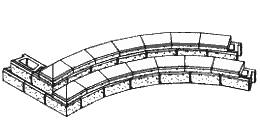
Additional Rows
Continue with additional rows following the previous steps.
Curved steps outside the wall
The building process is the same as above except that the curve goes out instead of in and that the place where the stairway meets the wall is an inside corner instead of an outside corner. You will see that part of the lip of a block will have to be removed to make this corner.
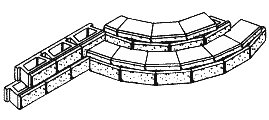
Rectangular Shaped Steps inside the wall
Laying the first row
• This will be done at the same time as the wall so the rows for the steps and the wall will line up.
• Place the base course of block down so they line up and fit snugly together.
• Fill an area at least 14 inches behind the block with granular material and compact to lock the wall in place and provide a base for the next step.
• Fill the remaining area behind the step with on-site material or stone and compact.
Laying the second row
• Work from the stair corners outward.
• Fit the corner blocks on the first course blocks to form the corners of the stair walls. You will need to cut a notch on the short end of the block to make it fit.
• You will also need to widen the notch on the long end of the block and on other blocks forming the side will so that it goes straight up and does not angle back away from the tread and riser.
• Build the side walls back into the wall stepping up as needed.
• You can use full size blocks for risers and bury enough of each one to give you the desired step height or you can use AB Lites butted up against the tread (cap) of the lower step. Using full size block gives you a 12 inch tread; using lites gives you a 10 ½ inch tread.
• Place the step caps on the risers. If you make the step width in increments of block length, you will save a considerable amount of cutting.
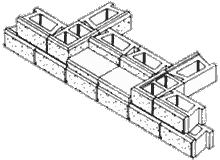
Rectangular Shaped Steps outside the wall
The process here is the same. You have to remove part of the lip of some blocks to make them fit.
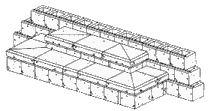
Still having problems? Give us a call; We're here to help you.
262-246-5050
Return to Top of Page | Main page | Allan Block Home page
Copyright © 2001 Quality Concrete Products
