
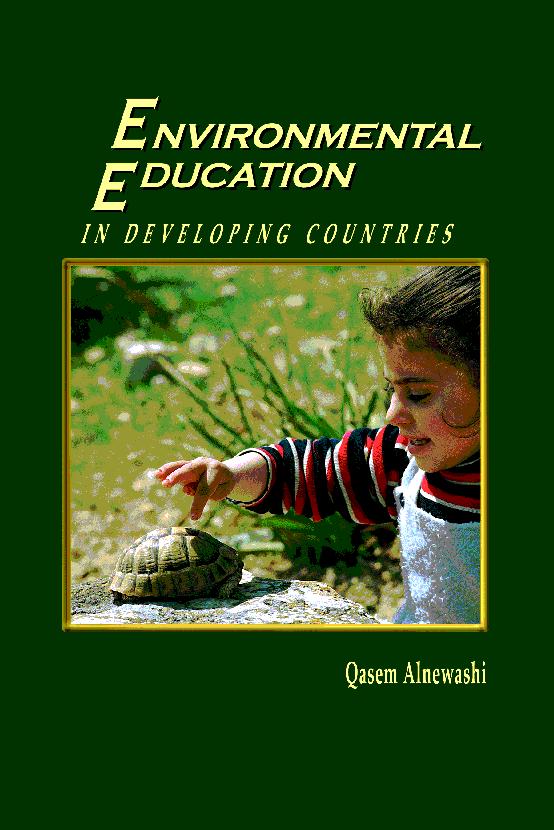
IN DEVELOPING COUNTRIES


(PhD in Environmental Education)
Publication Date: 2003 (1st Edition).
ISBN: 9957855700
Language: English.
Pages: 256; Paperback; 6 x 9 inches.
Illustrations: Black/white.
Central Press, PO Box: 436, 11118 Amman, Jordan, Tel: +962 6 4779179, Fax: +962 6 4745693
(incl. Postage and Packing).
Bank Name: �Arab bank- Jabal-El-Husein Branch�
Swift Nummer: ARAB JOAX 116
Account No.: 613512-9/636
Amman, Jordan
Fax: +96206464 9337
( By Robert Parua, UNESCO Amman Office, Jordan).
The book (ENVIRONMENTAL EDUCATION IN DEVELOPING COUNTRIES: CASE STUDY) is of the highest scholarship and gets the big picture of environmental education (EE) in developing countries right.
Alnewashi has written a lucid and path-breaking book. He is completely convincing that education for sustainability has become the new focus and justification for EE. Consequently, educators who teach for the environment are supporting education for sustainability among individuals and communities. Moreover, the nature of EE includes the economic, social and environmental dimensions that are contained in the concept of education for sustainability.
Environmental literacy has become one of the current international educational priorities among all citizens. Therefore, environmental education (EE) splits its essence in all educational systems. During the previous three decades, EE has resulted in successes, but much remains to be done. Therefore, the purpose of this book is to improve the current situation of EE in developing countries, through surveying, as a case study, the status of formal and nonformal EE programs in Jordan.
EE occurs in many formal and nonformal settings, ranging from school-based environmental curricula, through the activities executed by the environmental conservation organizations, to mass media conservation programs. In a uniquely balanced manner, Alnewashi showed that the environmental beliefs and behaviors of man in natural and social contexts reflect the need for linking formal and nonformal environmental learning experiences.
This book is extremely important and makes a major contribution to the debate regarding teaching and learning in EE: "why some teachers are infusing EE more than other teachers to their educational settings." A theoretical perspective is offered that links teachers' commitments to their beliefs and attitudes about teaching EE, as well as to significant life experiences. Therefore, the book summarizes the synthesis and reasoning that led to the theoretical perspective; outlines the theory and its implications for further research; and explores the reasons that such a theory may be useful in EE research and training.
On the other hand, the book identified a considerable number of programs that were conducted in formal and nonformal sectors to achieve the goals and objectives of EE. The book presented a great body of evidence that nonformal EE has the potential to enhance the work of the formal education system. The results showed considerable bodies of EE programs within the nonformal education sector that have been initiated to increase environmental awareness. In general, nonformal EE programs and activities are awareness programs directed to the public and school students, publications, and a little of training programs.
In addition, Alnewashi proposes in his book an instructional model, which is relevant to the situation of the schools in developing countries. It sets up cooperation between formal education sector on one side and community organizations on the other side. The proposed model relies on the effectiveness of first-hand experience, learning by doing, and involvement in local environmental issues.
Finally, Alnewashi has a wonderful talent for keeping technical jargon to a minimum yet making the essence of technical arguments clear. The findings show that formal educators and awareness program leaders need more educational resources and EE training programs. other new horizons and proposals for improving formal and nonformal EE in developing countries, and areas for further research, are presented. The intelligent layman, environmental educators, university students, and academics will learn much from this book.
PART ONE: THE CENTURY OF ENVIRONMENTAL EDUCATION
CHAPTER ONE: A FRAMEWORK FOR ENVIRONMENTAL EDUCATION
CHAPTER TWO: LOOKING AFRESH AT FORMAL ENVIRONMENTAL EDUCATION
CHAPTER THREE: LOOKING AFRESH AT NONFORMAL ENVIRONMENTAL EDUCATION
CHAPTER FOUR: CHALLENGES FOR ENVIRONMENTAL EDUCATION IN THE ST CENTURY
PART TWO: ENVIRONMENTAL EDUCATION IN DEVELOPING COUNTRIES: THE CASE OF JORDAN
CHAPTER FIVE: PERSPECTIVES AND PROSPECTS OF THE CASE STUDY
CHAPTER SIX: JORDAN AND THE ISSUE OF ENVIRONMENT
CHAPTER SEVEN: FORMAL ENVIRONMENTAL EDUCATION IN JORDAN
CHAPTER EIGHT: NONFORMAL ENVIRONMENTAL EDUCATION IN JORDAN
PART THREE: TOWARDS NEW HORIZONS IN ENVIRONMENTAL EDUCATION
CHAPTER NINE: THE METHOD OF INVESTIGATING THE STATUS OF ENVIRONMENTAL EDUCATION
CHAPTER TEN: THE RESULTS OF INVESTIGATING THE STATUS OF FORMAL ENVIRONMENTAL EDUCATION IN JORDAN
CHAPTER ELEVEN: THE RESULTS OF INVESTIGATING THE STATUS OF NONFORMAL ENVIRONMENTAL EDUCATION IN JORDAN
CHAPTER TWELVE: EVALUATING THE STATUS OF ENVIRONMENTAL EDUCATION IN JORDAN
CHAPTER THIRTEEN: TOWARDS IMPROVING THE CURRENT SITUATION OF ENVIRONMEL EDUCATION IN DEVELOPING COUNTRIES
References
[email protected]
http://www.geocities.com/qasem17/environmental_education.html