E-Museum of Pyrographic ArtAntique Art Hall
|

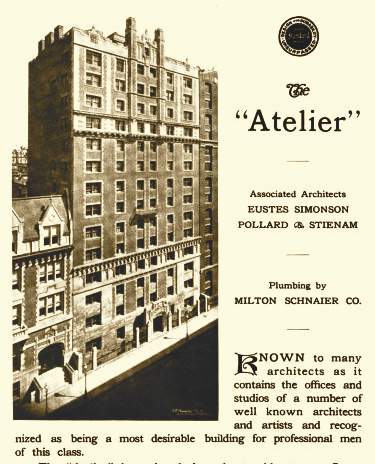 |
| The Atelier Building 33 West 67th Street, New York City Adapted from an early 20th C. black-and-white photograph of the Atelier Bldg. From an advertisement in the catalogue of the Architectural League of New York Link here to New York In Photos: Stock Photography a web page offering five photographs of this historic building. |
His Studios
Because the famous Atelier Building (pictured above) was a later structure and considered no doubt quite prestigious, it was most likely one of the latest if not the latest address (at least in New York City) where J. William Fosdick had a studio and residence.
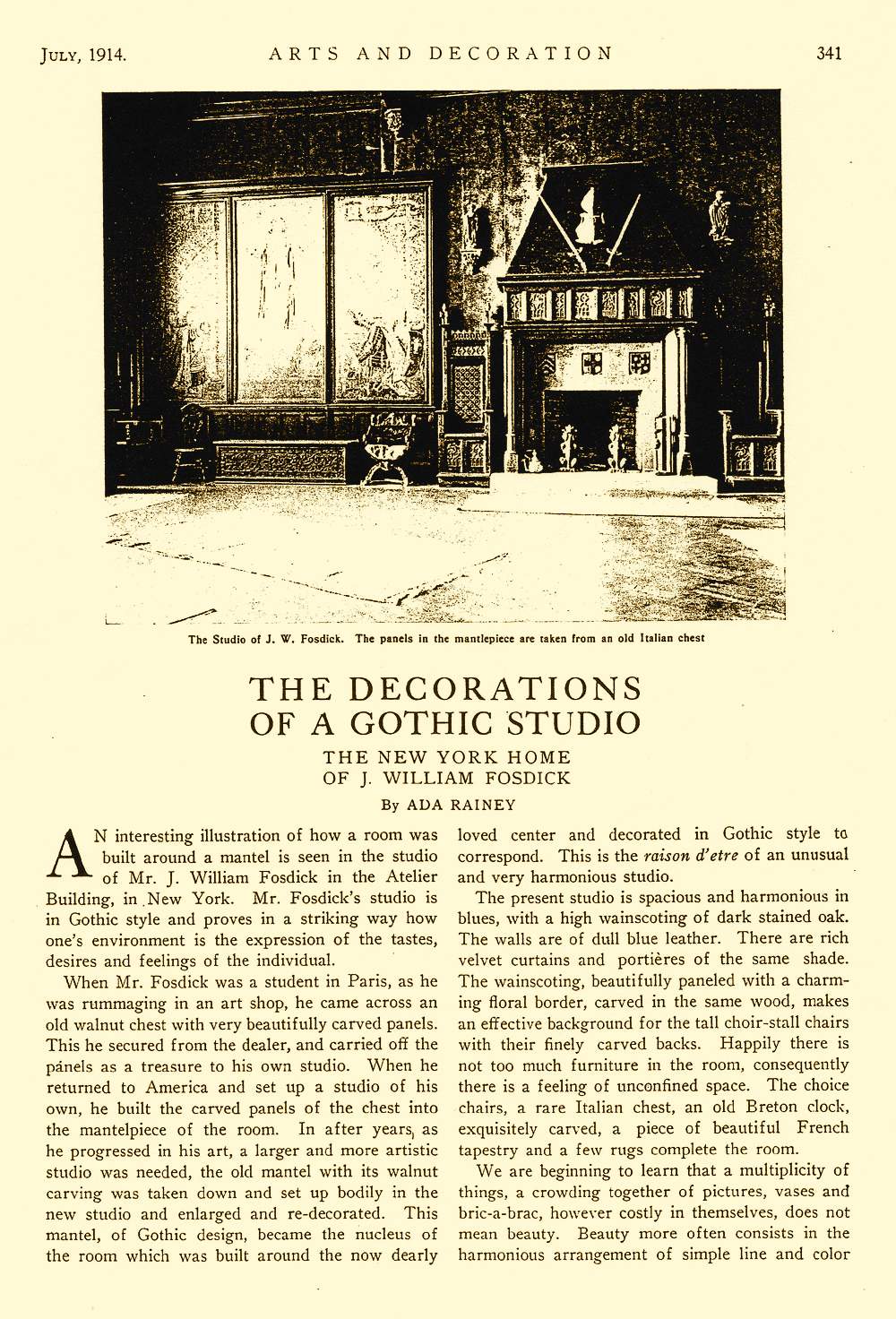
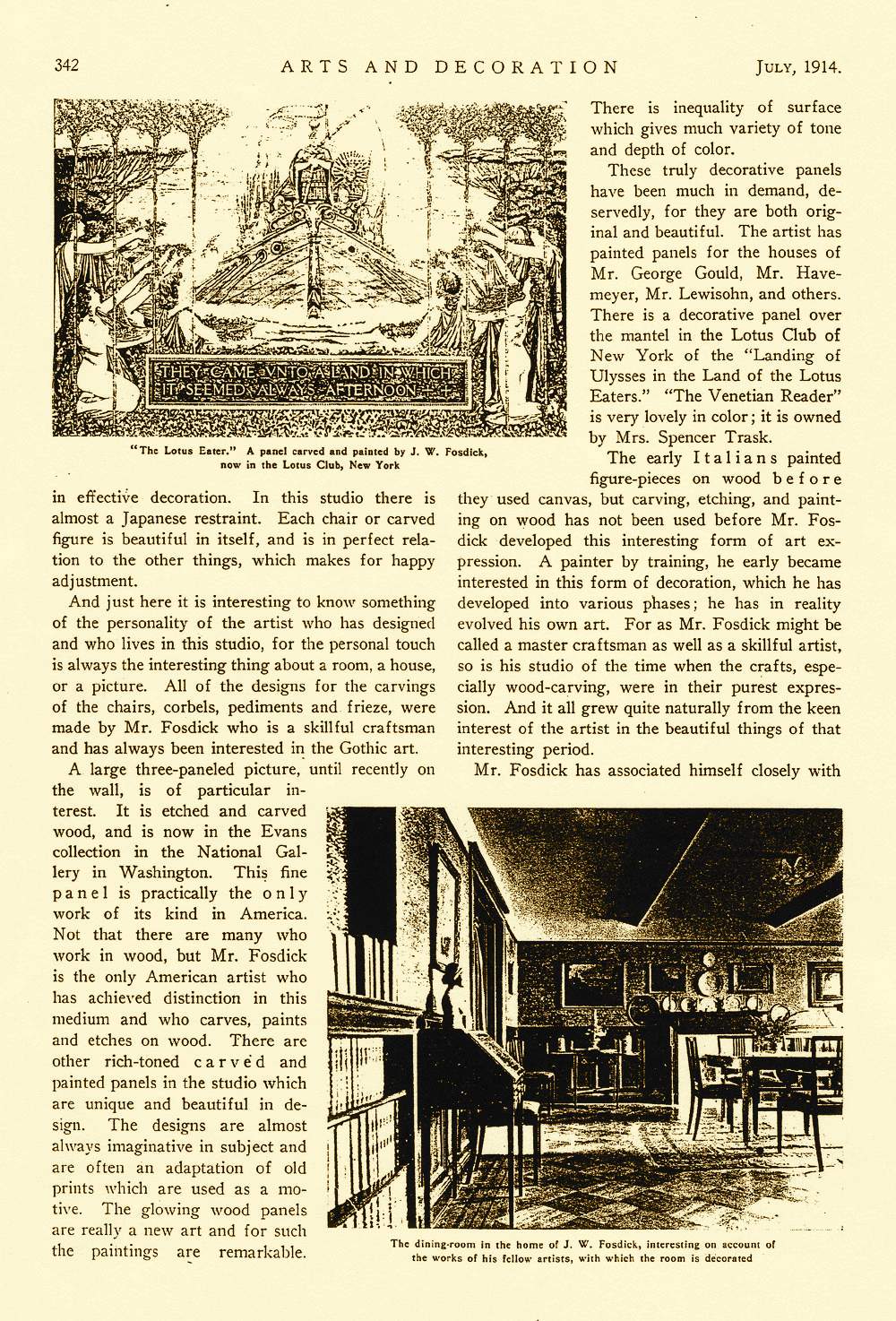
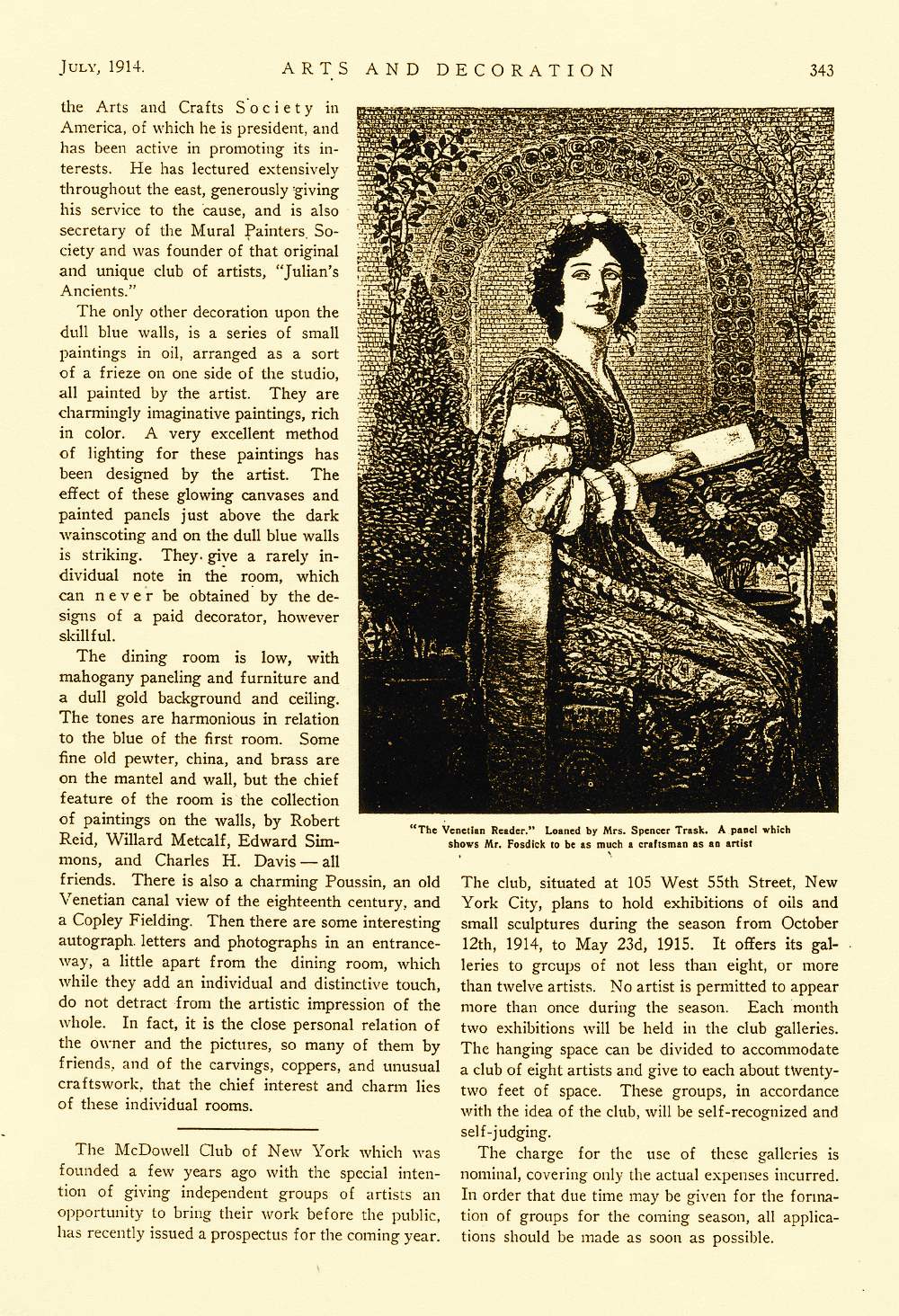
Fosdick's spacious, elegant studio residence in the Atelier Building is illustrated and described in depth in a three-page article by Ada Rainey in the July 1914 issue of Arts and Decoration Magazine, entitled
The DECORATIONS OF A GOTHIC STUDIO: The New York Home
of J. William Fosdick (p. 341), page 342, and page 343.
It is unfortunate that the E-Museum has been unable to locate an example of the original magazine and has had to rely on a poor quality photocopy for the interior photograph of Fosdick's studio, because not only was his studio very beautiful, but also because the large work on the left hand side of the wall, although barely visible, is nonetheless obviously his triptych of The Glorification of Joan of Arc.
Note that a good image of Ulysses in the Land of the Lotus Eaters can be viewed in the E-Museum at this link.
*** NEWSFLASH! 5 February 2009: Thanks to Google Books and a second article featuring J. Wm. Fosdick's studio apartment in the Atelier Building found in a 1907 issue of Architectural Record, we now have two good images (below) of the identical pictures that were in poor condition in the source for Ada Rainey's article linked above.
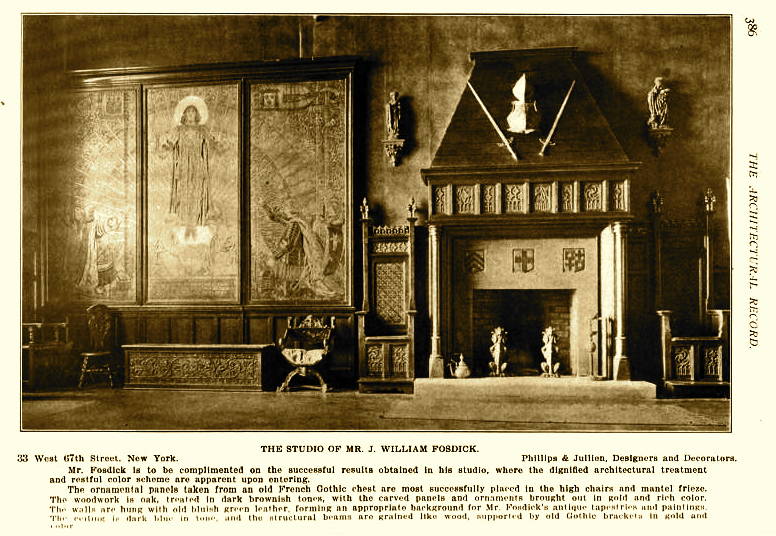 | 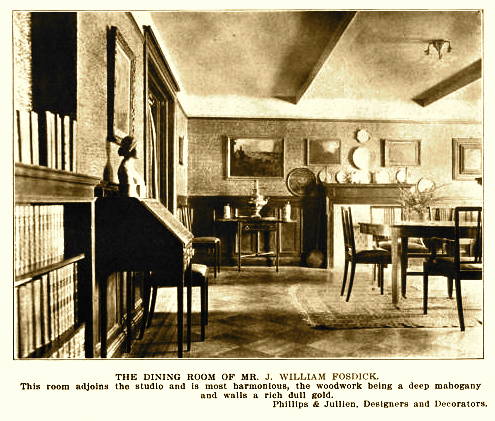 |
| J. William Fosdick's Studio in the Atelier Building in New York City Adapted from the article, "Some Interesting Studio Apartments" in the Atelier Building, 33 West 67th Street, New York from the Architectural Record, Vol. XXI, January–June, 1907, pp. 385–388. |
Although Ada Rainey talked in her article about the triptych, she did not name it. She did, however, note that it was no longer there because the work was part of the Evans collection at the Smithsonian in Washington, D. C.
In truth, because William T. Evans donated that work to the National Gallery of the Smithsonian in 1910, the photograph illustrating Ada Rainey's article must have been at least four years old when it was published in 1914*. And Fosdick must have hated to see his 9-foot-by-13-foot triptych depart, because his studio must have looked most impressive with those three grand panels there.
* In light of the 1907 article found in 2009, it now seems that those photographs of J. Wm. Fosdick's studio were at least seven years old. It is also believed that Fosdick's Joan of Arc triptych also spent some time on loan to the Boston Art Museum, so he may have had them in his studio for only a limited time.
Apparently in 1922 there was "trouble in paradise" even in that idyllic studio. Fosdick wrote two editorials of complaint to the New York Times that year. One was about the noise on Sundays from the hydroplanes passing overhead when people wanted to enjoy sitting on the rooftops of their buildings. This one below indicates his landlord was allowing entrance to some less than satisfactory tenants who were "ruining the neighborhood." No one likes bad neighbors.
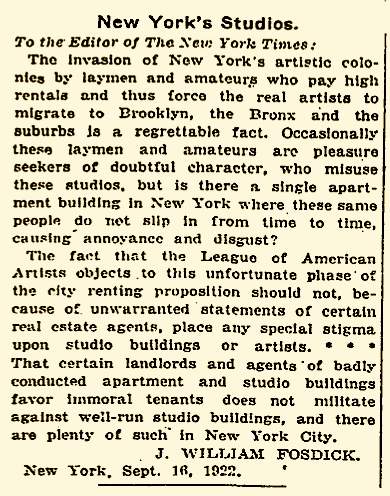 |
| New York Studios Editorial in the New York Times Published 19 September 1922. |
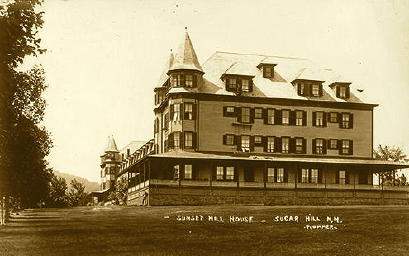 |
| The Nutshell, J. William Fosdick's Summer Studio was one of the cottages at Sunset Hill House Located in the town of Sugar Hill, in the White Mountains of New Hampshire, U.S.A. Adapted from a period photograph of what was the original Sunset Hill House until 1974. Today Sunset Hill House is a country inn. At the link here, read the history of it as told by its present owners. |
Excerpts from a July 1905 New York Times column "IN THE WHITE MOUNTAINS":
"BRETTON WOODS, N.H., July 8. — The season here was given a decided impetus. There came with Saturday the greatest influx of visitors ever known on a single day in the White Mountains. The New York train brought fifteen carloads of visitors, to the hills, and from Conway to Colebrook every station sent its full quota of holiday makers laden with golf sticks, tennis racquets, fishing tackle, and other outing paraphernalia...."
"J. William Fosdick, the New York artist, has rented the Nutshell to friends, as he is obliged to remain in New York this Summer."
Excerpt from a July 1912 New York Times column "THE SEASON AT SUGAR HILL":
"Old Friends Largely Make up Colony
At This Favorite Beauty Spot"
"Seek the whole world over and you
will find no such view as greets one from
the Sunset Hill house at Sugar Hill, supremely beautiful in its color masses,
simplicity, majesty; strangely fascinating under subtle influence of sun and
shadow, dawn and dusk.
For the season now well begun, many affairs are
planned, golf leading in outdoor sports,
with social affairs radiating from the
usual Saturday evening dances,....
Among the first of the cottagers to
arrive was Mr. J. William Fosdick, the
artist, who is at his studio, the Nutshell.
Mrs. Edwin B. Holden and family of
New York, return to the Vista.
Professor and Mrs. F. H. Hill and family of
Carlton College, Northfield, Minn., are
among the new comers.
Dr. and Mrs. W. H. Haskin, and Mr. and Mrs. W. J.
Parslow of New York lease the Adams
villa. Mr. and Mrs. George Stevenson
and family of Philadelphia, are at
Glamorgan Cottage."
"J. William Fosdick, the New York artist, has rented the Nutshell to friends, as he is obliged to remain in New York this Summer."
"Seek the whole world over and you will find no such view as greets one from the Sunset Hill house at Sugar Hill, supremely beautiful in its color masses, simplicity, majesty; strangely fascinating under subtle influence of sun and shadow, dawn and dusk.
For the season now well begun, many affairs are planned, golf leading in outdoor sports, with social affairs radiating from the usual Saturday evening dances,....
Among the first of the cottagers to arrive was Mr. J. William Fosdick, the artist, who is at his studio, the Nutshell.
Mrs. Edwin B. Holden and family of New York, return to the Vista.
Professor and Mrs. F. H. Hill and family of Carlton College, Northfield, Minn., are among the new comers.
Dr. and Mrs. W. H. Haskin, and Mr. and Mrs. W. J. Parslow of New York lease the Adams villa. Mr. and Mrs. George Stevenson and family of Philadelphia, are at Glamorgan Cottage."
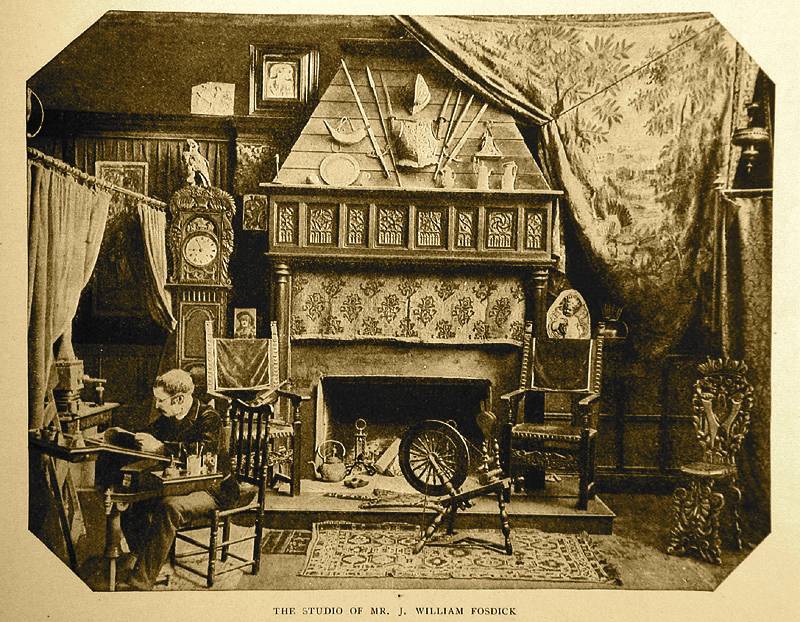 |
| J. William Fosdick Posing at Work in an Earlier Studio in New York City Located at 58 West 57th Street (near Carnegie Hall) Adapted from a circa 1890 black-and-white photograph |
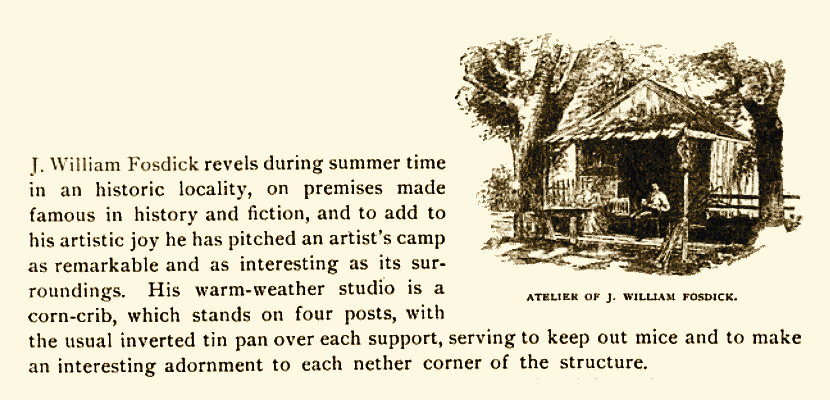 |
| J. William Fosdick Posing at Work in his summer studio circa 1893 Adapted from a drawing by him on p. 216 in an 1893 article in The Monthly Illustrator entitled THE SUMMER STUDIOS OF AMERICAN ARTISTS, pp. 209–224. |
Apparently before J. William Fosdick had his summer studio cottage in New Hampshire called "The Nutshell," he had a very rustic one that he had fashioned himself. The article excerpted here above, replete with small original drawings rendered by the artists themselves of their respective summer studios, failed to mention where exactly Fosdick's was located. This one, referred to only as his"atelier" in the caption did not appear to have been given its own special moniker as his later one had.
His Societies and Exhibitions, also Lectures
It was thanks to J. Wm. Fosdick's listings in the various magazine and newspaper articles and announcements, year books, and catalogues of the various societies and organizations to which he belonged that we learned of his studio and residential addresses over the years and the exhibitions in which he participated.
And it was thanks to his participation in many of those societies, no doubt, that he was able to meet and work for major entrepreneurs of his time and their architects, in addition to fellow artists and others, such as publishers and the press, who were essential in recommending, contracting, publicizing, and promoting his work.
Many of these organizations also provided venues for exhibitions, as well as catalogues. Following is a list of the societies to which J. William Fosdick was known to be a member. In some, he is listed as a non-resident member in one section showing an address other than New York City, and listed again in a separate section as a resident member showing an address in New York City. In most of these organizations he was not only an active member but one of the officers. Where this is the case, his position(s) held are noted in parentheses after each:
The New York Architectural League (Secretary)
The National Society of Mural Painters (Secretary)
The Copley Society (Member and Lecturer)
The National Society of Craftsmen, New York (Vice President)
The National Arts Club, New York
The Arts and Crafts Society of America (President)
Julian's Ancients (Les Anciens de Julian,
also known as the American Alumni of the Julian Academy) (founder)
Organized in 1908; annual reunions held in the Hotel Brevoort.
1889 Exhibition at the St. Louis Museum of Fine Arts
Link here to the catalogue of the 1889 Exhibition of Burnt Wood Panels by J. Wm. Fosdick. This catalogue reflects 28 works shown not only in St. Louis, Missouri, but also his early exhibitions of them in Paris and New York City.
1893 World's Columbian Exposiition
at the Art Palace in Chicago
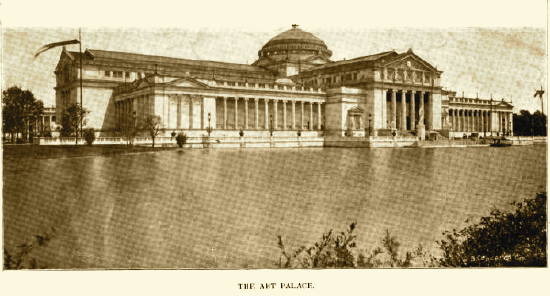 |
| The Art Palace Exhibit building at the 1893 World's Columbian Exposition in Chicago, Illinois, United States of America According to the catalogue for this exhibition, on p. 133, J. William Fosdick exhibited his "burnt wood drawing" from 1888 entitled Lady Godiva, which was number 2695 and hung on the east wall of the north court, near the entrance to the staircase at the northeast of the Rotunda. This work can be viewed at the link for the 1889 Exhibition in St. Louis in the previous entry. |
Atlanta Exposition, 1895
Awarded Grand Gold Medal for mural decoration,
for his frieze of Henry VIII The Field of the Cloth of Gold
1896 Exhibition at the Pennsylvania Academy of Fine Arts in Philadelphia
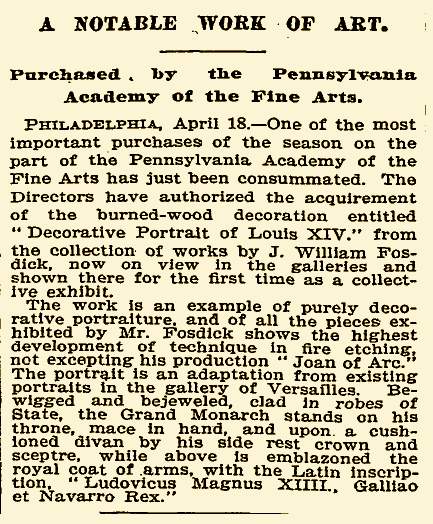 |
| J. William Fosdick, April 19, 1896 Exhibiting at the Pennsylvania Academy of Fine Arts (PAFA) in Philadelphia Adapted from a New York Times article A 20-page catalogue was published for this exhibition, which included other works, as well, and was entitled, A Representative Collection of the Glasgow School of Painting. The Adoration of Jeanne D'Arc and Other Burnt Wood Decorations By J William Fosdick. Notes on the Louis XIV panel: 1. The last two lines reflect errors in the automated transcription of the original article: The quotation at the end should say: "Ludovicus Magnus XIIII, Galliae et Navarrae Rex," i.e., Louis the Great XIV, King of Galle and Navarre. 2. The Roman numeral for 14 on the panel is written with an X and four I's vs. the usual XIV. 3. The lettering is all gilded, which, unfortunately, does not show up in the black-and-white photograph of the Louis XIV panel and its adapted digital image in the E-Museum. 4. This massive panel was acquired by PAFA in 1896 and is still there today, available (by appointment) to view in their archives. |
1900 Exhibition at the Lotos Club in New York City
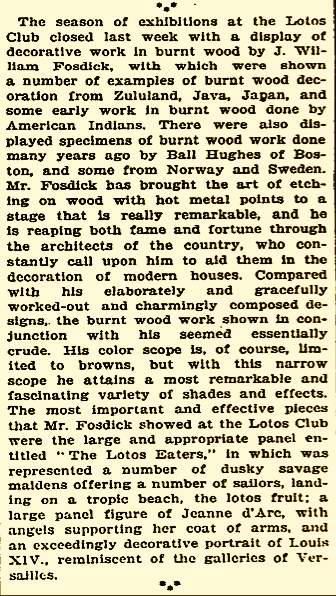 |
| J. William Fosdick, 1900 Exhibiting at the Lotos Club in New York City Excerpt adapted from a New York Times article This exhibition was broad in scope since J. Wm. Fosdick exhibited not only some of his largest, most impressive works there at the Lotos Club in New York City, but he also exhibited the two works he owned by Ball Hughes, as well as a collection of folk and traditional works from Africa, Asia, Europe, and America. |
Two 1901 Exhibitions in New York City:
The Society of American Artists
and
The Architectural League of New York
Published in The International Studio are segments from a feature article entitled "Studio Talk" with critiques and four lovely illustrations of two 1901 Exhibitions in New York City of J. Wm. Fosdick's burnt wood panels.
1911 Lecture in Boston:
The Boston Society of Arts and Crafts
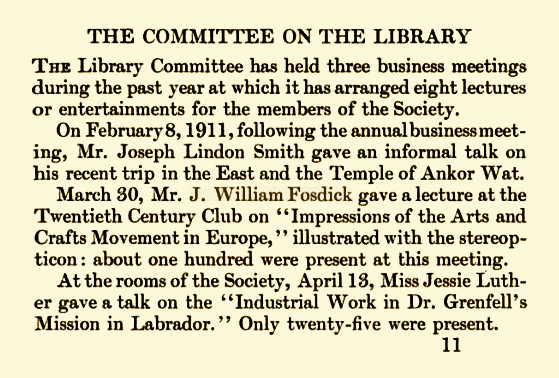 |
| J. William Fosdick 1911 Lecture in Boston Published in their 1912 Annual report are the following three lectures given the previous year at the three business meetings of the Library Committee. Note Fosdick's use of the stereopticon for his lecture entitled Impressions of the Arts and Crafts Movement in Europe. |
Posthumous Exhibition in 2003:
Traveling Tour of The Gilded Age
Treasures from the Smithsonian American Art Museum
The Cleveland Art Museum
"As the [Smithsonian American Art Museum's] building in Washington, D.C., [was undergoing] extensive renovation, the institution decided to tour [a] magnificent assemblage of highlights from the collection and to share them with the nation at large." Among the treasures exhibited in that tour was J. William Fosdick's triptych of St. Joan of Arc. Click on the Cleveland Art Museum link to see the story of that event.
If you have either any questions to ask or any information to offer regarding J. William Fosdick's works or biography, please e-mail
the E-Museum Curator.
You are leaving the J. William Fosdick Salon.
of his Studios, Societies, Lectures, and Exhibitions
You can return to the
Antique Art Hall
or continue on your tour to one of the following:
Pyrographic Art Exhibit Halls:
Portraits and Paintings
Decorative and Applied Art
Sculpture
Folk and Traditional Art
Children's Pyrographic Art
Special Pyrographic Art
The Book Store and Library Exhibits
Pyrography Tools and Techniques Exhibit.
Your questions and comments are welcome and appreciated. Please e-mail Curator.
Back to E-Museum Entrance homepage
2008, 2009 Kathleen M. Garvey Menéndez, all rights reserved.
This salon last updated 20 October 2009.
