The amplification of vibrations of atoms of a test specimen in the resonator under the effect of the inerton field can apparently be considered as an analogy of the effect of ultrasound or microwaves sound. In fact, the total force matrix W of a crystal is formed by the two terms, V and U, having the same rights. As is generally known, the effect of destroying and crushing various structures and polishing surfaces is characteristic of ultrasound.
The goal of our experiment was the study of measure of changes in the non-uniformity surface of the specimen (its polish, finish or sharpening), which stayed in the resonator for some time.
The resonator was made of two identical rectangular plates of organic glass (transparent in the visible optical spectral band and with the dimensions of the plate 20 cm x 16.5 cm and the plate thickness 3 mm), which were sharpened and bonded together along one of the long sides. The angle of inclination of each of the plates with respect to the horizontal has made up 52 degrees. Therefore, in the section perpendicular to the line of bonding of the plates, the resonator had the shape of a triangle. The dimensions of the base of the triangle a = 20 cm and of the height h = 12.7 cm satisfy the relationship above, i.e., a / h = pi / 2. The resonator was placed on a polished wooden horizontal surface. No objects were found at a radial distance of about 70 cm from the resonator. The upper edge of the resonator (the line of the plates bonding) was oriented along the South-North line and, therefore, one plate faced the East and the other the West. A wooden support column 4.5 cm height, with the cross-section area 1 cm x 1 cm was placed in the center of the resonator and the specimen being tested was put on the column.
Our investigation was related with the cutting edge (point) of a razor blade, but before putting it into resonator, a small reference specimen was cut out of the blade. The blade was put on the column into the resonator so that the axis of the blade was oriented along the South-North line. The main action on the blade on the part of inerton waves was expected in the plane of the blade along the East-West line (this action amounts to a peculiar sharpening of the cutting edge) and the less intensive action – along vertical direction. We studied razor blades produced by four different companies. Investigation of the structure of the cutting edge point of the reference specimen and of the specimen subjected to the hypothetical inerton field was carried out by scanning electron microscope JSM-35 (Japan) operated in secondary electron mode under 25 kV accelerated Voltage. The exposure time lasted to 30 days.
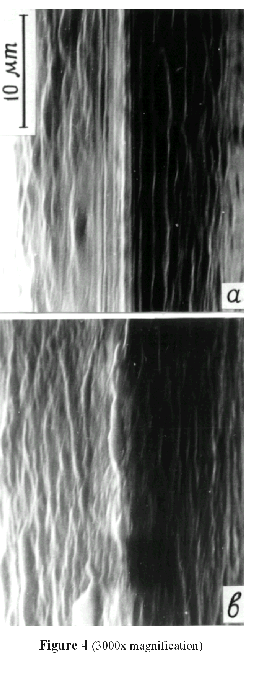
We investigated razor blades of several companies. Fragments of the cutting edge of one of them (a "Gillette" blade) are presented for comparison in Figure 4, the reference and test specimens, micrographs a and b, respectively. Figure 4a shows that the fine structure well discernible on the reference specimen is substantially smoothed on the edge of the blade, which has stayed in the resonator for a month, Figure 4b. The morphologically more coarse structure is well preserved. (Note that pressure, temperature, humidity, etc. could not make any changes in the morphological structure of the test metal specimen separated from the reference one by 1.5 meters; the two parts of the specimen were found under the same atmospheric conditions.)
When the whole system was swung through 90 degrees, i.e., the planes of the resonator and the cutting edge of the blade are oriented to the North and South, then no distinctions are observed between the fine structure of the test and the reference specimens after the blade has stayed in the resonator for a month. This points to the fact that the continuous generation of inerton waves of the Earth along the Sourth-North direction is absent.