In condensed media, the relationship between the parameters of atoms and their clouds of inertons shows that amplitude L of an atom's inerton cloud much exceeds the distance between neighbor atoms. This means that inerton clouds of atoms overlap and in such a way that additional interaction between a media's atoms is settled. In other words, when we treat any matter, we should take into account that it is embedded in another substrate, or a quantum aether, or the space net and that the interaction of atoms with the space net induce one more field (i.e. the inerton field) which together with the electromagnetic one connect all atoms of the matter studied.
In my recent research, the impact of inertons on the collective behavior of atoms in a solid has theoretically been treated and then experimentally approved in metal specimens. It has been derived that the force matrix W that determines three branches of acoustic vibrations in the crystal lattice consists of two components, W = V + U. Here, V is the conventional term caused by the elastic electromagnetic interaction of atoms in the crystal lattice and the second term, U, is originated from the overlapping of inerton clouds of adjacent atoms. Much probably U is very small. However, the availability of U means that an outside inerton field is able to influence the crystal lattice increasing amplitudes of vibrating atoms.
However, where can we take a source of the inerton field? A condensed medium and, in particular, our planet itself may be considered as a source of inertons. Actually, the motion of atoms of the Earth considered to be an ideal globe moving as a single unit apparently does not differ in principle from the motion of a free particle shortly described in the previous section. A macroscopic globe only contains inner structural bonds, which keep atoms in the globe. The bonds lead to the coherence of atoms – roughly speaking we may imagine that all atoms in the globe nailed to their positions. Deviations from coherence in the motion of atoms caused by thermal fluctuations and various mechanical, physical and chemical processes, produce excitation of the atoms and as a result, generation of acoustic waves takes place. Consequently, the corresponding excitation of inertons (inerton waves) accompanying the acoustic waves will appear as well. If the lifetime of a sound excitation happening in any place of the Earth lasts only 1 sec., the corresponding inerton wave will be able to round the terrestrial globe about ten times.
Figure 2
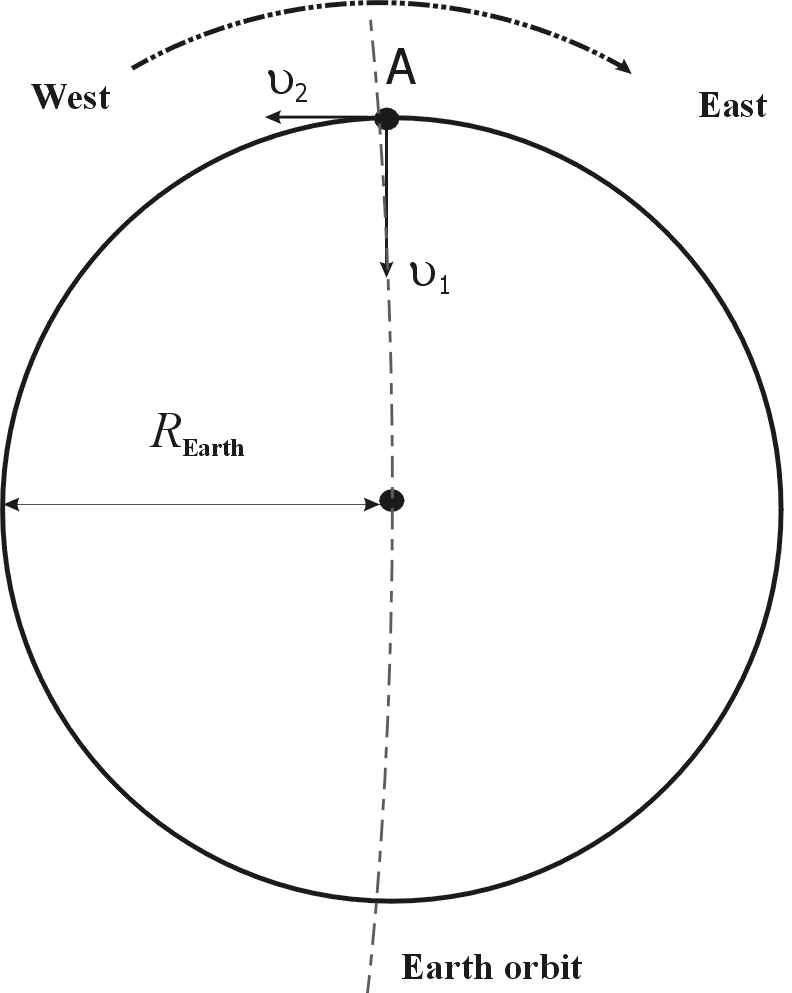
Two types of stationary inerton flows can be set off in the terrestrial globe. Their availability is associated with the motion of the Earth: 1) the orbital motion of the Earth around the Sun with the velocity v
1 = 30 km/s and 2) the proper rotation; with this motion the velocity changes from zero in the center of the Earth to v2 =2 * pi * REarth / 24 hour = 462 m/s in the equator surface (here REarth is the radius of the Earth). In Figure 2, the point A is a source of a sound excitation and hence the source of an inerton wave as well. Two directions of spreading of the said flows assigned by the vectors of velocities v1 and v2 are shown in Figure 2.
Waves of any nature in principle can be amplified in a resonator. Therefore, using a resonator in the point A one can try to amplify inerton waves generated by the Earth. Strong waves can more easily be recorded experimentally. Let us consider characteristics which a resonator of inerton waves of the Earth should possess. As mentioned above, we can separate out two types of inerton waves propagating in the terrestrial globe: 1) radial waves propagation along the diameter (rather in antiparallel with the orbital velocity vector v
1 of the Earth) and 2) tangential waves propagation over the surface zone of the Earth along the equatorial East-West line (i.e., rather against the vector of the rotational velocity v2 of the Earth on the equator). In the former case, the inerton wave front running along the diameter of the Earth travels in the cyclic period a distance Lrad = 4 * REarth. In the second case the inerton wave running around the Earth passes a distance Ltan = 2 * pi * REarth. (Here, for simplicity we neglect a constant factor at REarth that takes into account the geographic latitude of point A). From these two expressions, we obtain the relationship
L
tan / Lrad = pi / 2.
Apparently, this relation also characterizes the ratio between the wavelengths of the tangential and radial n-ths harmonics.
Let us assume that a material object is located in the globe surface far from its poles. The object has linear dimension
a in the horizontal plane along the East-West line and h in the vertical direction, i.e.,
a / h = pi / 2,
the object should play the role of a resonator of inerton waves of the Earth since the object has a form similar to the Earth sphere (in the limit
a, h << REarth). Figure 3 depicts:
Figure 3
a cross section of the terrestrial globe, the point A on the globe surface, lengths of two ways which the two distinguish inerton flows overcome per a circle and a resonator placed in the point A. The profile of the resonator has the form of an isosceles triangle which base and height are equal
a and h respectively. Such a resonator is able to intensify inerton waves, which have wavelength a in the horizontal direction and h in the vertical one and may amplify their harmonics.
(Of course the proper rotation of the Earth moves the point A from the orbit line of the Earth, nevertheless, in the globe radial excitations are spontaneous and self-sustaining process.)