Kiev 60 Shutter Notes
Updated 6/3/2004
I recently found myself in possession of a Kiev 60 SLR -- a
great hulking beast of a camera that takes 120 roll film -- with
a bum shutter: the second curtain doesn't close for speeds below
1/250 of a second, leading to somewhat longer exposures than intended...
I blame sleep-camera-buying. I can't have been awake at
the time.
Nevertheless, I like the camera: it feels good in my hands, and
the lenses are reputedly good. I have been doing simple
camera repairs -- cleaning leaf shutters, etc. -- for a while,
and can't justify paying someone else to fix this camera at this
time.
So I decided to open up the camera and take a look, and see if
there was any obvious problem.
I followed the instructions at Russ
Hippert's Kiev Kalibration site to check the shutter curtain
tension from the bottom of the camera (that wasn't the problem)
and to get the top of the camera off so I could watch the shutter
speed mechanism not-work. I then realized that, even after
watching the shutter operate 50 times, I wasn't figuring out what
bit did what -- and I haven't been able to find any useful repair
information, on the web off off, to explain all these spinning,
whirring doohickeys.
So I took a few pictures, and I'll post them with my notes on
what I have figured out, with the help of some folks at the Kiev Report
(and maybe *YOU*! If you know something I don't, let me know,
and I'll add it).
Comments, corrections, additions (or broken Kiev bodies for me to practice on!) to pwillarney.spamnope AT spamnope.yahoo.com.invalid (please remove the spamnope and invalid mungs to email me).
I don't know the official names for a lot of the parts so I'm
going to make them up (well, I did find an exploded parts diagram
of the Kiev 60, but all the labels were in Russian: anyone care
to translate for me?) (I've mislaid the link to that document
-- I'll post it when I find it again).&nnbsp; And, of course, I
make no promises to be right about any of this! Open your
cameras at your own risk. The springs bouncing on the floor
may be yours.
Click on any image for a larger view.
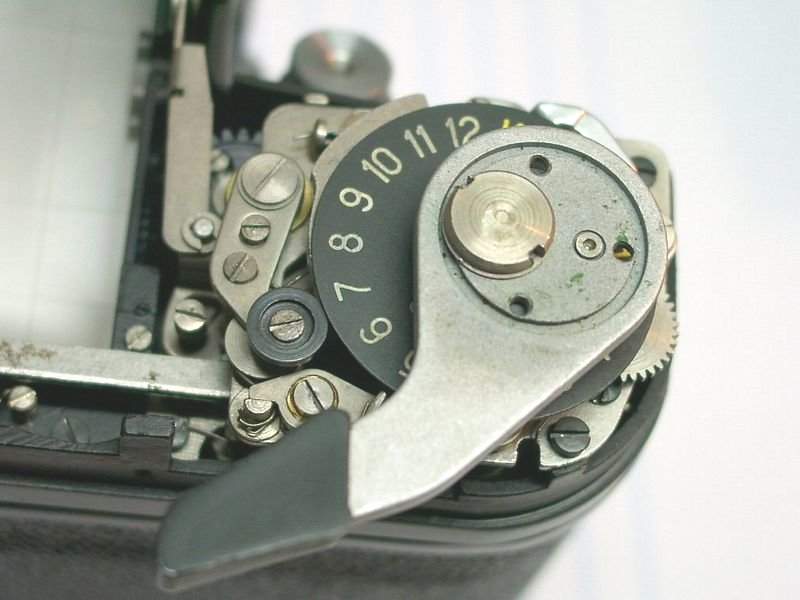
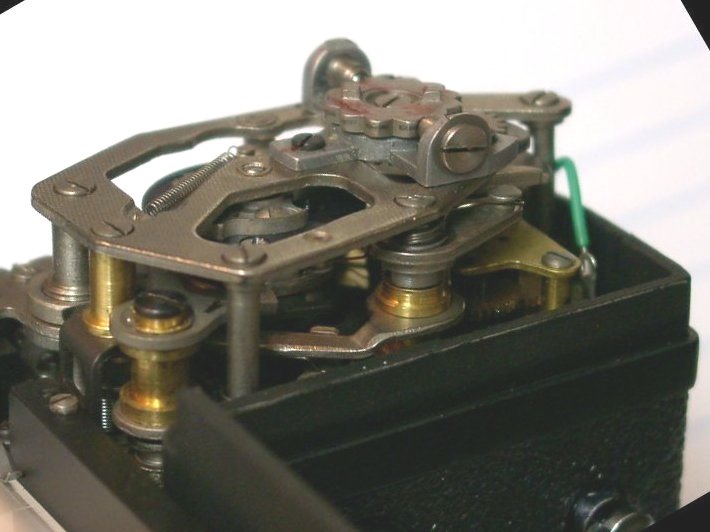
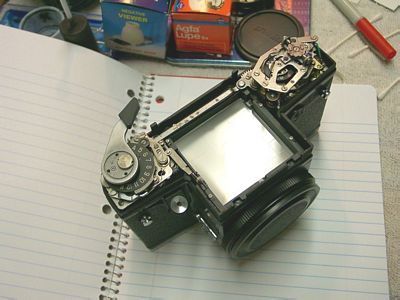 Here we go, eh? Here's my K60 with the top off, seen from the
top front (click for a larger picture). The film wind & count
mechanism is on the left side, with the wind lever remounted;
the shutter speed mechanism is on the right. Note that
to get the top off, one thing I didn't get at first is that the
black outer ring surrounding the film-type reminder (above the
film wind lever) is what actually unscrews -- I spent some time
trying to unscrew the inner disk with the notch cut out of it,
and didn't get anywhere. The silver bar across the back of the
camera, behind the ground glass, goes from the film wind mechanism
to wind the shutter speed mechanism.
Here we go, eh? Here's my K60 with the top off, seen from the
top front (click for a larger picture). The film wind & count
mechanism is on the left side, with the wind lever remounted;
the shutter speed mechanism is on the right. Note that
to get the top off, one thing I didn't get at first is that the
black outer ring surrounding the film-type reminder (above the
film wind lever) is what actually unscrews -- I spent some time
trying to unscrew the inner disk with the notch cut out of it,
and didn't get anywhere. The silver bar across the back of the
camera, behind the ground glass, goes from the film wind mechanism
to wind the shutter speed mechanism.
Let's follow the flow of the shutter mechanism as far as I
understand it.
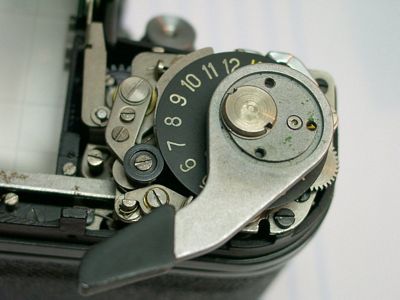 Here's the shutter wind/film counter mechanism with the top off,
looking from behind the camera, with the wind lever reattached
to allow winding the shutter. The gray bar (bottom left of the
picture) is the shutter wind bar; it moves left to wind the shutter
when you advance the film.
Here's the shutter wind/film counter mechanism with the top off,
looking from behind the camera, with the wind lever reattached
to allow winding the shutter. The gray bar (bottom left of the
picture) is the shutter wind bar; it moves left to wind the shutter
when you advance the film.
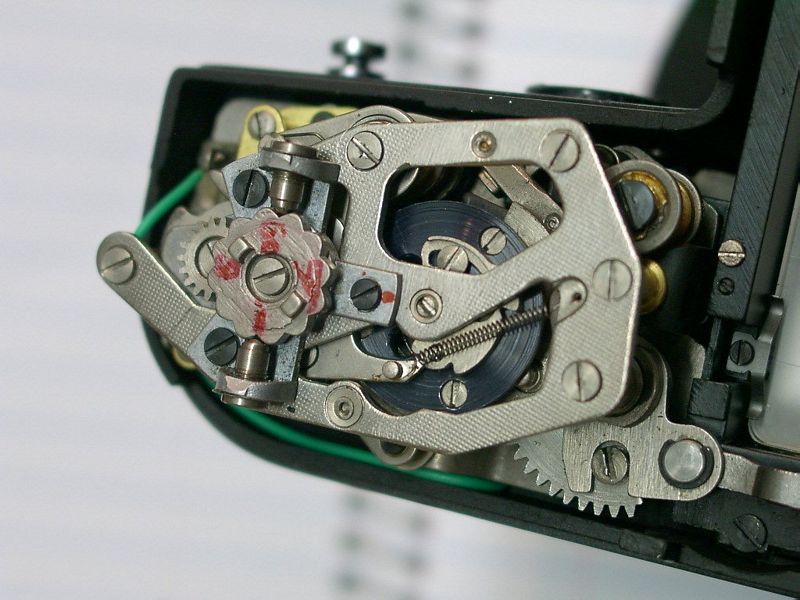
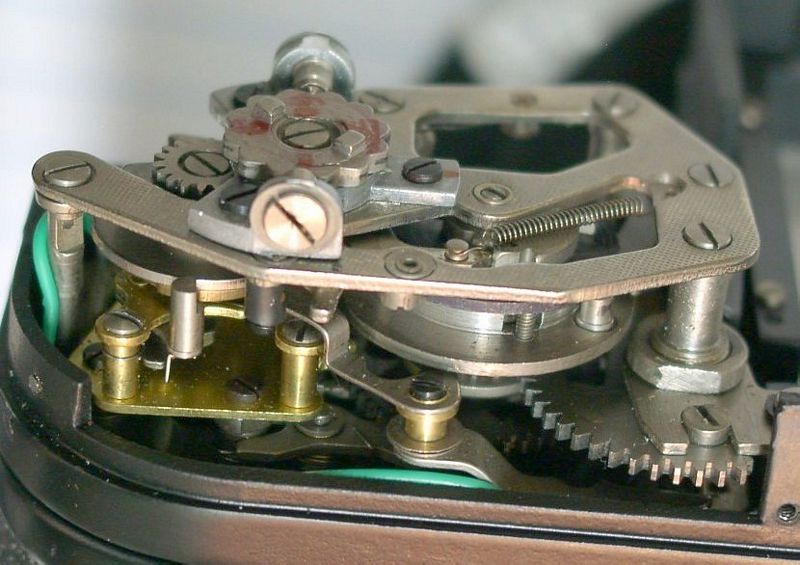
 The
shutter speed mechanism, seen from above and behind the camera.
The bar (rightmost bottom corner of picture, leading off to the
right) connected to the large shutter winding gear seen at bottom
right of the picture is from the film winding mechanism (as seen
above). When you advance the film, the bar moves to the left,
and the upside-down-u in the metal plate pushes against the screw
in the shutter winding gear. The gear moves about 1/4 turn clockwise,
and winds the shutter.
The
shutter speed mechanism, seen from above and behind the camera.
The bar (rightmost bottom corner of picture, leading off to the
right) connected to the large shutter winding gear seen at bottom
right of the picture is from the film winding mechanism (as seen
above). When you advance the film, the bar moves to the left,
and the upside-down-u in the metal plate pushes against the screw
in the shutter winding gear. The gear moves about 1/4 turn clockwise,
and winds the shutter.
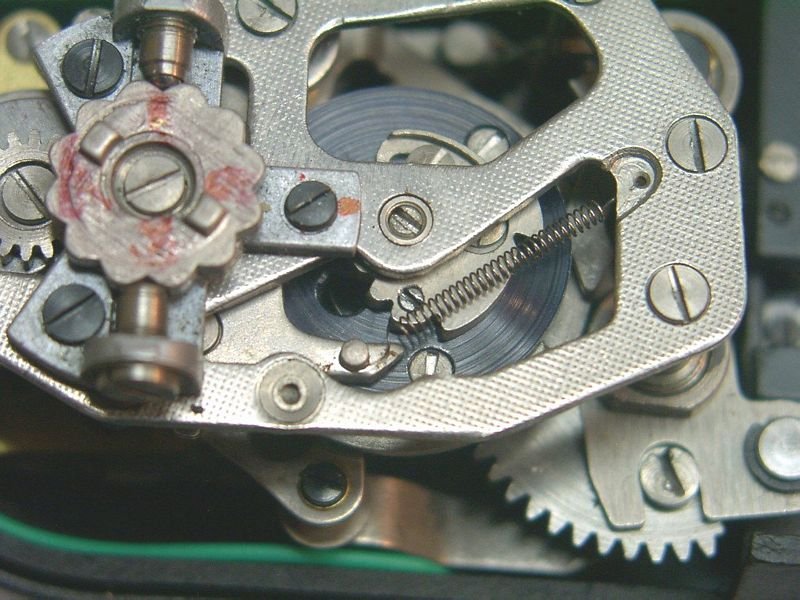
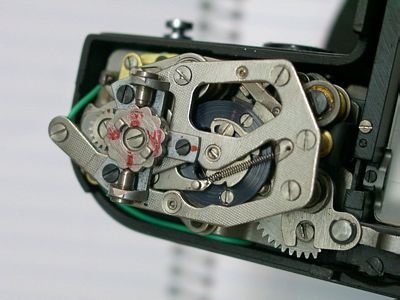
What else do we see here? The black circle seen through the
cutouts in the top plate, right hand side (under the spring) is
the Shutter Rotor (SR). This turns roughly 1/3 of a revolution
clockwise when the shutter is wound. I *think* there's a spring
inside the SR that gets wound when the shutter is wound.
The silver notched disk on top of the SR is the Second Curtain
Release Cam (SCRC); the pointed piece of metal with the spring
leading to it is the Second Curtain Release (SCR); this is a "T"
shaped piece of metal, with two other ends (hidden here). One
end points down, towards the back of the camera, to hit a stop
there; the other end rids a shutter speed cam (see below). I'll
say more about the SCR later.
The notched gear on top with the red marks on it is the shutter
speed setting dial (SSD) (this is what turns when you turn the
shutter speed dial outside the camera). The two objects above
and below the SSD are the click stops for the SSD. The external
shutter speed dial is not actually fastened to this inner dial:
it's just held in place by the top of the camera. This means you
can't screw the shutter speed dial back on to set speeds while
watching the shutter, which is why I've got little red speeds
marked on the SSD. One of those let's me know where "B"
is, honest. I can't tell yet if turning the internal speed dial
past either end of the speed scale will damage the shutter; the
"stop" on my camera is a slot in the top cover of the
camera that a pin in the external shutter speed dial fits into.
The gear to the left and behind the SSD (you can see about 2/3
of it here) turns when you turn the SSD, and.connects to the shutter
speed cam.
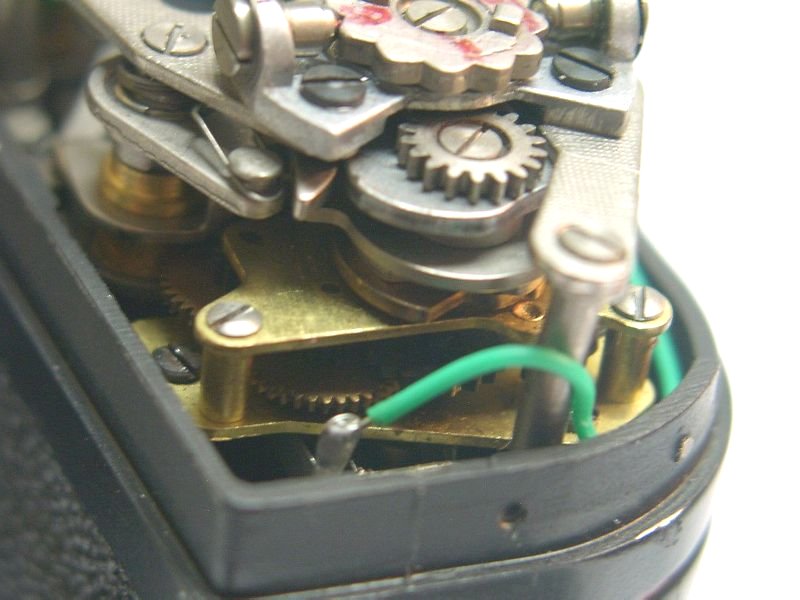
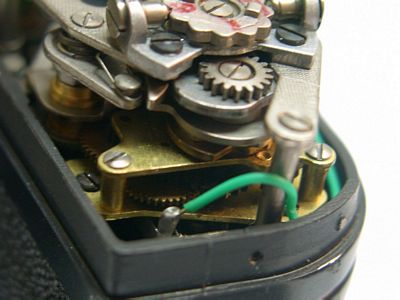 Shutter
speed cams, seen from front of the camera, right front top view.
SSD at top, shutter cam gear below, shutter cams below that. The
projection just left of the top cam on this axis is the other
end of the SCR; as you turn the SSD, the gear on top turns the
shutter cams, moving the other end of the SCR closer to the SCRC
for fast speeds, farther away for slow speeds.
Shutter
speed cams, seen from front of the camera, right front top view.
SSD at top, shutter cam gear below, shutter cams below that. The
projection just left of the top cam on this axis is the other
end of the SCR; as you turn the SSD, the gear on top turns the
shutter cams, moving the other end of the SCR closer to the SCRC
for fast speeds, farther away for slow speeds.
The brass mechanism below the shutter speed cams is the slow
speed mechanism. This doesn't work on mine, so I'm having some
trouble figuring it out.
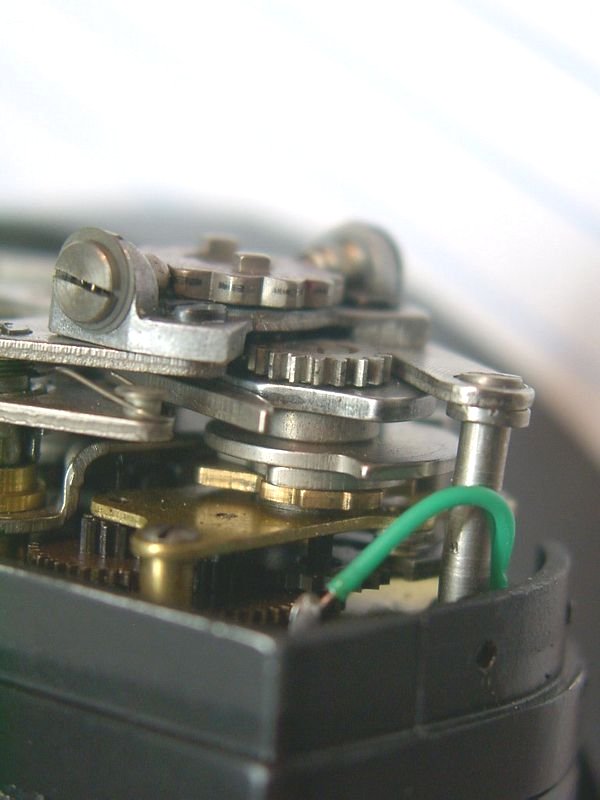
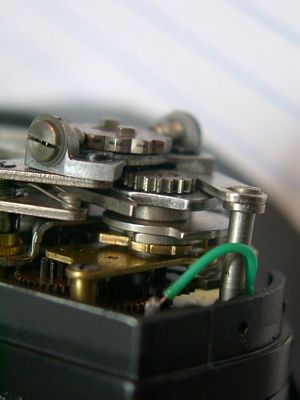 Another
view of the shutter speed cams seen from front of camera, right
end. Here, just below the top gear, you can see the top cam (that
the SCR rides on -- the gray projection just left of the top cam);
the cam below is a plain circle, and nothing rides on it. The
three plates below that (ending in the brass plate) are also shaped
cams, which appear to control the slow speed mechanism. A total
of 5 plates on the shutter speed cam axis.
Another
view of the shutter speed cams seen from front of camera, right
end. Here, just below the top gear, you can see the top cam (that
the SCR rides on -- the gray projection just left of the top cam);
the cam below is a plain circle, and nothing rides on it. The
three plates below that (ending in the brass plate) are also shaped
cams, which appear to control the slow speed mechanism. A total
of 5 plates on the shutter speed cam axis.
Where were we? Ah yes, winding the shutter. The wind bar has
pushed the shutter wind gear 1/4 turn clockwise; the Shutter Rotor
has turned 1/3 turn counter clockwise; what else happens when
you wind the shutter?
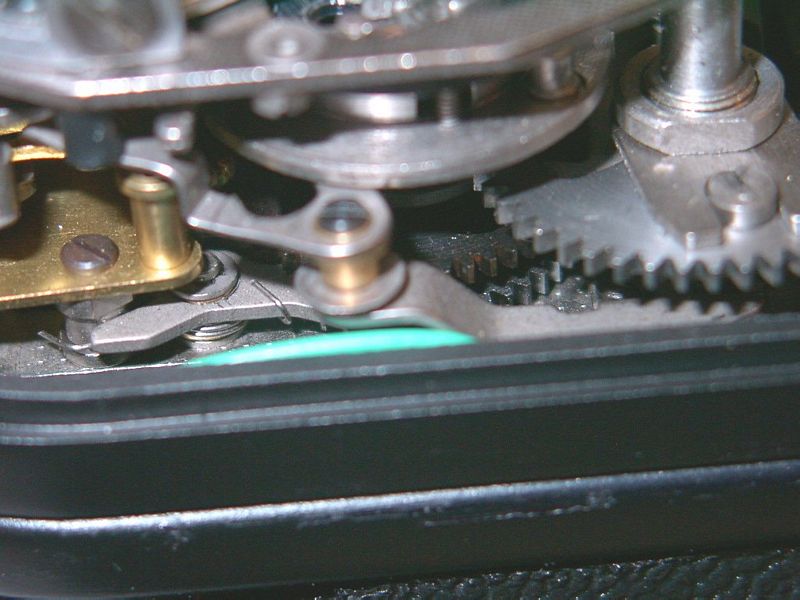
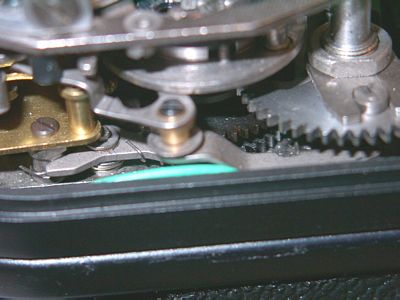 A
closeup from behind the camera, looking into the shutter speed
mechanism. The big gear (right end of picture) is the shutter
wind gear. This turns to the left (clockwise) to wind the shutter.
Just left of that, and down inside the mechanism, you'll see two
stacked black gears. The top black gear winds the first shutter
curtain after it's been released; the lower black gear (closer
to the body of the camera) winds the second shutter curtain. These
gears appear to turn about 3/4 of a turn counterclockwise when
the shutter is wound.
A
closeup from behind the camera, looking into the shutter speed
mechanism. The big gear (right end of picture) is the shutter
wind gear. This turns to the left (clockwise) to wind the shutter.
Just left of that, and down inside the mechanism, you'll see two
stacked black gears. The top black gear winds the first shutter
curtain after it's been released; the lower black gear (closer
to the body of the camera) winds the second shutter curtain. These
gears appear to turn about 3/4 of a turn counterclockwise when
the shutter is wound.
When these gears turn, inside the camera the shutter curtains
are pulled from the right side to the left side. Since focal plane
shutter curtains are like window blinds -- one end is attached
to a spring wound rod, which pulls the curtain back when the curtain
is released -- This must mean that the *spring loaded* rods are
in the side of the camera under the shutter wind mechanism.
On my camera, on the speeds that work, both of these gears
turn when winding the shutter again. On the speeds that *don't*
work (e.g. only the first curtain releases, not the second) only
the top gear turns when winding the shutter -- winding the first
curtain.
Here you can also see -- top left, slightly out of focus --
the third end of the SCR (the blurred metal projection above the
brass post, poking out towards the back of the camera). The black
post hanging down from the top plate just left of the SCR is a
plastic sleeved bumper or stop for the SCR.
OK,
we've wound the shutter. Let's set it to one of the speeds that
works -- say 1/250 - and release it, and watch what happens. Take
a look at this picture again. It's hard to get a picture of, but
if you look through hole in the top plate, past the shutter rotor,
you'll see a metal bar that runs diagonally down from left to
right. Near the top end of this -- just top of the top plate opening
-- small metal rectangle just below the diagonal bar. Phew. This
moves down when you press the shutter release button.
Whoops -- this is actually a picture of an *unwound* shutter.
See below...
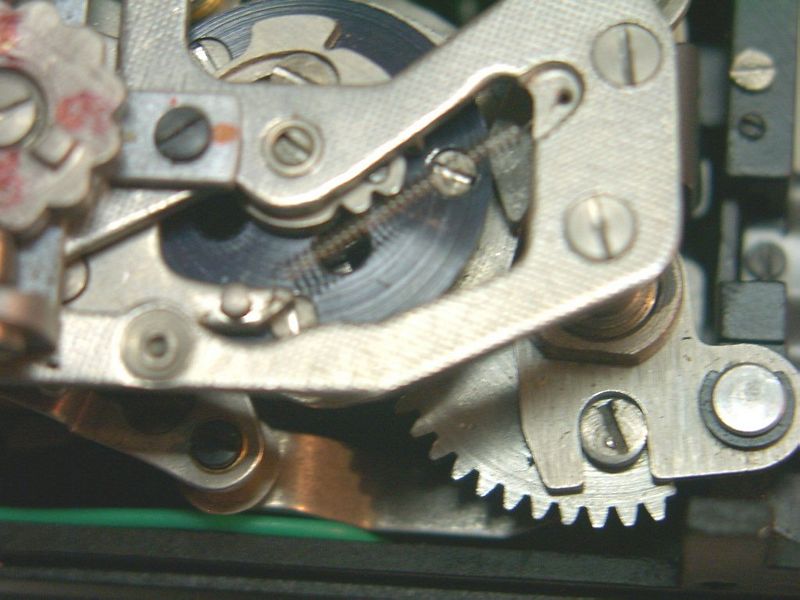
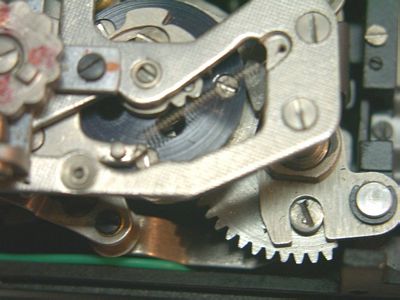 For
a picture of the shutter rotor in a wound state. Note that the
Second Curtain Release Cam (SCRC) has rotated counter clockwise
away from the Second Curtain Release (SCR).
For
a picture of the shutter rotor in a wound state. Note that the
Second Curtain Release Cam (SCRC) has rotated counter clockwise
away from the Second Curtain Release (SCR).
The shutter is released. The Shutter Rotor (SR) starts rotating
clockwise.
What happens next? First curtain release. If you'll look to
the right side of the SR, just below the right end of the spring,
you'll see a tapered gray metal bar just right of the SR. This
is the First Curtain Release (FCR).
The large gray metal circle behind the black SR is part of
the SR, and rotates with it.
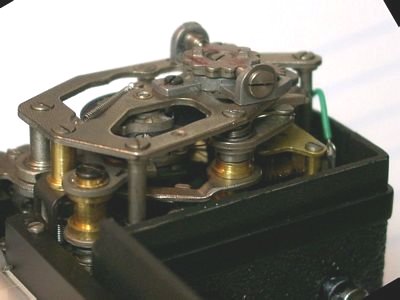 Another
view of the FCR: this is the shutter speed mechanism seen from
the front center of the camera (roughly above the lens). It's
difficult to see in this picture, but the brass pivot, bottom
left of the picture, has the First Curtain Release (FCR) lever
on top of it (the dull gray metal lever that goes in next to the
Shutter Rotor (SR)).
Another
view of the FCR: this is the shutter speed mechanism seen from
the front center of the camera (roughly above the lens). It's
difficult to see in this picture, but the brass pivot, bottom
left of the picture, has the First Curtain Release (FCR) lever
on top of it (the dull gray metal lever that goes in next to the
Shutter Rotor (SR)).
The shutter is released, the SR is rotating clockwise.
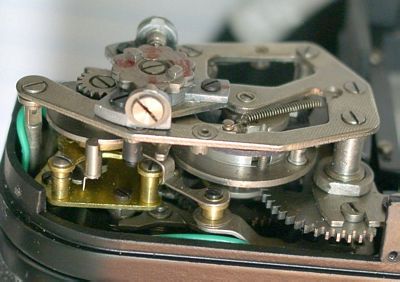 Seen
from the back left of the camera. Below the spring, below the
top plate, is the SR (you can't see the black top of it in this
picture). The large disk is part of the SR. The silvery peg you
see on the right side of the large SR disk is trips the first
shutter release (let's call it the FCRT -- First Curtain Release
Trip.).
Seen
from the back left of the camera. Below the spring, below the
top plate, is the SR (you can't see the black top of it in this
picture). The large disk is part of the SR. The silvery peg you
see on the right side of the large SR disk is trips the first
shutter release (let's call it the FCRT -- First Curtain Release
Trip.).
Inside the camera, the First Curtain starts moving from the
right side of the camera (as seen from the back) towards the left.
Now -- remembering that we're looking at one of the speeds
that work -- the SR is rotating clockwise; the Second Curtain
Release Cam (SCRC) on top of the SR is also rotating clockwise.
In
a moment, one of the notches in the Second Curtain Release Cam
(SCRC) hits the pointed end of the Second Curtain Release (SCR)
-- inside the camera, the Second Curtainn now starts moving form
the right side (as seen from the back) to the left.
*WHEN* the Second Curtain Release (SCR) is hit controls the
shutter speed; when it is hit is determined, I think, by which
notch on the Second Curtain Release Cam (SCRC) hits it. The SCR
moves closer and farther away from the SCRC because the other
end of the SCR rides on a shutter speed cam, which rotates when
the SSD is turned (see earlier pictures).
When the second curtain has finished traveling, the curtain
is closed, and the exposure is finished. Phew!
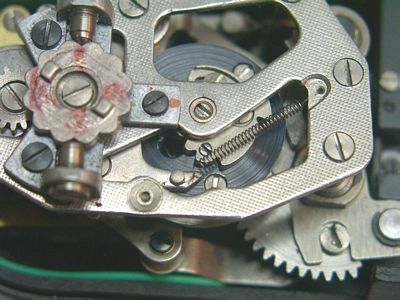 Now:
what about the speeds that don't work? I'm still trying to work
them out. You'll see here a picture of the *unwound* (released)
shutter, set at 1/60 of a second. You can see that the SCR is
a visible distance away from the SCRC -- to far away to be triggered
by the SCRC as it turns, so the second curtain never releases.
The second curtain is wound and functional, however: if you move
the SCR by hand, the Second Curtain does release. Is the shutter
speed cam that the other end of the SCR rides on the wrong shape?
I don't know.
Now:
what about the speeds that don't work? I'm still trying to work
them out. You'll see here a picture of the *unwound* (released)
shutter, set at 1/60 of a second. You can see that the SCR is
a visible distance away from the SCRC -- to far away to be triggered
by the SCRC as it turns, so the second curtain never releases.
The second curtain is wound and functional, however: if you move
the SCR by hand, the Second Curtain does release. Is the shutter
speed cam that the other end of the SCR rides on the wrong shape?
I don't know.
Another issue: the slow speed mechanism -- the brass clockwork
seen in earlier pictures -- never releases, even on slow speeds.
I *think* there's different way the slow speed mechanism is supposed
to trigger the SCR, but I haven't figured this out yet.
If
you look at the slow speed mechanism (brass, bottom left corner
of this picture -- from behind camera) you'll see a gray metal
peg sticking up from inside the brass plate. I *think* this is
the slow speed wind mechanism: the long bent gray lever right
of it (between the black SCR stop peg on the left, and the SCR
on the right) moves left when the shutter is set on slow speeds,
and pushes the silver peg out/left when the shutter is wound:
however, when the shutter is released, the gray peg moves back
right quickly, with no slow speed gear delay. So I don't understand
this part yet...
How many people are interested Kiev 60 Shutter Guts? --->

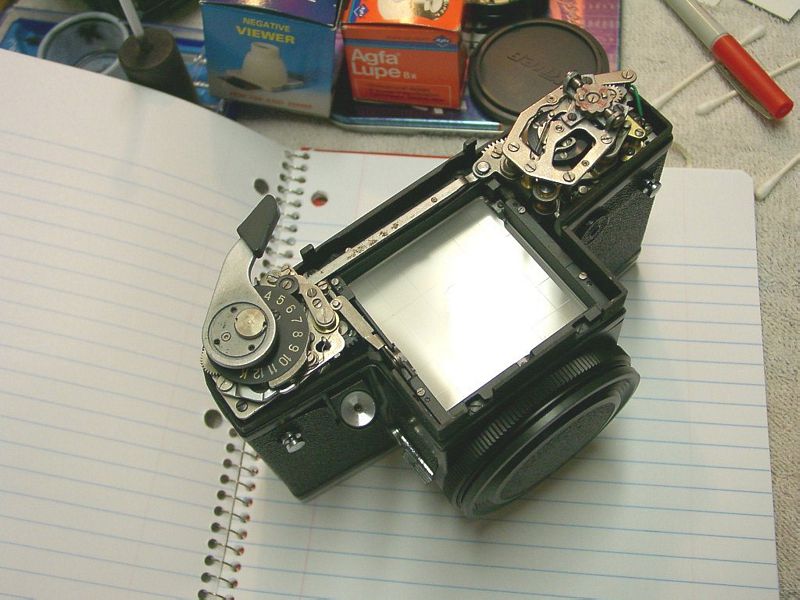 Here we go, eh? Here's my K60 with the top off, seen from the
top front (click for a larger picture). The film wind & count
mechanism is on the left side, with the wind lever remounted;
the shutter speed mechanism is on the right. Note that
to get the top off, one thing I didn't get at first is that the
black outer ring surrounding the film-type reminder (above the
film wind lever) is what actually unscrews -- I spent some time
trying to unscrew the inner disk with the notch cut out of it,
and didn't get anywhere. The silver bar across the back of the
camera, behind the ground glass, goes from the film wind mechanism
to wind the shutter speed mechanism.
Here we go, eh? Here's my K60 with the top off, seen from the
top front (click for a larger picture). The film wind & count
mechanism is on the left side, with the wind lever remounted;
the shutter speed mechanism is on the right. Note that
to get the top off, one thing I didn't get at first is that the
black outer ring surrounding the film-type reminder (above the
film wind lever) is what actually unscrews -- I spent some time
trying to unscrew the inner disk with the notch cut out of it,
and didn't get anywhere. The silver bar across the back of the
camera, behind the ground glass, goes from the film wind mechanism
to wind the shutter speed mechanism.