|
|
|
|
|
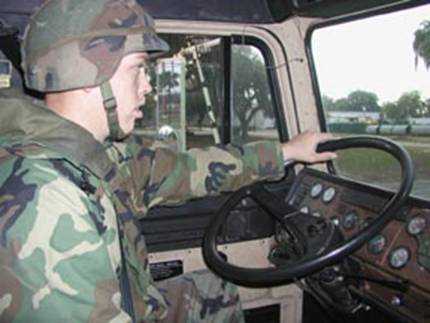
Above: Spc. Christopher
Brenner, a 416th Trans. Co. driver, concentrates on the road ahead during a
fuel mission at Hunter Army Airfield.
Below: A line of M915A2 Freightliner semi trucks
with tankers lines up in the 416th Trans. Co. motorpool, ready to head out on
mission. Each tanker can hold 7,500
gallons of JP8 jet fuel. |
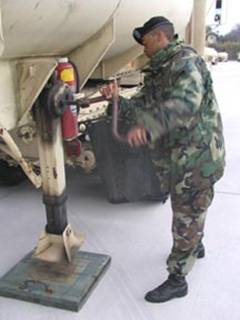
Spc. Alex White, a 416th
Trans. Co. driver, rolls up the landing legs of a M1062 fuel tanker. The legs support the weight of the trailer
when it is not hooked up to a truck. |
|
|
|
||
On the Road Again… |
||
|
with the 416th Trans. Company ‘Road Dawgs’ |
||
|
Story/commentary by Spc. Rebecca Burt Hunter Public Affairs Office
I must admit, looking down on the rest of the traffic on the road from my high perch in the passenger seat of a Freightliner M915A2, a military semi truck, stirred a feeling of power. Towering over even pick-up trucks, I felt like the master of the road. At the same time, knowing that there was 7,500 gallons of highly flammable jet fuel five feet behind my head made me more than a little wary of how vulnerable I was. Considering the fact that I’m a journalist and not a truck driver, you might wonder how I ended up in the cab of an Army semi truck in the first place. Well, I wanted to tell the story of professional drivers in the Army, what it’s like and why they’re important. So, I tagged along on a fuel hauling mission with Hunter Army Airfield’s 416th Transportation Company. In light of the unit’s prior week of missions hauling fuel
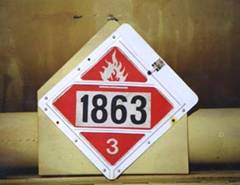
between The day’s mission started with each driver performing a preventative maintenance check and service on his truck and trailer. The PMCS includes checking every system in the vehicle, including its fluid levels, tires, lights and breaks. The operators also go over the M1062 fuel tankers carefully checking for any drips or leaks and making sure that any air vents are closed. After the PMCS, each driver starts his truck and pulls it “on line,” taking his place in the convoy. Before leaving, the drivers go over their trucks again and check to make sure that all of the rigs have the correct convoy signs and safety placards describing what is inside. On the side of the truck is a bright red placard, with little flames and the number ‘1863’, which tells other drivers and emergency crews, if there were an accident, that the tanker is filled with jet fuel, called “JP8”. PMCS’s, placards, 80-hour blocks of training classes and on-the-job training with experienced drivers is all part of making sure that every |
|
|
|
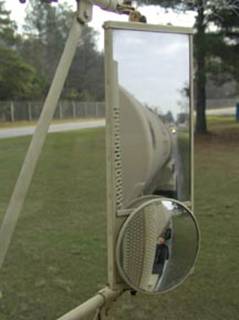
A truck’s mirrors allow the driver to see down the
side of his trailer giving him a view of both how the trailer is reacting and
what other drivers may be doing on the road below. |
||
|
|
||
|
Placards tell drivers and emergency crews what‘s
inside a tanker.‘1863’ is the code for JP8 jet fuel. |
||
|
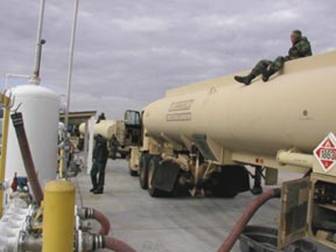
soldier knows exactly what he or she is doing and the situation that they’re working in. More than anything else, the 416th stresses safety, according to Spc. Christopher Brenner, the 416th “Road Dawg” driver I rode beside. “Safety is the number one priority of every driver in the company,” said Brenner. “There is nothing that everyone focuses on more. This is very serious stuff. If you’re not careful you could kill somebody. “A wife with two kids in the car could throw a cigarette out the window and if it lands next to your truck which is leaking – you just killed yourself and everyone else near you on the road,” he said. At the very least, the Department of Transportation can shut down an entire convoy if one truck spills a single drop of fuel on the highway, said Brenner. That responsibility is not one that the drivers of the 416th take lightly. Their strict safety guidelines at work also transfer over to habits in their personal driving, according to Brenner. “We have fewer accidents, both at work and at home, than most other people,” he said. Once the soldiers have thoroughly PMCSed their vehicles, they receive a safety briefing and directions from the noncommissioned officer in charge. Then the NCOIC gives the drivers their material inspection and receiving reports, which tells each operator how big his load is, where it came from and where it’s going. Now the convoy is ready to hit the road. I clamber into the passenger seat, which is a somewhat daunting task, considering how far it is above my head when I open the door. Luckily, there are handles to help you up. “Can you pull that mirror this way a bit,” asked Brenner after I closed the door. I rolled down the window and hauled on the bar holding what seemed like a dozen different mirrors. “There – that’s good. Thanks,” said Brenner. “Every time you slam that door it moves.” I watched as the driver pulled around corners and stopped at the train tracks slicing across the road and figured pretty quickly that this was one job I could never do. I was shocked at the amount of attention it took just to watch both sides of the 36-foot trailer, calculate the truck’s turning radius at every crook in the road and the distance to stop and still pay attention to other cars on the road. I truly believe at best I would have taken out a stop sign, gone over a few curbs and had to make multiple three-point turns just to go those few miles to the “fuel farm.” “People think it’s easy,” said Pfc. Lonnie Woodard, another driver with 416th who also drove commercial trucks before joining the military. “They say things like ‘all you’re doing is driving,’ but what they don’t understand is that once you go 100 miles you’re beat. There’s a lot of difference between a car and a semi truck.” Along with the challenges of driving a big rig, the drivers of the 416th have to learn to handle the extra difficulties of hauling fuel. Most loads, such as engine parts for example, are stationary – once they’re strapped down correctly, they’re not going to move. Fuel, on the other hand, can flow freely back and forth in the tanker, which can cause problems, said Woodard. With a regular load, the driver has an idea of the weight behind him and can judge the distance he will need to stop. With fuel, though the driver can feel the weight and come to a stop, the fuel can slosh in the tank pushing the truck further forward, according to Woodard. “The force is like a wave hitting you — regardless of how you’re standing, a wave can knock you down,” said Woodard. “Driving with fuel takes different techniques,” said Brenner. “I actually like it better than a regular trailer though. There’s more of a challenge. You may think you can drive a truck, but with these tanks full of fuel it’s different. If you can’t drive you’re going to find out.” Brenner wheeled the truck through the entrance of Hunter’s Bulk Fuel Storage facility and when our turn came, I jumped out to ground guide him up to one of the facility’s two pumping stations. Once at the station, a tank farm fuel technician tested the fuel’s quality. “You know if it’s good gas because you can see clear to the bottom of the tanker,” said Brenner. “Gas that’s not quite as good will have dirt and particles in it.” The fuel looked as clear as water in the technician’s long glass beaker, and after recording a few measurements, the truck was hooked to the pump. Brenner sat on top of the tanker watching the fuel level fall through a port hole, as I stood below, under the watchful eyes of the NCOIC, ready to flip an emergency cut-off valve if anything should go wrong. After 15 or 20 minutes, Brenner banged on the side of the empty tanker signaling that it was empty and the fuel technician came back to remove the pump hoses. Then we were on our way back to the motor pool for another load of fuel to start the whole process again. It seems most of the drivers love what they do, and many plan to either continue their tenure in the military as a professional driver or enter the same field as a civilian when they leave. “I love truck driving, and just going places,” said Woodard. “I love knowing that’s my job – to go down the road, seeing different places and meeting different people.” “I love this work – it’s exciting,” said Sgt. Barry B. Johnson, a 416th driver. “I don’t know why I like it, I just do,” said Brenner. “It’s what I want to do.” Spending the day with a handful of these soldiers, watching them in their niche, men and women “behind the wheel”. I have seen the meticulous checks they complete to ensure the safety of everyone on the road, and observed the pride they hold for their unit, trucks and skills. I feel safer knowing that those giant machines are being handled by well trained and highly motivated soldiers. And, the next time some one says ‘that’s easy, it’s just driving’ I’ll be able to tell them just how wrong they are.
|
||
|
|
|
|
|
Drivers
wait as the Bulk Fuel Storage facility’s pumps drain the fuel from their
tankers. One driver sits on top of the
tank to signal the facility’s fuel specialist when the tanker is near empty.
|
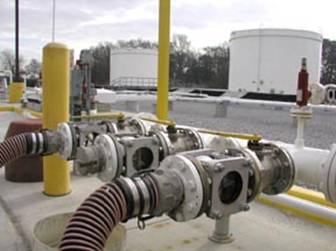
A
view of Hunter Army Airfield’s Bulk Fuel Storage Facility, nicknamed the
“tank farm.” The pipes in the
foreground are used to pump fuel from waiting trucks. |
|