It was August, and 5 days of training camp was underway to help get the kids in shape before the regular practices begin. As I pace back and forth between the lines of future football players, barking out exercise commands, I make eye contact with a chubby first year player who was obviously struggling to handle these exercises. With the look of terror in his eyes he says � Coach, do I have to take the long run today?� Tears swelling up in his eyes, � I don�t think I can make it.� I had noticed that he was the last one back every time we ran, and he walked a good part of the run because of the distance. So I bent over, got eye to eye with him, and said, �What�s your name son?� � Elias, Coach.� �OK Elias, will you do something for me? Will you try, just try to make the run, and run the whole way?� Unsure of himself, and disappointed, he said, �OK Coach.� And off they went. I watched the whole way. He came in last, but he made it without stopping. I ran up to him, gave him a high five, and told him, �I knew you could make it, I knew it! Good job Elias!� He smiled, and you could see the self-confidence begin to show itself.
By the end of the week he was beaming with excitement about the season which was about to begin. All the coaches got together to pick their teams; when I picked Elias Hansen from the hat I was so excited, not because he was going to be a good player but because he has the heart of a champion. Elias earned a position of starting Center and helped our team go undefeated. I love that kid, and he�s now, only one year later, one of the best linemen in the league. These kinds of stories are why I coach.
I also would like to thank Daryl Read and Chuck Burns for allowing the use of their plays in Chapter 7 of this book.
This book would not have been possible if not for the constant support of my wife Lavonne Pettay who did all the graphic design in this book including the playbooks in Chapter 7. Lavonne also did the page layout graphics and photos. Thanks also go to Larry Dusavage who helped transfer files and convert the document for us.
Thanks to Kenny Cook, Sam Higgins, Ryan Kahler, Bryant Hovland and Cameron Pettay for posing for the pictures.
To the South Kitsap Peewee Association Board and all of you who have supported this project, Thank You.
Coaching youth football is demanding and you should be aware of what you�re in for before you make the commitment.
If you believe you can give of yourself what is required to become a coach than this book will help you.
I think sometimes that people get into coaching football for the wrong reasons. Maybe they want to relive their own playing days or try and turn their own child into something they wanted to be. Sometimes we forget youth sports is not about molding kids into the next superstar in the NFL but a way for kids to learn the skills of the sport and have FUN!
With youth football you can help the youth of your community build self-confidence and gain discipline, learn sportsmanship and teamwork.
If you can commit to the schedule, teach and motivate the players to come together as a unit and help each other work to achieve a common goal. If you can set a good example by being a good role model than you are ready to take on the challenge of becoming a youth football coach.
Ah, the pre-game speech, I remember it well; the words can change but the message is the same. Although it really never won or lost any games, its value to the whole experience is immeasurable. It�s all about emotion, dedication, desire and heart.
The pre-game speech is one of many aspects in coaching, the X�s and O�s of football are the easy part, consider the following and how much more is involved with coaching youth football.
1) Teaching Good sportsmanship.
2) Bringing out the emotion, dedication, desire and heart.
3) Teaching the fundamentals of the game, the X�s and O�s.
4) Dealing with injured players, dealing with parents or guardians, The good ones and the not so good ones.
5) Running an efficient practice schedule.
6) Selecting a team parent to oversee and schedule team activities like pictures, fund raising, and team parties.
7) Keeping the kids� equipment in good working condition and making sure they know how to wear it.
8) Keeping files of the kids� medical release forms and other paperwork.
9) Etc�etc�etc�.
In other words, coaching youth football is a demanding position and should be considered only by those who have a good understanding of all aspects of the game, not just emotion or the love of the game. Remember: we are here for the kids! (First and foremost)
In coaching youth sports, any youth sport, the number one goal should NOT be to field the best team. The number one goal should be to teach the kids sportsmanship and how to interact with others to achieve a common goal (teamwork). Really we are teachers, and like it or not we are role models.
Be a good role model, be a good teacher and you can be a good coach.
How important is winning? Well pretty darn important considering the object of the game is to try and put more points on the board than the other team before the game ends. DUH! But if that is your main focus chances are your season will not be as meaningful or enjoyable for you or your team. Having a championship team might make you look good but to an eight, ten, or twelve year old kid it�s meaningless if he or she didn�t learn and have any fun and receive a overall good experience.
Relationships between coaches, players and parents are extremely important to the success of your season, and by success I don�t mean wins and losses I mean how positive was the entire experience for everyone involved.
As you read on you will find samples of various forms that might assist you. You will also see examples of practice schedules and practice drills, you will learn a little about setting up basic offensive and defensive formations as well as some sample playbooks.
It is my hope that you will get the basics you will need as a new youth football coach and that this might help you get organized and be prepared for an awesome football season.
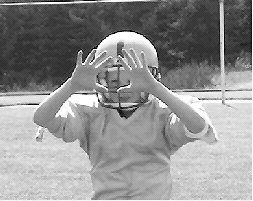
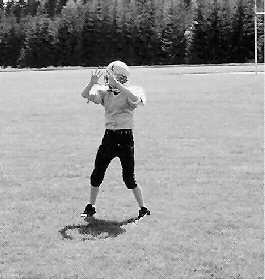
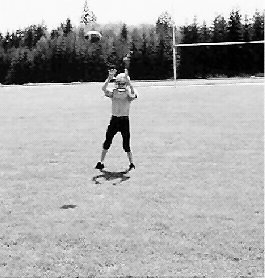
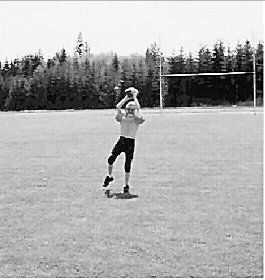
The most common mistake a receiver makes is to try and use his arms, what will happen is the football will hit the shoulder pad and bounce away. Ask them often, how do we catch a football, their answer should be to hold up the triangle and say "With your hands coach"
It is also a good idea to have extra snaps, helmet pads, chin straps, mouthpieces, shoulder pad straps etc. on hand at games.
Lets start with the components of the uniform.
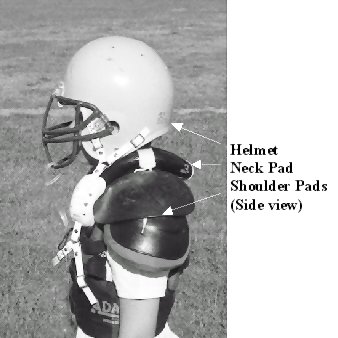
Shoulder Pads: The shoulder pads should be on and snapped up and/or tied when fitting. It should not be loose around the neck and the inside portion should be over or slightly over the shoulder blade with the upper two pads extending over the shoulder. The player should be able to raise his or her arms up over their head and still have protection over the chest and shoulder blades.
Jock and Cup: This is optional in most leagues.
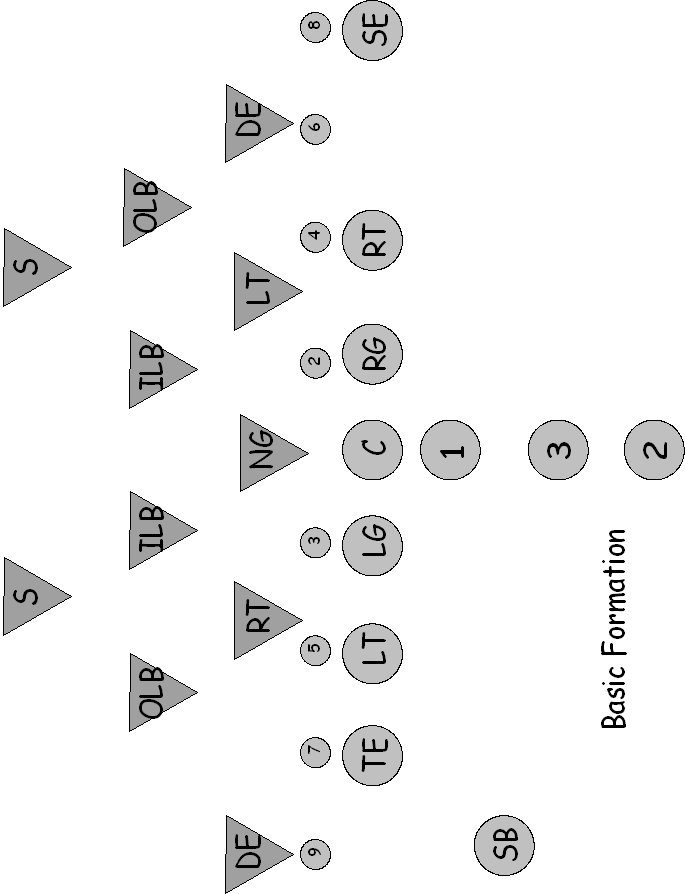
In this playbook you will notice that a defensive formation was included on each play to help the players understand what their blocking assignment might look like for that play.
The number system was used to show the ball carriers and the holes. The same system we talked about in chapter three where we number the backs and the hole between the lineman, odd numbers on the left side and even numbers on the right side of the line.
The dotted line represents the movement of the ball.
A brief description of what happens once the ball has been snapped is on each page to help better understand the diagram.
Using this playbook you can run the same play out of various formations thus confusing the defense.
Coach Daryl Read designed this playbook and Lavonne Pettay did the graphic design.