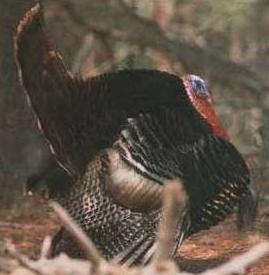
 Eastern (Meleagris gallopavo silvestris)
From Florida to southern Maine and Ontario, and from Texas to South Dakota The adult male Eastern, called a gobbler or tom, may measure up to 4 feet tall at maturity and weigh more than 20 pounds. Easterns are the heaviest of the 5 subspecies, and the turkeys found in the northern parts of the U.S. can really become large. Some of the corn fed gobblers in the upper mid-west (Iowa, Wisconsin, Missouri) have body weights over 30 pounds. Gobbler over 25 pounds are fairly common in those areas. Chestnut brown-tipped tail coverts (smaller feathers which cover up larger ones) and dark-buff or chocolate-brown tail tips characterize the most abundant and most widely hunted turkey, the Eastern Wild Turkey. The gobbler�s breast feathers are tipped in black, while other body feathers are colored with copper or bronze metallic iridescence. The primary wing feathers have white and black bars that extend to the feather shaft, while the secondary wing feathers mainly have prominent white bars. This results in a white triangular area on each side of the back when the wings are folded backward. A mature female, called a hen, may be nearly as tall but is usually lighter, weighing between eight and twelve pounds. Females are similar in color to the males but more brown, and the metallic reflections are less brilliant. Feathers of the hen's breast, flanks and sides are tipped with brown rather than the black and white tips of the male. |
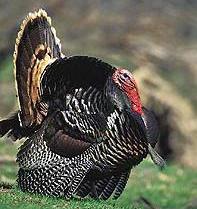 Merriam (Meleagris gallopavo merriami)
Transplanted into almost all western states Although approximately the same size as the Eastern, the Merriam has different coloration. It is black with blue, purple and bronze reflections. White feathers on the lower back and tail feather margins distinguish the Merriam from other subspecies of turkey. Merriam�s appear to have a white rump due to pinkish buff, or whitish tail coverts and tips. It closely resembles the Gould's turkey but its tail margin is not usually quite as pure white nor is the light margin of the tail tip quite as wide as in the Gould's. The tail feathers are very conspicuous when the gobbler struts against a dark background. Toms have black-tipped breast feathers, while the hens exhibit buff tips. Hens have a more extensive white area on the wings giving a whiter appearance when the wings are folded. |
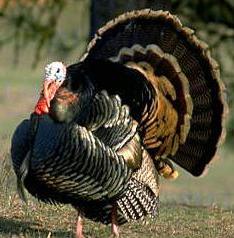 Rio Grande (Meleagris gallopavo intermedia)
Transplanted predominately into Texas, Oklahoma, and California The Rio Grande turkey, at full maturity, is approximately four feet tall with a slightly smaller body size than the Eastern wild turkey. It is pale and copper-colored having tail feathers and tail/rump coverts (short feathers located at the base of the tail) tipped with a yellowish buff. An alternating color pattern includes tan feathers with medium or dark brown buffed tips. The Rio Grande�s color is consistently lighter than the Eastern or Florida bird, but is darker than the same feathers in the Merriam or Gould subspecies. Feathers of the hen breast, sides and flanks are tipped with pale, pinkish buff. |
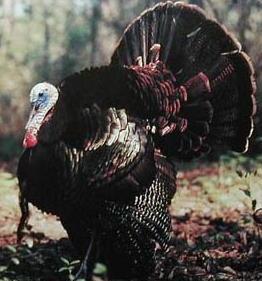 Osceola (Meleagris gallopavo osceola)
From Florida and transplanted to southern Louisiana through southeastern South Carolina The Osceola turkey is the smallest and one of the most challenging subspecies of turkey to hunt. A mature tom turkey will only weigh 16 - 18 pounds in his peak breeding state but makes up for the lower weight with longer spurs and beards on average than the other subspecies. The Osceola subspecies is similar in feather markings to the Eastern except that black predominates in the wing barring of the primary wing feathers. Feathers of the Florida turkey show more iridescent green and red colors, with less bronze than the eastern. The dark color of the tail coverts and the large tail feathers tipped in brown are similar to the eastern, but unlike the lighter colors of the three western subspecies. Its colorations and behavior are ideal for the flat pine woods, oak and palmetto hammocks and swamp habitats of Florida. Adult females, or hens, are similar to the males but duller and lighter colored throughout, except wing feathers, which are darker. |