 |
 |
| arises with eye-contact as condition - whether pleasant or painful or neither painful-nor-pleasant.
He becomes disenchanted with the ear, with the mind, with whatever feeling arises with mind-contact as condition". "Becoming disenchanted, a learned disciple, who sees (things) thus, becomes detached (viraga), with regard to the eye, visible forms, visual consciousness, visual impression, also with whatever sensation, pleasant or painful or neither-pleasant-nor-painful, arises on account of the visual impression with regard to that too he becomes detached... (repeat with reference to the rest of the senses). Thus being dispassionate, he becomes detached and through detachment he becomes liberated - vimutti. When liberated there is the knowledge that he is liberated. And he knows: "Birth is exhausted, the holy life has been lived, what has to be done is done, there is no more left to be done on this account." "Bhikkhus do not allow your-selves to be consumed by the flames of desire, hatred and delusion. See the impermanent and interdependent nature of all dhammas in order not to be enslaved by the cycle of birth and death created by the sense organs, objects of the senses, and sense consciousness." The thousand bhikkhus and the three Kassapa brothers listened with rapt attention. Each one was deeply moved. There was a brief but pregnant moment of silence. Then a thunderous roar of "sadhu, sadhu, sadhu" rent the air, for all of them had instantaneously understood with panna the Buddha's message of how deliverance from the samsaric round could be achieved. They had thus attained Arhantship. Discussion The fact that the thousand new bhikkhus and their three teachers were able to attain to the highest Holy state comes as no surprise when we remember that they all were experienced ascetics well versed in meditating for extended periods of time with total one-pointed concentration. They were also used to austerity and discipline. Consequently, it was possible for the Buddha to teach them the fundamentals of his Dhamma in the same manner that he used to teach his original band of five ascetics. In this case after teaching them for three months in the theory and practice of the Dhamma, the minds of the newly ordained monks had become pliable and alert. It was only then that He spoke a sermon in which the words fire and flames were used repeatedly. Now, these were words to which these monks could relate, since they were previously fire-worshippers. Consequently they paid full attention to each and every word of the Buddha. By doing so, they instantly comprehended the innermost message contained in the Buddha's words and attained Arahatship. But for us understand with wisdom (panna) the contents and significance of the above sermon we need to recollect and understand the processes involved in all of our day to day activities, and how these processes are all interconnected to our six senses. A good starting point is to first recollect the Buddha's explanation of the human condition. He found that by penetratingly examining his own nature, he could comprehend the reality within himself. He realized that every sentient being is a composite of five processes called aggregates (skhanda), four of which are mental, which He called nama, and the other, physical which he called rupa. He found that mentality and materiality always work in unison, for there was mutual interaction between the physical base and mental activity. They were interconnected and had a cause and effect relationship. Matter or Rupa: Matter is all of the visible components that make up our body (rupa), and at the ultimate level consists, merely of four primary elements (dhathu). They are: pathavi or solid element, apo or liquid element, tejo or fire element, vayo or wind element. They also possess properties of solidity, fluidity/cohesion, caloricity/heat, and movement respectively. These four primary elements manifest themselves in the human body as well as in all other formations in various permutations and combinations. But at the fundamental level they are just sub-atomic particles in constant rapid motion, arising and vanishing in unimaginably rapid succession. Ultimately matter is nothing but crystallization of energy, thus giving them an apparent false reality. Mind or Nama: There are four components or aggregates comprising the mind. But at the fundamental level they are simply four processes in constant interaction with one another. These are: sensation or feeling (vedana), perception, sense-impressions (sanna), reaction or cognitive activities (sankhara) and consciousness (vinana). We need to also constantly keep in mind the universal characteristics of the human condition, namely anicca (impermanence) - dhukkha (suffering) and anatta (no permanent self), and the human legacy of greed (loba), hatred (dosa) and moha (delusion/illusion/confusion). For, human-kind is subject to the latter three characteristics because they are 'part of a package' which it had inherited during the evolutionary journey from unicellular organisms to what it is at present, - complex human beings. To be continued |
| Knowledge and truth in early Buddhism
AN EXAMINATION OF THE KALAMA SUTTA AND RELATED PALI CANONICAL TEXTS Dharmacari Nagapriya Kalama Sutta: What is the Dharma? At first glance this may seem a trivial question. At least for a Buddhist, it hardly seems worth asking. Surely, it is the Noble Eight-fold Path, the Three Characteristics of Conditioned Existence, the Four Noble Truths and, above all Dependent Origination (pa.ticca-samuppaada). However, upon further investigation it may seem less clear that such teachings are 'obviously' the Dharma. If we are not enlightened, how can we know? In other words, upon what grounds do we claim that, say, the notion of anattaa (no fixed self) is the Dharma but the notion of attaa (fixed self) is not? If we are a Buddhist, we may rest our claim upon the Buddhist tradition; it says so, therefore, it is the case. However, is the Dharma nothing more nor less than what traditional Buddhism has said that it is? How then do we assess contradictory doctrines found in the tradition? Who is to arbitrate over which teachings to admit to the 'Buddhist tradition' and which to exclude? How are we to evaluate the historical developments of the Buddhist tradition? In brief, what reliable criteria can we use to assess the claim to authenticity of any traditional or contemporary Buddhist teaching? Moreover, how is a committed Buddhist to demonstrate to a non-Buddhist that the teachings of Buddhism are sound? We cannot simply invoke the tradition and expect others to be convinced. Neither is it enough to rest upon our 'faith' (saddhaa). After all, why should anyone accept the perspicacity of our faith. We need more reliable and less dogmatic and subjective grounds upon which to demonstrate the compelling value of the Buddha's message. It is such issues and difficulties that the Buddha addresses in his dialogue with the Kaalaamas and which I want to look at here. In considering that sutta I want to examine the criteria rejected by the Buddha as inadequate grounds for confidence in spiritual teachings and then explore critically the criteria that He (allegedly) recommends for the identification of beliefs and views that can be confidently trusted. In doing so, I will look at a number of other texts that deal with similar issues. In his dialogue with the Kaalaamas the Buddha casts a good deal of light on the question of how he communicated his message to people who had not already gone for refuge to him or who, in other words, did not yet have confidence in his proclamation of Enlightenment (bodhi) and the system of liberation that he was steadily developing based upon it. To some extent at least, even practising Buddhists are in the same position unless of course they are already Enlightened. For example, while I may believe - for a variety of reasons - that the Buddha gained Enlightenment, I cannot claim to know this. Neither can I claim to know that Enlightenment is even possible, even assuming that I can properly understand what it consists in. My understanding is limited by my own kilesas (defilements), my own lack of spiritual insight. The question then arises: if one does not already believe that the Buddha was Enlightened and that the Dharma offers a path to liberation how can one comes to develop such confidence? This is precisely the issue that the Buddha tackles in his dialogue with the Kaalaamas. At the beginning of the sutta we encounter the Buddha on a period of itinerant wandering (as was his usual practice outside the rainy season) through the kingdom of Kosala, accompanied by a large retinue of monks. He arrives at the town of Kesaputta where the Kaalaamas are based. On hearing that the Buddha has entered their territory, and having heard favourable reports about him such as that he is enlightened, the Kaalaamas, perhaps somewhat excitedly, go to see him. After paying their respects to the Buddha it immediately becomes apparent that they have a fundamental spiritual problem, even a universal spiritual problem. This is how they formulate it: There are some monks and brahmins, venerable sir, who visit Kesaputta. Painting at World Peace Vihara, Hiroshima, Japan. Artist: Upasena Gunawardene They expound and explain only their own doctrines; the doctrines of others they despise, revile, and pull to pieces. Some other monks and brahmins too, venerable sir, come to Kesaputta. They also expound and explain only their own doctrines; the doctrines of others they despise, revile, and pull to pieces. Venerable sir, there is doubt, there is uncertainty in us concerning them. Which of these reverend monks and brahmins spoke the truth (sacca) and which falsehood (musaa)? [2] Are we not in the same position? Shopping, as we now do, in the spiritual supermarket we too are bombarded by self-proclaimed 'enlightened' teachers and charismatic gurus of all creeds and practices, consistently offering seductive, panacean sound-bites. How are we to sort out the truth from the hype, the spiritually realised from the charlatan, the spiritual invigoration from the narcotic reassurance? The spiritual condition of the Kaalaamas then has many similarities to the spiritual condition of the contemporary man and woman. It is characterised by uncertainty, confusion, and the proliferation of conflicting perspectives. To be continued |
 |
| Suba Theri's eyes
Here, Take them Take my eyes They are superfluous A burden really A flicker of a flame Does not Bring back The memories Of yore Any more Morning sun Does not weave A golden tapestry Before them Anymore The birds Beasts And Flowers Just Vanishing Atoms Bundles of Nothingness Take my eyes Take them They are Dead Anyway Ariyawansa Ranaweera From the net The Song of meditation All beings are from the very beginning Buddhas. It is like water and ice: Apart from water, no ice, Outside living beings, no Buddhas. Not knowing it is near, they seek it afar. What a pity! It is like one in the water who cries out with thirst; It is like the child of a rich house who has strayed among the poor. The cause of our circling through the six worlds Is that we are on the dark paths of ignorance. Dark path upon dark path treading, When shall we escape from birth-and-death? The Zen meditation of the Mahayana Is beyond all our praise. Giving and morality and the other perfections, Taking of the Name, repentance, discipline, And the many other right actions, All come back to the practice of meditation. By the merit of a single sitting He destroys innumerable accumulated sins. How should there be wrong paths for him? The Pure Land paradise is not far. When in reverence this truth is heard even once, He who praises it and gladly embraces it has merit without end How much more he who turns within And confirms directly his own nature, That his own nature is no-nature Such has transcended vain words. The gate opens, and cause and effect are one; |
Supposing, if a person did not even suspect that he was afflicted with a cancer would he take treatment? No, in the same way there must be initial acceptance of the Noble Teachings (about dukkha), for a person to generate right view (samma dhitti) by placing his confidence in the Buddha, Dhamma and the Sangha. 'Right view' being the first step on the path of Dhamma is so essential. But, that does not mean to suggest one should learn the Dhamma in depth before one begins practising. The Buddha's Instructions The Pali Canon has enough examples where the Buddha had not preached the four Noble Truths to every one who came to him, but just what was necessary, of course having regard to their past accumulations which only a Buddha has the ability to do. The best example is the instructions given to Bhikku Nanda (former prince) who was feeling so depressed because he could not return to his fiancee-Janpadakalyani as requested by her when he was walking behind the Buddha. When the Buddha came to know about his problem, using his psychic powers the Buddha made him to see beautiful nymphs in the deva world. Nanda then agreed to meditate as instructed by the Buddha, not for extinction of suffering but to be born in the heavens so that he could have a celestial nymph as promised by the Buddha! Nevertheless, Nanda was fully cured of his desire for lust with the realisation of ultimate truth of Nibbana. He immediately released the Buddha from the promise he had made. What is to be understood from this is the importance of practice without which there would be no progress towards liberation. The purpose of this article is not to discourage those who wish to study the Buddha's teaching, but to convey to them that Dhamma is understood better when one studies it while practising. It's like doing practical experiments in the school laboratory by science students. Only after seeing sunlight passing through the prism the student gets convinced that it has seven colours. Dhamma is sandhittika i.e. it has to be realized through direct knowledge. |
In this very brief exhortation the Buddha did not make reference to dukka (suffering), cause of dukkha, or the liberation from dukka. Also to Upatissa (i.e. Ven. Sariputta before ordination) who was in search of a teacher of dhamma, Ven. Assaji replied in a concise statement the teaching of Buddha; answering Upatissa's query as to the teacher under whom he has taken refuge, Elder Assaji said: "Of all those things that from a cause arise, Thathagatha the cause there of has told; And how they cease to be, that too he tells, This is the doctrine of the great Recluse" |
 |
| But to Ven. Ananda, the Buddha in a single stanza explained what every Buddha would teach. It is the famous verse most Buddhists will know: (sabba papassa akaranam...)
"Refrain from evil Practise virtue Cleanse the mind This is the teaching of Buddhas" |
Surprisingly, there is no reference to dukkha, cause of dukkha or cessation of dukkha or cessation of dukkha (nibbana). Yet; this is the essence of Dhamma as taught by every Buddha. Does it mean that we need not learn the three Noble Truths not referred to in this verse? This question has to be examined from a practical point of view. Perhaps it can be better understood through an illustration. What should a patient do to cure from his illness? Take the medicine prescribed by the physician and that's all. He need not know the scientific analysis of his illness. A child who is afflicted with an illness will even not know that he is sick. He simply takes the medicine given to him by his parents, and he would be cured from his illness. On the other hand, if a patient without taking the medicine, keeps researching about his illness to know what caused it; or keeps on reading the prescription and reciting it many times like a mantram will he get cured? Never, not by those means. The extinction of suffering can come about only by practising the way of Dhamma. That is why every Buddha will stress the importance of treading this 'ancient path' they discover, rather than merely reading the 'sign boards' giving directions. The verse above referred to contains nothing but the three essentials for one's progress towards deliverance i.e. sila, samadhi and panna. In other words, it is the Noble Eightfold Path. Sila is moral restraint - not allowing one's desires generated by craving (thanha) for sensual pleasures (as well as aversion) to let lose. If we simply give in to our desires we will be behaving like wild beasts. Craving for sensual pleasures has no bounds unless controlled by sila. Like a fire that burns any amount of fuel, craving is insatiable. But, why should we not seek satisfaction through indulgence. Is it wrong because of a taboo according to the Teachings of the Buddha? No, a Buddha can only teach us the way to end dukkha; it is for us to follow the way. We should consider ourselves very fortunate to be born at a time when the Noble Teachings are found and can be practised. If we let go this opportunity we are to be blamed for it. Indulgence in sensual pleasures will only keep us blind to reality; to use the famous simile, it is like the crab's fleeting water dance in the curry pot. Indulgence in sensual pleasures would only make us stupidly delay (pamada) and postpone practising the way of the Buddhas. This is why the Buddha exhorted the bhikkhus in his last words, 'be heedful'. No amount of mere theoretical knowledge of the Buddha's Teachings would be of any use if we do not earnestly practise in accordance with the Noble Eightfold Path. If not, it would be similar to a patient reading the prescription without taking the medicine. |
 |
Full awareness - sathi When a person's sila is intensified, his awareness (sathi) will naturally develop, for there has to be awareness before one could observe the arising of the desires in one's mind. In this manner sila and sathi will work together to bring about calmness of the mind which is smadhi. It is the samadhi that helps one to detect the arising of desires at its initial stage so that one's sila and sathi will work together to bring about calmness of the mind which is smadhi. It is the samadhi that helps one to detect the arising of desires at its initial stage so that one's sila becomes more refined. But, still there would be desires arising in such a way to justify giving into it. Say, even in the form of directing mettha to a person of the opposite sex. Beware of your mind which is so cunning and artful in getting what it wants through deception! At this stage one has to have developed skillfulness (panna) in determining what is wholesome (kusal) and unwholesome (akusal). Wholesome deeds or kusal are the bodily, verbal and mental activities that lead one towards cessation of dukkha-i.e.nibbana. It is through panna one determines kusal and akusal. Through right effort one should suppress all akusal from arising and develop kusal. To do this, one must develop clear comprehension (sathi samapajanna) or full awareness. The combined work of sila, samadhi and panna will now keep the practitioner in the right track. |
| What happens is, with full awareness he would 'let go' every sensation, including the most subtle ones; no matter whether they are wholesome or unwholesome, so that even if a person has a vision of the Buddha while in meditation, he should 'let go' the vision without grasping it.
It is due to attachment to sensations and grasping (upadana) them one gets carried away with what one has grasped. When one does not grasp and let go, with full awareness, one is free from attachment and there will be no more dukkha for him. By mere intellectual knowledge of Buddhism one will not be able to 'let go' sensations with nonattachment. It can only be achieved by practising the Noble Eightfold Path which leads to the realization: 'all that arise due to causes are subject to cessation'. This is the essence of Buddhism. This is the fundamental reason for dukkha, which Upatissa realised when he listened to Elder Assaji's aforementioned stanza. For convenience a person might get into a state of complacency that he is so learned in the Dhamma that he can 'let go' any thing. But the real test comes at the moment of his death. Unless he has developed the skill to the extent of instinctively 'letting go' what ever the sensation, mere intellectual understanding of the Dhamma would not be sufficient for his consciousness to release the grasp. His consciousness would cling on to the last sensation like the person who grasps even a straw to save his life when he is at the threshold of being drowned. If this is the case, why did the Buddha preach the other three Noble Truths? The answer is, if the Buddha did not preach them, no one would have accepted the Noble Truth relating to the Path only. |
 |
|
 |
| President Mahinda Rajapaksa on Wednesday unveiled a photo exhibition in Beijing to mark 50 years of Sino-Lanka diplomatic relations. Here the President and First Lady Shiranthi Rajapaksa viewing two photo exhibits depicting former Prime Minister Sirimavo Bandaranaike and Chinese leader Chou En-Lai. Chairman CCPIT Wan Jifei is also in the picture. |
 |
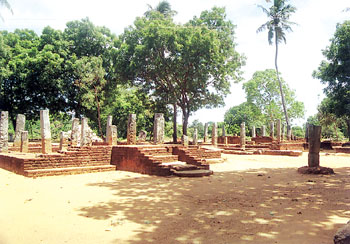 |
| Ruins at Ramba Viharaya Mamadala (Ambalantota) |
| Guard yourself like a fortified city
Like a border city, guarded within and without, so guard yourself. Do not let slip this opportunity, for they who let slip the opportunity, grieve when born in a woeful state. Niraya Vagga - The Dhammapada |
| In the scriptures we find a similar epithet used to announce and convey the realisation of the initial stage of experiencing the dhamma by a stream winner (sothapanna).
The first disciple of the Buddha to have become a sothapanna was Ven. Kondanna; it happened while he was listening to Dhammacakkapavatana sutta - the first sermon of the Buddha. The sutta says the eye of Dhamma arose in Kondanna in that he realized 'whatever that arises due to causes all that are subject to cessation" (yan kinci samudaya dhammam sabbantham niridha dhammam). The same epithet was used in Dhiganaka sutta to announce the realization of sottapanna stage by Dhiganaka, Ven. Sariputta's nephew. True, a Buddha arises in the world to teach the four Noble Truths - (1) the dukkha, (2) cause of dukkha, (3) cessation of dukkha (i.e. nibbana) and (4) the way for liberation from dukkha which is the Noble Eightfold Path. BUDDHISM: The Buddha's last words to the bhikkhus, before his parinibbana, were: "Now monks, I declare to you: all conditioned things are of a nature to decay, work out your salvation without delay.' (Vayadhamma sankhara, appamadena samapadetha). In this very brief exhortation the Buddha did not make reference to dukka (suffering), cause of dukkha, or the liberation from dukka. Also to Upatissa (i.e. Ven. Sariputta before ordination) who was in search of a teacher of dhamma, Ven. Assaji replied in a concise statement the teaching of Buddha; answering Upatissa's query as to the teacher under whom he has taken refuge, Elder Assaji said: "Of all those things that from a cause arise, Thathagatha the cause there of has told; And how they cease to be, that too he tells, This is the doctrine of the great Recluse" |