| CRASS WORDS The aesthetics of anarchy |
| MIKE STAND reports from the House of Crass
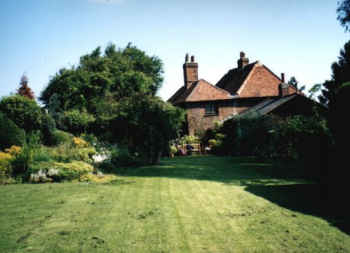
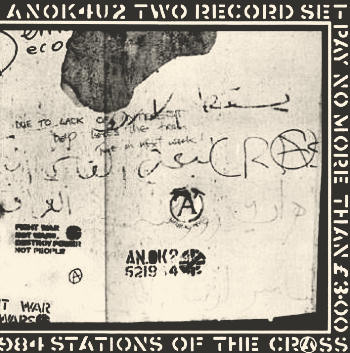
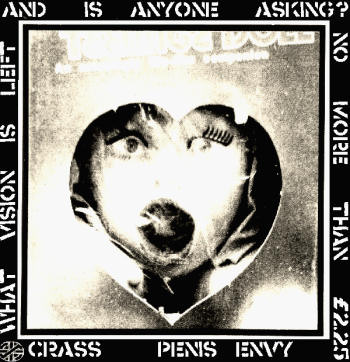
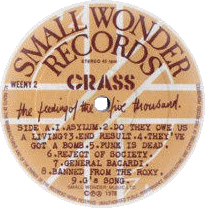
This must be the dialectic of rock journalism. The talk is about whether there should be talks. Should Crass co-operate with THE FACE? It was good, they thought, that the rnagazine is independent of the usual vast corporations, good that it probably doesn't sell on the whole to people who already know about Crass and their ideas; it was bad that it is interested in fashion and sometimes publishes arguably sexist pictures of naked women. We were sitting in the "library" of their large house in the country, a small room lined with shelves of paperbacks ranging from thrillers to political treatises filed at random. Members of the group came and went throughout the hour it took to settle this first point. Should Crass talk to THE FACE? There was no vote taken, but the conclusion was that the people who wanted to talk to me would do so under certain conditions; the others wouldn't-the Crass philosophy in action. Out of group discussion came separate individual decisions accepted by all. Anarchy, I presumed as distinct from both democracy and chaos. The conditions were that this article shouldn't be presented as a straight interview, a sequence of linked quotes, but as my impression of them, openly subjective. Any quotes used should not be attributed because of Crass's loathing of the personality cult and their confidence that any statement made would be a digested representation of the group. Finally their name was not to be used on the cover because that could lure Crass followers into buying an expensive magazine whereas they were only interested in the article reaching people to whom it would come as a surprise. I said that only the editor could guarantee that and they phoned him later. Like me, he deferred to their wish. Both of us yielded to limitations imposed on our freedom, you'll notice. Essex. Autumn sun. The station, in the middle of a rural nowhere, winner of a London Transport certificate of merit for its garden. Birds sing and a couple of giant sunflowers peer over my shoulder as I wait for Andy/NA Palmer/BA Nana to pick me up in the very dodgy Crass courtesy car. The house, rented from the Post Office, has been the home of between a hundred and 150 people over the last 15 years, all of them linked by vegetaran-pacifist-anarchist beliefs, drummer Penny Rimbaud is the only original resident left. Each of the ten present occupants have their own rooms to preserve the option of privacy amid communality. They have two golden rules: no meat and no drugs. "We know official eyes are on us and it would be bloody silly to blow it all on having half an ounce of dope in the cupboard." they say. From their half-acre garden they are self sufficient in everything but grain and dairy products: "Self-sufficiency isn't about bigotry it's about survival". There's no melodrama in that remark. The household's cash income is �160 a week which averages well below the base rate for the dole per person. They live comfortably because they are so well adjusted to their setting. They say: "We have a perfect environment in terms of what you can salvage from our culture. All sorts of lizards and grass snakes live in our half acre whereas on the farm over there a terrible acid smell comes off the soil and there's no wildlife". Within this environment too their own differences of age and class from middle-class fortyish Penny Rimbaud to working-class twentyish Steve Ignorant mean nothing. All the divisive pressures are outside, they explain: "We have lived together in almost complete harmony. We know it's a possibility". This is the living source of their optimism aside from all theories. It's also something, I would suggest, they fail to express in their music where their savage attack on what is offers barely a glimpse of what might be. With the talks-about-talks phase of the debate concluded we move up to the "lounge" for the interview itself. Armchairs, cushions, a bed, stereo, small TV'. They are very serious and their seriousness is sometimes very funny in a way even they laugh at, because what is necessary is absurd and vice versa�a paradox from which there is no escape. At their most intellectually ruthless they write in one of the numerous pamphlets they produce: "If you're not looking for an answer you're part of the problem". That's very hard. More so because it begs the question of the question. "Anarchy, peace and freedom" may be accepted as the starting-line, but the finishing tape probably isn't even in the same lifetime. So every step has to be weighed up. Such as boots. "I can see a lot of the areas we seem to get bogged down in are incredibly self-conscious, but we are trying to be specific about everything we do," they say. One of them wants a new pair of boots. Nothing flimsy. He's dropped a bass bin on his toes before now and will again. Dr. Marten's are best. Dr. Marten's are leather, a product of killing animals, pain and cruelty they do not wish to be involved with in any way. Custom-made canvas boots with steel toes have been checked out and cost about �100 which they can't afford. This issue has not been resolved vet. The people who have old Dr. Marten's carry on wearing them and the ones who are down to their plimsoles just have to be more careful. 'When we get letters saying 'We want to start a Crass Army' it's hard not to just write back 'Don't be such a bloody arsehole'. That's how the music business has always exploited people.' 'We hope we're the last of the big punk bands...' After long discussion with the "Persons Unknown", victims of the notorious conspiracy trial, they agreed among themselves that these were not violent anarchists who would make a mockery of their own pacifism and decided to help raise funds for their defence and the establishment of a centre as a social and ideological base. The place opened in September, called the Autonomy Club, and Crass contributed around �6,000 to it. But they are still clarifying and making distinctions. They are playing no part in running the club, they stress, and they are at odds with the PU's stance as "organised anarchists" in some respects. Crass urge complete individualism and try to draw "the fine line between co-operation and co-ordination". The final paragraph of their "Nuclear Electricity" pamphlet gives more guidance as to what that might mean when it proposes a campaign, or perhaps a non-campaign, like this: "Alone it cannot be done but as individuals with an agreement between us we can work towards . . ." It is remarkable that ferociously assertive music comes out of such a reflective, even meditative, process of seeking the honest answer (a slightly truer concept than "the truth", I think). But it is the upshot of their belief that all things connect. Their elaborate argument in a pamphlet called "Protection/ Possession" relates (with unblemished logic as far as I can see) insunng your TV against theft to supporting the nuclear deterrent: "A great big glorified protection of MINE". They say we all have to accept "complete responsibility". Hard. I ask whether their best efforts had resulted in anything they now regard as a complete mistake. Nothing final that couldn't be learnt from and put right later, they say . . . with the sole exception of "Hurry Up Garry", a track on "Stations Of The Crass" which gave a brutal pasting to their chief music press detractor, Garry Bushell of Sounds. I'd wondered about that. I think it's rotten too. The breast-beating self-justification put me in mind of Queen's execrable "We Are The Champions". Crass now regret it as an outburst of anger which caused "a contradiction of what we believe in". They fell into the trap of boosting someone else's personality cult and lowered their common denominator into the mire. All right. Owned up. All this should have given some indication of Crass thinking. If the next logical question is what they might achieve by it, that's really below the belt as it tends to lead crudely to the "Britain hasn't become Utopia since the release of 'Feeding Of The 5,0000' therefore Crass are a failure and why are they trying to foist all this codswallop on us?" type of response. However, speaking very broadly Crass will state that they have made a limited contributionto change, for instance, stimulating thought on the nuclear issue and thereby adding a few faces to the vast resurgence of CND and a few micro-degrees to the temperature which ripened the recent TUC resolution against Nuclear arms. Crass the band began when Steve Ignorant joined the household after seeing The Clash in Bristol and, inspired by Joe Strummer's cry of "Go out and do it!", said they should form a band. Pete Stennet of Small Wonder, the Walthamstow-based independent, heard their first demos and liked them so much he released them as the 18-track 12-inch single "Feeding Of The 5,000". This was followed by the first Crass label single, "Reality Asylum". It made an instant impact in the independent charts. But actually, as they now acknowledge, they were cocking it up: "We were really bombastic. 'Fuck the business people!' We insisted that 'Feeding' went out at �2 which took no account of Pete having a shop, flat and staff to support. It was hardline and naive." With "Reality Asylum" at least they were only screwing themselves. They priced it at 45p thinking "If we keep our prices down we'll force others to follow", This just meant that every copy sold at a loss until this year. One of their slight miscalculations was to forget about VAT. Thus a �1,000 inheritance from Andy's grannie bit the dust. After ngourous reassessment they decided to try again, this time riding on an extraordinary gesture of confidence by John Loder who put up his Southern Studios as collateral for a �10,000 loan facility for the band. In fact they only ever drew �2,000 and the resulting "Stations Of The Crass" double LP for �3 has kept Crass Records going ever since, marking up well over 60,000 of the label's quarter-million gross sales. Although they came to grips with "economic reality" price-fixing has been a horror to them ever since those early misjudgements. For Crass it's a separate decision for each record and they wrestle with costs offset by predicted sales to come up with a figure just above breaking even �so that they can finance the next one. If Crass get it right by their own lights you have a "Nagasaki Nightmare" selling maybe 50,000 at 70p with each copy representing at most a penny in the label kitty. That would be �500. You can see why they say that "hiring a van at �100 to do a gig is a big deal for us": that's the proceeds from 10,000 singles gone in a night. So they try to make their own sense within a system they abhor. They give the dealers their full percentage because otherwise they would have an excuse for the re-pricing tricks they sometimes pull. When they record other artists the label bears all the advance costs as boldly as a multinational so that unknowns they deal with are not involved in any possibility of loss. They refuse to exploit the development of careers they have helped to launch by doing no more than one single per band (close friends Poison Girls were the exception) and are pleased that Flux Of Pink Indians have started their own label, Zoundz are doing well with Rough Trade, and even that Honey Bane has signed to EMI (though with EMI's armaments interests that was bemusing). They say "You cannot compromise innocently" and looking back on our conversation I take that as a recognition of their own loss, consciously exchanged for wider access. They could sit in their garden but they choose to go out and transact. They have built a structure in which the modest profit from records supports their gigs, which are 90 per cent benefits. Crass never use agents or regular promoters. They issue an open invitation to people to set up gigs for them, check a lot of details about the prospective venue, advise on preserving the peace without an army of bouncers, then wing it on trust. Their last two tours have worked like this since a sticky night in Yorkshire put them off clubs for good when the manager charged �2 instead of the �1 agreed and then gathered six heavies about him to discourage Crass's legitimate claim for expenses. Which brings us to the ultimate reason why Rough Trade usually receive more mail for Crass than all the rest of the bands they deal with put together. Their music, I presume. Most of it you would have to call ugly at least. I find "Stations Of The Crass" unremittingly painful with no element of catharsis to make it worthwhile. It's the most bare-arsed punk for the limited number of people who like that sort of thing. To me, as sound, it's too uncommunicative even to destroy, negating the coherent power of the lyrics you can read on the sleeve. But with "Penis Envy" Crass did open up to the possibility that revolutionary music could be other than giving your brain a quick trim with a Black & Decker. Switching the lead vocal from male to female, which in itself is as radical a step as a popular band has even taken, they are still savage and sour, but interesting too. They've stopped using sound like a stone age club to overpower you�it was never an apt translation of their thinking into music. Still, easy listening they could never be. Blackness prevails. The sleeve images are of death and the slaughterhouse. Despite the "harmony" they know at home, they say this is the only way it can be: "I don't think there's a day when we don't confront ourselves with what's happening in the world. We have been made aware of being humourless and having no compassion, but that's the way we feel it. We lay ourselves open." Their arguments do make deep sense. Yet I think they lose some of them in exaggeration. They are too absolute. For example, "lies" is one of the key words in their songs. Listen to Crass and you will hear that nobody tells the truth about anything ever. Steve Ignorant sings that the Guardian and the Sun are "just a load of fucking lies". Is that entirely so? When I raise this with the band they affirm: "People operate within layers of lies. The lies are all there is in most people's lives". Isn't that presumptuous, maybe rather snobbish? Isn't it an undercover variant on the enfeebling religious concept of original sin? And if we're really all so disgusting why bother (as they do)? They reply: "There isn't any room for doubt in public statements. The doubt comes in the hours and hours of sorting it out beforehand. The little realisation you might have had picking a flower in a garden has to be clung to in front of a thousand people at a gig. Suddenly the whimsical thing you thought of in a perfect moment has to be stood by in front of 60,000 people who buy the record." That "little realisation" is what is never glimpsed in Crass's songs. So they appear before maybe ten million readers in a News Of The World headline as a "Band Of Hate" without much Fleet Street fear of contradiction, while they sincerely assure another writer trom In The City fanzine that "What we are doing is allowing people to be gentle and kind". The later I would suggest is certainly not a lie and certainly not absolutely true. Certainly. Crass do occasionally refer to themselves as a "rock'n'roll band". It has been their life for four years after all. They say 'Rock'n'roll is a genuine form of folk revolution" and "We hope we're the last of the big punk bands. The very fact that we are big is a sign of the failure of what punk was all about. But we do feel it's building up behind us now, hundreds of bands and fanzines." They surely do remain a beacon. That's not to say the bastards haven't ground them down though. There was temptation. Like most bands who show well in the independent charts they were once accosted by a wheeler-dealer who offered to make them very rich. He told them they would never succeed on their own, but together "we can market the revolution!". Huge advances were implied. Crass went back to Essex and toyed with the dream for four days, always knowing what their response would be. Then they told him "No". He said they should see the Prudential about their kneecaps. If Satan was behind them the fires of Hell were ahead. Their early gigs had been innocuous affairs at the White Lion in Putney with nobody paying too much attention to the band ranting away earnestly and safely in the corner. When the first records established their reputation and, unavoidably, "image" the character of a Crass concert was transformed. Their violent music drew violent people, both for and against them. "It was bad because we had to spend more time thinking about security than about what we were going to play," they say. They recall one night in Perth with the police banned from the venue on principle and standing outside rubbing their hands over the aggro within, when the group had given up playing and jumped off-stage to talk to the troublemakers and eventually had succeeded in diverting the mayhem towards dialogue: "I suppose it's a bloody silly method and a dangerous one, but there's a degree of hope in it. You have to go on believing that people are going to behave decently to one another. "It does make gigging unappealing. It's no fun to drive 200 miles to somewhere grey and get gobbed on and abused and have to stop fights and get thumped. It makes you wonder if it's worthwhile. To keep going you have to persuade yourself not to anticipate it. It's horrible to see our friends in the crowd trying to cool it out and then getting punched for their trouble. The good thing is the talk afterwards because a lot of them stay behind to see us. You realise this was all new to us? The violence was frightening, horrific. But . . . one simply grows deeper as a human being." And wearier. "We're watching ourselves for degeneration. When we came into this we were in very good form, very good shape physically and mentally. Prepared for the attack so to speak. Four years on we're tired and jaded, much weaker. It would be easy to disappear, become an empty shell mouthing ideas. Do you know that since the band took off I've only had two clear days with the person I have an intimate relationship with." The heart of the matter is their followers. They feed them and feed on them. Followers? Of a band that denounces leaders? Well, Crass feel "fan" is an insulting term and don't want anyone to act like that: they won't sign autographs because it's an approach to the name rather than the person. Followers? "When we get letters saying 'We want to start a Crass Army' it's hard not to just write back 'Don't be such a bloody arsehole'. That's how the music business has always exploited people. We've lost most of our original following because they're all up to something themselves now." Strictly for want of a better word then, their "followers" write to them at length and regularly and Crass write back, a team of them sitting down for several days at a stretch to reply personally to every one�a mail-out which had cost them around �400 in stamps, envelopes and-their own leaflets a couple of days before I visited them. This is where Crass are truly in contact as very few rock'n'roll bands have ever been, despite the opacity of so much of their music. What it all adds up to is that they make large claims and they fulfil them. (Background Illustration from Crass bulletin International Anthem.) THE FACE 1981 (From the Don't Care Archives) FOR THE FULL SPIEL ON CRASS GO HERE |
 |
 |
 |
 |
 |
 |
 |
|
|