Track Dreams
A metallic beeping sound tears itself across my slumbering room, and I groan. Like every morning for the past two months, I angrily stretch out my arm and slap my alarm clock�s snooze button as if it were a particularly annoying mosquito. I can�t help it. Its quarter to six in the morning, and I have a big day ahead of me.
Pushing back my covers I slowly sit up and examine my body. The large muscles I�ve only recently acquired are all still there, and all almost alarmingly stiff, as per usual. I pick my way clumsily across my bedrooms floor that is covered with an array of workout clothes, normal clothes, and of course books of all kinds. Throwing on a sports bra and a pair of workout shorts I head upstairs. I�m always a funny sight in the morning, and as I walk up the stairs to the bathroom, like every morning, I zigzag back and forth like a drunken fly.
A banana is my food of choice, and I quickly munch it down with a glass of water as I head back downstairs into the pleasantly cool basement. Grabbing a highly used videocassette, I make my way into the family room. In front of the TV I clear a fairly large space, laughably large as I look back on it now, to do my yoga. Popping the tape in, I stretch my arms out a bit before I hear Steve Ross�s familiar voice resonate out to me.
"Good morning! Lets stand up, its time to do some yoga!"
I�ve managed to record just one episode of my favorite yoga show Inhale before it got taken off air, and so every single morning I do the same routine. Even my mom has it memorized by heart. After about an hour of good hard yoga I am feeling thoroughly worked out, supple, and relaxed. Thanks to yoga, I am ready to start my day.
Like normal, I am running behind schedule, and I run upstairs into the shower, passing my mom who is chopping up fruit for her breakfast. After about three minutes of my rinse off shower I am back in the kitchen and preparing my own breakfast.
Its highly known in the running community that oatmeal is the perfect runners breakfast, and its what I�ve been eating for the last two months every morning; oatmeal with raisins or cranberries in it. Its good stuff and it always leaves me feeling ready to start my day.
After throwing on some clothes as fast as I can manage, I run out the door looking like the hunch back of Notre Dame, calling goodbye to my mom over my shoulder. Why the hunchback? Well, mainly because I always have a bag full of track clothes hanging off of my left shoulder, a bag of school books hanging off of my right, and a massive viola case and orchestra folder in my right hand; but also because I�m always at least five minutes late.
Such is the life of an insane track athlete.
Sprinting events are composed of all running events where the competitors run their hardest, or sprint, during the entire course of the event. These are basically all of the short running events. Sprinting events include: 100 meter dash, 200 meter dash, 400 meter dash, 400 meter relay, 800 meter relay, 1600 meter relay, 100 meter high hurtles, and 300 meter intermediate hurtles. Distance running events are basically anything in which the athlete would have to pace themselves, in other words, not sprint for the entire race. These races include: 800 meter run, 1600 meter run, 3200 meter run, and the 3200 meter relay.

A relay is a race in which there are four different athletes on the same team that each run equal lengths of the race, and pass a baton between themselves when they change turns. For example, in the 800 meter relay each athlete will run 200 meters (800 divided by four). The first runner will start out with the baton, run 200 meters, then pass the baton on to the second runner, the second runner to the third runner, and finally the third runner to the anchor (fourth runner). In total the runners will have ran a full 800 meters. Also a good thing to note would be that each section of the relay is called a leg. As in: first leg, second leg, third leg, and anchor leg. A hurdles race just means any race in which the athlete must jump over hurdles.
The standard length of an outdoor track, which most high school races are run on, is 400 meters in circumference. Generally just slightly larger than the length it takes to circle a football field. Four hundred meters is a fourth of a mile. So the 1600 meter run is also commonly known as the mile, and the 3200 meter run as the two mile.
In high school track, all ages, freshmen through seniors, compete together. The only distinction made is between girls and boys teams, though generally both the girl�s and the boy�s team will compete at the same track meets. The girls never compete against the boys, but rather, a boy�s event will be run, and then a girl�s event. On odd numbered years the girls run their races first, and on even years the boys will. For example, last year was 2003 and the track meets always started with the girl�s 3200 meter relay, followed immediately by the boy�s 3200 meter relay. The rest of the events follow in the same manner by a scheduled order of events. All of the running events pass in the same order at every track meet, and the field events as well, though it is important to note that the field events are run at the same time as the running events. The only event in which the girls and boys run together is the 3200 meter run. In small meets there will normally be room on the track to run both girls and boys at the same time, and as the 3200 meter run takes some time, it is normally run together to shorten the overall time of the meet.
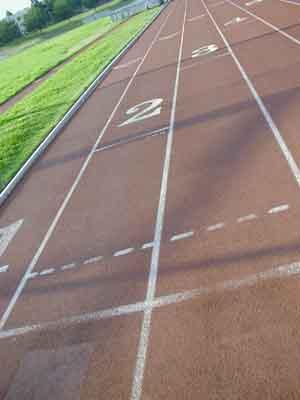
Most normal high school tracks will have between six to eight lanes. A lane is just that, a lane that the runner will follow all around the track during his or her race to avoid collisions with other runners. During short races there are normally more runners then there are lanes, and so there will be more than one heat. Judging by previous scores, each runner will be divided into different heats, and will then run the race accordingly. For example, the worst heat will normally start first, so the worst eight runners will line up in their lanes on the track and run their race. Their times will be reported, and then the second to worst eight will step up and run their heat. This will continue until the best heat runs. In short races the athlete is required to stay in their lane for the entire length of the race. This is why in races like the 400 meter run a stagger will be put on the starting line. The runners in the outside lanes would have more to run on the outside of the track than the runner on the inside of the track if there were no staggers, but because of this each runner is staggered out slightly further then the last, and the distance equals out. It is common for the runner in the eighth lane of the track to end up starting almost one hundred meters in front of the runner in the first lane, but at the end of the race, they both end up running the same distance. In distance races the stagger is the same, but everything else is different. Distance runners are commonly given what we call alleys. An alley is two lanes put together where perhaps eight different runners will start. The best runner will be given the inside position in the first lane, and the second best will be on their right. So before the mile run you may end up seeing the first two lanes of the track holding two rows of four different runners. Lanes three and four will contain another eight runners who are staggered out in front of lanes one and two, and likewise as you move outward on the track. When the race starts the runners are allowed to move immediately to the inside position of the alley, no matter where they started. Then after the first three hundred meters of the race, all of the runners are allowed to cut in to the first lane on the track. In this way, distance races don�t have to have staggers of full laps put in on different runners just to have the final distance of the race be the same. Of course there is the dreaded �waterfall start� method of kicking off distance races as well. In the waterfall, the method is much simpler. The best runner is placed in the first position in lane one and successively the rest of the runners are placed in a line from best to worst across the track. In the waterfall, once the gun is shot, all runners are allowed to cut into lane one immediately and all runners do. This creates a mass chaos of pushing and shoving among all of the runners attempting to reach the front of the pack which inevitably makes all of the times worse. Just ask any distance runner, they all hate the waterfall start.
In high school track meets the placing received in each race comes with a certain number of points attached. For example, first place may count for 10 points, second place for 8, third for 6, and so on. These points count for the team, and at the end of the meet, whichever schools team has won the most points wins the meet. In larger meets there are normally more points for each place than in smaller meets.
In the upper peninsula of Michigan, there are four Divisions of track teams that compete. Division One is made up of the biggest schools, and likewise Division Four is made up of the tiny schools. In this way, the small schools have a chance at winning a championship for themselves. In the average high school meet, teams of any Division will compete together. The Division standing normally starts at the end of the season when the UP finals come in. To start with, in UP finals each Division competes only against the other schools in its Division. This is where organizing gets complicated. So, on an odd year, you will see the meet kicked off with the girls Division One 3200 meter relay, followed by the girls Division Two 3200 meter relay, then the girls Division Three 3200 meter relay, and finally by the girls Division Four 3200 meter relay. Then the boys do the same thing. All of this includes, of course, more than one heat for each Division�s race, so just for the 3200 meter relay alone, for example, you are running eight different races between the boys and the girls from all four Divisions, but then you also have to add in at least two or three heats for each individual Division�s race.
Yeah, it�s a long meet. So to fix that problem, the MHSAA holds what we call regionals. Regionals are basically qualifying meets. For example, there are two Division One regional track meets held about a week before UP finals. At each regional you will find half off the Division One teams in the UP. In each individual race, the top four places qualify to go to the Finals, the top two places in relays.
The track season normally runs from halfway through March to the very beginning of June. Starting in April, there are around ten to fifteen meets that each athlete must attend. Normally, there is mandatory practice everyday after school for around two hours. The meets take place after school as well, and sometimes on the weekends. It is normal to have two meets a week once the season gets going, though the occasional week with three meets or one meet isn�t uncommon. Most meets last for several hours from start to finish. The average meet size is about four to six schools. At large invitationals there are more schools and, likewise, the meet takes more time. At UP Finals, the biggest and normally most anticipated meet of the year, there is every school in the UP that has qualified to attend, and the meet takes all day, from around ten o�clock in the morning until seven or eight o�clock at night.
I could go on, but I think you�ve had more than you can handle already. By now, at least, you understand that being an all out high school track runner can be pretty time consuming.