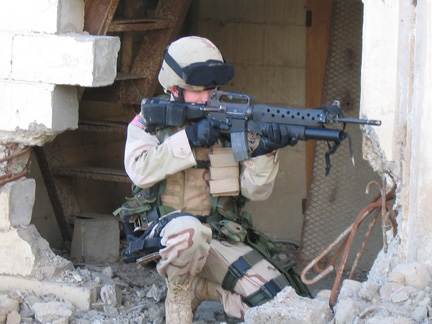
Guarding Abu Ghraib
One Soldier's difficult journey from Hofstra to Iraq
by: Colby Itkowitz
He
stands guard inside
In
his first two months living and working inside Abu Ghraib overseeing the
maximum-security detainees, he has witnessed an insurgent storm the gates to
attempt a suicide car bomb at his base, and on many occasions he has survived
fired rockets and mortar attacks. Some sound merely like a deafening
firecracker, but others—ones that have rocked him from a sound sleep—rattle
the entire building from the inside out.
But
even in such deadly situations, this former Hofstra student said he can not
afford to be afraid.
“It
has crossed my mind that one day I might be at the wrong place at the wrong
time,” Sgt. Patrick Venetek said. “But I don’t fear it. You can’t live
in fear.”
A
Venetek
had always supported the eventual overthrow of Saddam Hussein, but he wasn’t
convinced the war had served its purpose until he arrived in
“There
are still a lot of hostilities,” he said. “But we’re giving their people a
democracy, we’re giving them freedom. And they want it.”
On
Jan. 30, as the world paused to watch the outcome of
“I
don’t know about you,” Venetek said, “but if I watch someone die on
elections, I’ll wait four years till the next one [to vote]. Once I saw that,
I knew these people wanted freedom.”
NO
FREE RIDE
Venetek
always wanted to become a fighter pilot. Even as a baby, he would point at
passing airplanes overhead. Today, he finds himself staring longingly at the
stars, wishing he could be among them.
But
when Venetek joined the Army immediately after graduating high school, he really
just wanted a free ride through college.
Nine
weeks into basic training, the
“There
was a lot of fear from everyone that we would just go to war,” Venetek said.
“But we just continued training.”
Venetek
completed one semester at Hofstra in February 2002. One month into his fall
term, his unit, the 800th military police brigade, deployed to
But
the following spring, rather than return to Hofstra, Venetek stayed in
The
next weekend his unit received a warning: they were leaving for
RESTRAINTS
FOR BOTH SIDES
Venetek
waited three months after his father’s death before he felt ready to join his
unit overseas. He left a few weeks after Christmas and arrived in
He
keeps a photo of his family in his wallet; a reminder that his father would have
been proud of him.
He
now lives in an old prison cell—a neighbor to detainees suspected of
withholding intelligence or guilty of inciting riots. It’s a holding cell used
mainly for isolation.
“It’s
nothing you would want to live in, but it’s better than a tent,” Venetek
said. “At least I have a ceiling over my head.”
Venetek
acts essentially as a babysitter for the prisoners—not allowing them to speak
unless spoken to, and escorting them to use the bathroom and the recreational
area.
One
detainee from the Iraqi army spits and violently resists whenever Venetek moves
him. He’ll harass the Americans, taunting them with the Iraqi insult,
“donkey.” Venetek, who weighs
only 150 pounds, he calls “baby donkey.”
Due
to the high-profile nature of Abu Ghraib after the recent abuse scandals, a
strict shadow hangs over Venetek and his unit’s activities.
There are very specific rules of conduct when dealing with an unruly
detainee. They must not retaliate against rebellious prisoners, and the maximum
restraint allowed is a holding chair designed like a straight jacket, so the
detainee is incapable of moving. Venetek
said shooting is only allowed if an unruly detainee is threatening the life of a
fellow soldier or prisoner.
Sometimes,
Venetek said, soldiers are afraid to do their jobs, because the line between
what is authorized and what is criminal can be blurred.
FLIRTING
WITH DEATH
Venetek
maintains that he’s not afraid of dying in
“I’m
not scared for myself,” Venetek said. “I’m more scared of losing someone
here. Someone who has been a part of my life.”
Although
some bombs detonate less than a football field from Venetek’s base, he said he
is relatively safe at work. On his
days off, he’ll volunteer to travel with convoys throughout
There
is no way to prepare for a homemade bomb planted inside an innocent coffee cup
or roadside animal remains. There is always the chance of an unexpected ambush
or car bomb. In a terrorist war, nothing is absolute.
“In
full aspect I’m flirting with death,” Venetek said. “If it’s your time,
then it’s your time. There’s nothing you can do about it.”
Strapped
to every convoy vehicle is a sign in both English and Arabic stating that if
another motorist comes within 50 meters it will be shot. The army will shoot
three times on the ground then three times at the car’s hood and if the
motorist continues to approach Venetek said he can place three shots in the
driver’s head.
Venetek
wouldn’t comment on whether he’d been in any similar confrontations.
Despite
all the uncertainty and violence, Venetek chastised American media for only
reporting what he calls “the negatives of war.”
“When
you do something good everyone’s blind and when you screw up once, everyone
has 20/20 vision all of a sudden,” he said. “There are a lot of good things
happening here, but no one in the states really knows it.”
NO
REGRETS
Venetek
foresees a time in the near future when the people of
And
while he desperately misses
Venetek
has no regrets about
“I
think there has been enough death and destruction,” Venetek said. “I think
this war should end with
When
he left on his last two missions, Venetek had to break up with two girlfriends.
His friends constantly tell him life at home isn’t the same without him. He
misses flushing toilets and American cuisine.
But
if he could go back to high school, knowing what his future would hold, he would
still enlist.
“It’s
made me stronger and forced me into maturity,” he said. “Things I do, my
friends will never see in their entire lives.”
He
probably won’t return to Hofstra, but he will pursue flight school when he is
deactivated. He’ll eventually seek a college degree because it is an
accomplishment his father always dreamed for him.
“I don’t regret the things I’ve done,” Venetek said, “but those I did not do.”