Hip-Hop to a Higher Degree
Elements of hip-hop culture are popping up in lecture halls across the U.S.
by: Patia Braithwaite
Though
it is over 30 years old, it still remains cool. It moves effortlessly from
upscale
As
hip-hop celebrates its 30th birthday, it is beginning to infiltrate
yet another arena: academics.
Though
hip-hop is a subculture often associated solely with music, it is actually
rather diverse. In the mis ’70s graffiti, scratching, and break dancing were
wildly popular. However, as hip-hop music becomes more mainstream and other
elements become covert, many scholars are beginning to recognize that the
overlooked elements are worth some academic attention.
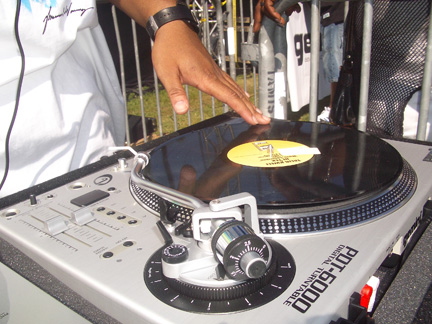
SCRATCHING
IN SCHOOL
Anyone
who has ever tried to DJ by defiling a record while it spun innocently on a
turntable knows that there is a science to scratching.
Kembrew McLeod, 34, a gangly professor at the
Hailed
a turntable historian in hip-hop circles, McLeod has written several books on
copyright infringement and intellectual property law. Because DJs take samples
from other songs to create new works, his expertise in law and turntablism are
somewhat intertwined.
“The
name turntablist sprung up in the late ’90s as a way of legitimizing what the
DJ does,” McLeod said. “The way
a keyboardist uses a keyboard, a turntablist uses a turntable.”
Still,
McLeod said many DJs reject the title of turntablist, preferring to distinguish
between two types of DJs.
“Club
DJs just mix songs together, but scratch DJs isolate small portions of a
sound,” McLeod said. “They turn a sound into something else, creating
something new.”
Just
as club DJs are essential to every Saturday night partygoer, scratch DJs are
essential to a rapper. Before the dawn of technology-driven producers, DJs would
cut, scratch and sample sounds from other songs to create a new melody. These
DJs were also essential because most rappers did not have the funds to tour with
live bands. At concerts the DJ would act as an orchestra, playing the
instrumental an MC rhymed over.
Although
“scratching” is a talent most do not possess, many still claim that melodies
in rap songs are unoriginal because they are derived from other songs. McLeod
vehemently disagrees. He cited many works in popular culture where artists have
“sampled” previous works, including entire passages in T.S Elliot’s,
“The Wastelands,” with themes borrowed from the
Bible and medieval folklore.
“Wood
Guthrie’s song, ‘This Land is your Land’ borrows its entire melody from
previous songs, more so than Puff Daddy ever did,” McLeod said. “To think
that because hip-hop is unoriginal because it uses preexisting sounds is a
simplistic way to look at art and culture in general.”
Berklee
College of Music in
“People
take it for granted today that jazz is serious music worthy of the same
disciplined study as classical music,” said Webber in a press release. “But
when Berklee began teaching jazz improvisation in the 1940s and rock guitar in
the 1960s, most other music schools perceived those musical forms as a threat to
‘serious’ music. It’s the same situation with hip-hop and turntablism
today.”
GRAFFITI
GRADUATES
Depending
on whom you ask, that vibrant splash of lines and colors gleaming on buildings
are more than some teenager’s act of public vandalism. Some say those colors
are works of art.
Graffiti
is an urban form of expression that emerged from
“Urban
Art Decal,” is part of a student-run department that allows students receive
credit in courses that interest them.
“I
wanted to introduce the art form to everyone and anyone possible,” said Michel
Krimper, a student facilitator of the
“Urban
Art Decal” is wildly popular course that draws in the interest of hundreds of
students each semester. Though it is primarily a practical course, Urban Art
Decal also explores the societal influences of graffiti.
Kimper and David Yaun (another student facilitator) discuss traditional
graffiti and its transition into popular culture. By creating that framework for
the students, they can begin teaching the practical side of graffiti.
“Urban
art right now is at a very critical point in time, where it is slowly being
enveloped by the marketing culture at large, making it a homogenized, boring,
unthreatening, yet aesthetically pleasing form of expression,” Krimper said.
“Because of this critical point in the subculture’s development, we figured
the only way to show the energy and genuine empowerment of the art form was to
practice it ourselves.”
Krimper,
a firm believer in freedom of interpretation, tries to incorporate guest
speakers into the course as well. He feels that the diversity of voice is
important to the art form.
“Everyone
comes in with their own perspectives and reasons,” he said. This is why we
encourage guest speakers who offer different perspectives, or the necessity for
our students to only look at our stories as one part of the story.”
Each
class begins with instructions on new forms and styles of graffiti. Though
Krimper describes the course as “laid back,” there is a midterm assignment
that is required. Students are split into groups and must work on an urban art
piece to submit. Krimper believes that by having the students work in groups, he
allows them to communicate and help one another.
In
addition to the midterm, the class meets on Sundays to paint. Although graffiti
is often attributed to vandalism, Krimper pointed out that Sunday painting
sessions “are at legal spots, of course.”
Krimper
said his “practical goals” are to help students understand that graffiti is
an art form worthy of analysis, and to create an environment where students will
truly come to love and “obsess over” urban art.
FROM
THE BRONX TO
Though
break dancing can be traced back to clubs like Studio 54, it truly gained
momentum on the streets of the
“We
want to give people understanding of b-boying,” said Michael Im, 21,
coordinator of the course. “For instance, we try to emphasize that b-boying
isn’t about doing gymnast moves and such, but dancing. Basically, [we teach
this class] to help build the b-boying/hip-hop community on campus.”
Im
and Kenneth Kong, 20, are the student facilitators of a
“Our
course is capped at 40 students, and we had over 80 students e-mail us showing
interest each semester,” Im said. “So, we ended up having to do
auditions.” But instead of turning additional students away, Im and Kong allow
interested students to take the course without credit.
The
auditions feature a short routine that consists of basic foot work. At the end
of the audition is a freestyle session so that Im and Kong can assess each
student’s comfort in front of a crowd.
“Almost
everyone that auditioned didn’t have prior experience; we just looked for
willingness to learn and effort,” Im said.
Though
most of the students lack breaking experience, this is not a casual dancing
course. It would be a mistake to think that this one-credit break dancing class
does not involve hard work and dedication. Most of the learning and
reinforcement comes from work done outside of the classroom.
“A
typical class would start of with warm-ups, a few new dance steps, a few new
footwork sets, and a freeze or two,” Im said. “Then we’ll also teach more
complicated sets that string together moves that we teach in class. We also try
to give mini-lectures on b-boy history and culture; we pass out handouts to the
students—the reading is somewhat required. Other than that, homework is to
just practice.”
Keeping
true to the competitive nature of break dancing, Kong and Im have devised a way
of injecting b-boy culture into the instruction. Historically break dancers ran
the town in groups called “crews.” When they would encounter a rival crew,
they would battle each other, often dancing atop pieces of cardboard in the
street.
“We
changed the format of the class this semester so that the class is broken into
four ‘crews,’” Im said. “So after teaching as a class, we break into our
respective crews to learn on a smaller/group format. It was our attempt to
communicate and get to know the students more. However, breaking is inherently
competitive and we do try to show that.”
Though
Im and Kong do not get paid to teach this course they are able to receive one
credit toward graduation. However,
Kong did not sign up to receive the credit.
“More than anything, it’s just our way to share what we like to do, and since we know there is a large audience for our class we try to get as many people involved as possible,” Im said. “Hopefully, the students will continue or come just practice with us after they finish the course.”