How
Sweet Is a BlackBerry?
Chris
Falcone
Paris Hilton has one. So
does Jay-Z. Every corporate bigwig carries one and even supplies them to their
employees. And of course, now every college student in
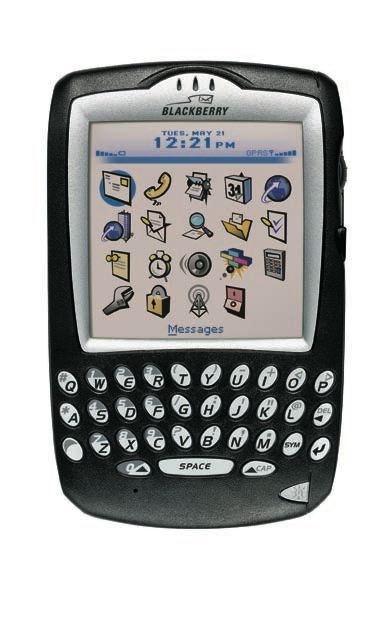
The BlackBerry is one of
the newest rages in American culture. Celebrity endorsed, new editions and
customized versions are popping up constantly. What most users don’t know is
that these miniscule memory filled machines can inflict physical harm, in the
form of a syndrome dubbed the “BlackBerry Thumb.”
On January 25, The American
Society of Hand Therapists (ASHT) issued a national alert warning users of
handheld electronic about the possibility of getting Carpal Tunnel Syndrome and
other ailments from heavy usage of these devices. According to Stacey Doyon,
vice president of ASHT, there haven’t been many serious cases yet since the
devices in question are relatively new. But she is aware they’re being used
more frequently in colleges and universities throughout the country. And in
time, Doyon believes this will lead to a significant problem.
“We initially began
researching this growing problem about a year ago,” she said. “Before that
we had a similar problem with text messaging and prior to that it was the
keyboard.”
“Just as the keyboard and
the computer led to a lot of concern about repetitive stress of typing, this is
the next wave of concern, with the use of the thumb on a handheld device,”
said Keith Raskin, M.D. from the Department of Orthopedic Surgery at the New
York University Medical Center, in a CNN.com article.
The problem with the
BlackBerry, Sidekick and similar devices is the tendency to try and multitask.
By holding the BlackBerry in one hand and using the other hand for something
else there is a tendency to put all the pressure on the thumbs. Doyon says
it’s important to use all fingers to hold the device. What differentiates
these devices from others such as the iPod is the regularity with which they are
used.
“With the BlackBerry you
are continually putting information into it,” Doyon said. “You are repeating
the same steps over and over again.”
Research In Motion, the
Canadian manufacturer of the BlackBerry, projects that by the end of the year
over three million will be sold.
Mark Jeshiva,
“It just doesn’t feel
like a natural motion, most of the time you’re only using your thumbs,” said
Jeshiva, now a senior business analyst for the global banking division for
Citigroup. “Look at it like this, if you type all day at work on a computer
and than the rest of the night on your BlackBerry you’re going from one act to
another. That can’t be good.”
Be that as it may, Doyon
does not feel that it’s something that can be pinned on the manufacturers of
these products. Rather, it’s more a matter of personal responsibility. She
references her own PDA, equipped with rubber siding. The importance of the
rubber siding is that it helps alleviate some of the added pressure on your
grip. This pressure is normally felt more by users with metal siding.
“Really the manufacturers
are just responding to the demands of society,” she said. “To prevent this
problem we need to take responsibility ourselves.”
Doyon said one of her own
patients even used his BlackBerry throughout their whole session one time.
“He didn’t put it down
the whole time,” she said.
According to an article in The
Washington Post workplace injuries have risen in white-collar jobs with the
increased use of mobile communications technology. A study done by the Bureau of
Labor Statistics showed that ergonomic disorders are the fastest growing
category of work related injuries of the reports it has seen. In 1981, 18
percent of all illnesses reported were repetitive strain injuries, known as RSI.
By 1992, the figure had skyrocketed to 52 percent.
Jeshiva knows first hand
about the pain associated with Carpal Tunnel Syndrome. His mother, Maria,
suffered from it and eventually had surgery to alleviate the pain. After working
as a manicurist for over 35 years, she began experiencing unbearable pain in
both of her hands. After her operation she was forced to decrease her workload
and now wears braces at night. She still on occasion feels pain but that is
something that some patients with this syndrome must learn to live with.
Doyon notes this isn’t a
huge problem yet, but with people constantly on these devices throughout the day
it can become one.
“Just like any other kind
of activity that you do,” she said. “Your muscles need a break.”