|
President Bush’s First 100 Days:
A Look at How the Special Interests Have Fared
Health Care
The night before a bipartisan group of legislators was planning to re-introduce
the Patients’ Bill of Rights in Congress in February, Rep. Charlie
Norwood (R-Ga.) was invited to the White House. Norwood, a principal sponsor
of the bill, had been pushing for HMO reform for four years. But after
meeting with President Bush’s senior aide, Karl Rove, Norwood suddenly
reversed course. He withdrew his support for the bipartisan proposal and
didn’t show up the next morning at the press conference with Sens.
Ted Kennedy (D-Mass.) and John McCain (R-Ariz.) to introduce the bill.
It was a small victory for the president, who announced his own plan to
protect patients’ rights a few days later. The McCain-Kennedy proposal
would give patients the right to sue their HMOs for up to $5 million in
damages—a provision the HMO industry has vigorously lobbied against.
In contrast, the president’s plan would cap damage awards at $750,000.
Bush was a top recipient of campaign contributions from the HMO industry
during the 2000 elections, receiving more than $60,000 in individual and
PAC donations.
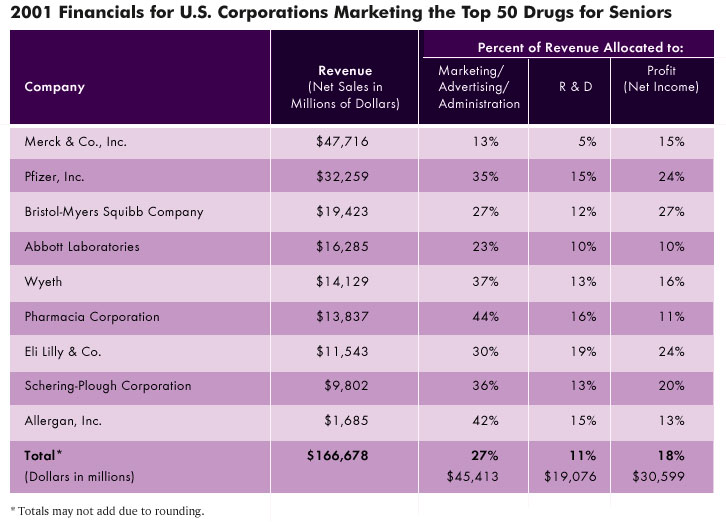
The president was also a top recipient of donations from the pharmaceutical
industry (nearly half a million dollars in 1999-2000), which has been
lobbying against expanding Medicare to include a prescription drug benefit.
The pharmaceutical industry is afraid that any government-sponsored drug
benefit will automatically require price controls, cutting into the industry’s
profits. Bush has proposed $153 billion over the next ten years to address
the problem of rising prescription drug costs, a move critics call a "stop
gap" measure that falls far short of the $1.5 trillion the Congressional
Budget Office estimated would be necessary to address the problem. The
Senate responded by doubling Bush’s proposed spending plan to $300
billion.
Source: Center
for Responsive Politics |
Do Uninsured People Work?
Myth: Most people who lack
health insurance don’t work
Fact: More than 80 percent
of uninsured children and adults under age 65 live in working families.
Most people who lack health coverage work for businesses that do not offer
health benefits, or the benefits they do offer are too expensive for employees
with modest incomes to afford. One in five uninsured work for an employer
or are dependents of someone who works for an employer who offers coverage,
but these employees and their families can’t afford the cost of
their employer-based health insurance.
Source: CoverTheUninsured.Org
Have you ever looked into the eyes of a child after telling his
desperately ill mother that you couldn’t help her?
I have.
It was the most horrible experience of my life. And it’s made me
feel that I am part of a health care system that is so fundamentally flawed
and unfair that we as Americans should be ashamed.
We should be ashamed that, in a country of unmatched wealth and prosperity,
we simply allow people to suffer and die if they don’t have the
money to pay for our vast array of medical technologies and services.
We should be ashamed that, with everything we have to offer, people who
work hard to support their families frequently find that there is nothing
for them when they are sick. Why? Because they can’t afford health
insurance.
That is why my patient, a 36-year-old mother of five whose husband earns
about $30,000 a year, may not live to see 37.
Continued...
People die from illness every day in this country. They
fight the good fight, they get the best treatment available, their doctors
do everything they can for them – but in the end the disease wins.
My patient was sick too. But he died unnecessarily because he didn’t
have health insurance.
Our health care system, which pulls out all the stops for people who have
insurance and can pay to be treated, failed him. It did too little, too
late.
As medical director for a center city clinic, I’m part of that system.
The lack of health insurance presents a barrier to good care every day
in my clinic. That’s a fact I find difficult to live with. Continued...
|