The first factory-assembled pickup debuted in 1925 and sold for $281. Henry Ford billed it as the "Ford Model T Runabout with Pickup Body." The 34,000 built that first year featured a cargo box, adjustable tailgate, four stake pockets and heavy-duty rear springs.
In 1928, the Model A replaced Model T - becoming the first closed-cab pickup and sporting innovations like a safety glass windshield, roll-up side windows and three-speed transmission. It was powered by a four-cylinder, L-head engine capable of 40 horsepower.
In 1932, the 65-horsepower Ford flathead V8 engine was offered as an option in the truck. By 1936, Ford had already produced 3 million trucks and led the industry in sales.
F-Series - the beginning�
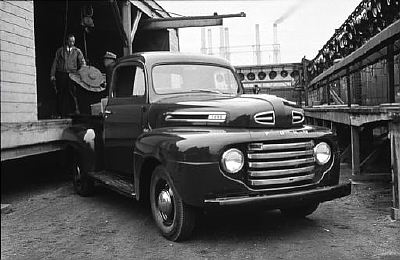
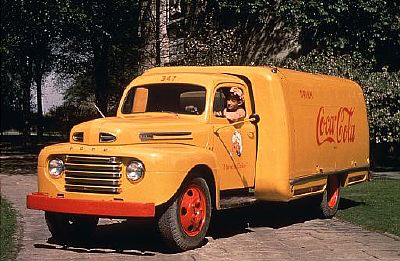
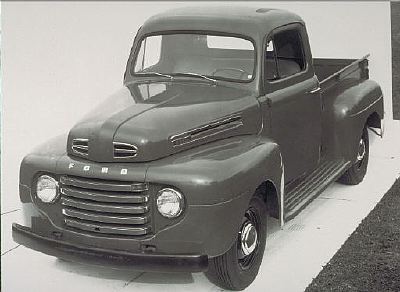 In 1948, the famous F-Series truck was unveiled. Advertised as "Bonus-Built," the F-1 marked Ford's first all-new, post-World War II line of commercial vehicles that ranged from the half-ton F-1 to the three-ton F-8.
With a one-piece windshield and side vent windows, the redesigned cab's front end featured a recessed grille and headlamps along with squared fenders. The spare tire, moved from the side, was now mounted under the load floor as it is today. A new six-cylinder engine, the Rouge 226, boasted 95 horsepower. The redesigned 100 horsepower Rouge 239 V-8 was also available.
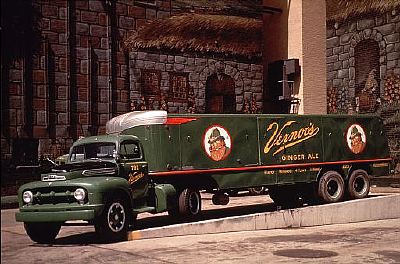
The 1950s marked a movement to make trucks more car-like in comfort and styling. 1951 featured a redesigned front end, a larger rear window and a new instrument panel. The new "Cost-Clipper" 6-cylinder engine debuted in 1952.
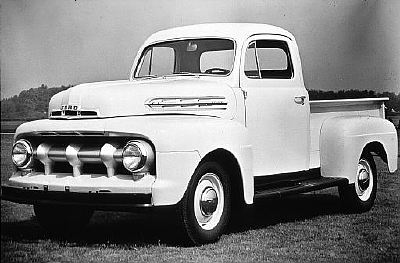
In 1953, Ford offered a truck line-up featuring the most significant changes in design and product content in 20 years.
- The front overhang and wheelbase were redesigned for improved weight distribution and better turning radius.
- Its "Driverized" cab featured a larger, curved windshield and new instrument panel, new grille, shorter fenders and a hood that sloped downward.
- F-Series' numbering system also changed from single digits to hundreds, a tradition that continues to this day. The F-1 became the F-100, the F-2 and the F-3 merged to become the F-250 and so on.
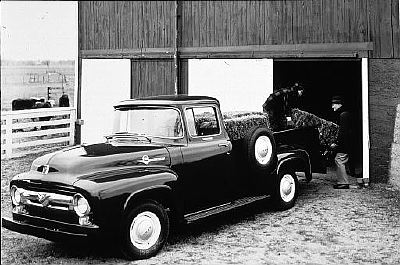
In 1957, a new design featuring a slab-sided, all-steel pickup body was introduced as the F-100 Styleside. The fendered pickup box, now called the Flareside continued to be offered.
Design Innovations
Characteristics of the 1958 models included a dual (twin 2-unit) headlamps and a mesh-patterned grille. Its V-8 engine boasted more horsepower, rising from 167 to 186 in 1956.
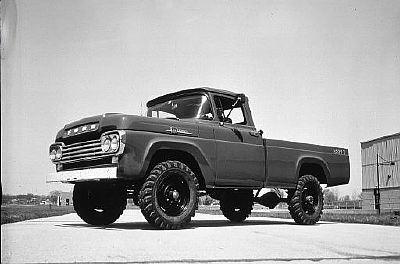
In 1959, Ford introduced the first factory-built F-100 and F-250 four-wheel drives. Buyers could choose from three- or four-speed manual transmissions.
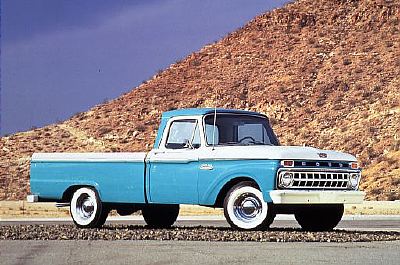
Major changes came in 1961 including longer wheelbases, shorter front overhangs and lower heights. Front-end styling was highlighted by a conventionally curved windshield, more shallow hood and single headlamps
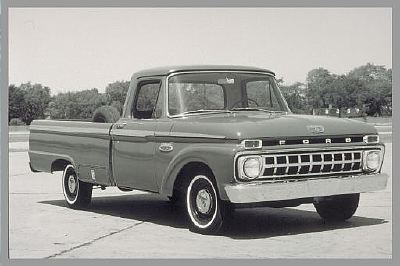
By the mid-1960s, increasing numbers of pickup owners - nearly two-thirds - were using their trucks for recreational and personal pursuits as well as commercial uses. Ford introduced Camper Specials in 1965, an industry first, and buyers could special-order a crew cab pickup to carry extra passengers.
Ford of Canada's Ontario Truck Plant began F-Series production in 1965 Ford Motor Company of Canada began producing F-Series trucks on August 26, 1965 in a 1.24 million square foot plant on 45 acres in Oakville, Ontario. Over the years, the plant underwent several expansions - the latest of which occurred in 1996, bringing production floor space to 3.01 million square feet on 94 acres of land.
The current plant now includes state-of-the-art body and paint facilities within a facility whose total assembly line is 16.7 kilometres long. The line makes use of more than 220 robots, computer controlled conveyors, sophisticated data gathering equipment and the latest generation of control systems for welding and paint applications. The Ontario Truck Plant has attained both ISO 9001 and 14001 certification an international measure of production quality and environmental excellence respectively.
Twin I-Beam suspension topped the advancements of 1965. The suspension provided the truck with a good ride and was a major factor behind the tremendous success of F-Series.
Full-size pickup truck sales in 1970 reached 1.2 million, with F-Series commanding a 41.9 percent share of the segment.
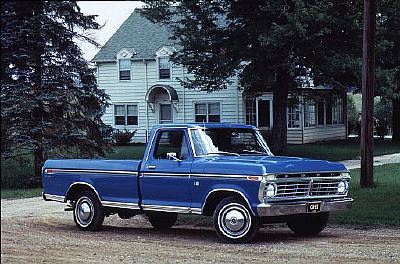
The next generation of Ford light trucks - with two-inch longer wheelbase to accept longer cabs - arrived in 1973. New doors, floor pans, roofs, outside skin and instrument panels were featured. That year, the F-Series was the country's third-best-selling vehicle - car or truck - behind Chevrolet and Ford full-size cars.
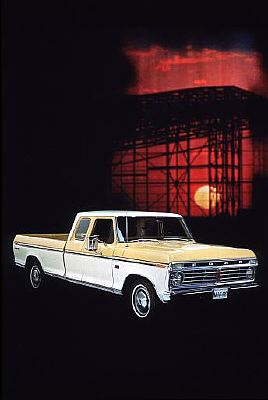
Ford introduced SuperCab in June 1974, adding 44 cubic feet behind the driver's seat with either a bench seat or two jump seats for extra passengers.
F-150 Introduced
The F-150 debuted in 1975. At 6,050 pounds, the 4x2 F-150 weighed 50 pounds more than the F-100. Available in Regular Cab and SuperCab variations, the F-150 comprised more than one-third of the 663,000 F-Series sales in 1975. In 1978, F-Series sales topped 864,000 trucks.
In 1980, Ford launched the most extensive redesign in the history of the line. To meet the demands of a growing population of personal- and recreational-use truck owners, interiors were more finished and offered more car-like features. Cabs featured swept-back front ends with improved aerodynamics and 4x4s featured a twin traction beam independent front suspension with coil springs.
The F-100 designation was dropped in 1984; its role merged with the F-150 to simplify choices for customers. The front end was restyled in 1987 and again in 1992. A new F-150 4x4 SuperCab with a 139-inch wheelbase made its debut in 1988. A driver's side air bag became standard in 1994.
In 1997, the under-8,500-pound GVW F-Series was completely redesigned with a new platform, new engines, new aerodynamic styling and an industry first: the standard three-door SuperCab. In 1999, a standard fourth door was added to the SuperCab model.
Super Duty and the dual platform strategy
The Super Duty F-Series line-up revolutionized the heavy-duty pickup market when introduced in 1998 as a 1999 model. Customers gravitate to Ford's Super Duty F-250 and F-350 pickups for their toughness, dependability and versatility. They serve the varying needs of commercial users, small business owners who often combine personal and work usage in one vehicle, and heavy-duty recreational buyers.
In 2000, the under-8,500-pound GVW F-250 designation was dropped to further simplify customer choices. A special F-150 Heavy Payload Package was added to meet these customers' needs.
In February 2000, the 2001 F-150 SuperCrew - the only full-size pickup in its class to offer a full rear seat and front-hinged rear doors for optimum rear-passenger comfort - once more raised the bar in the under-8,500-pound GVW pickup market. With a 5.5-foot pickup box, extending to seven feet with the optional Bed Extender, SuperCrew adds passenger-carrying capability while maintaining traditional pickup durability and versatility and the exceptional F-150 ride and handling characteristics.