The Pug Dog Ancestry
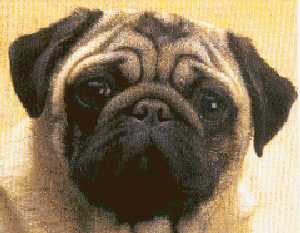 Here's some brief history on about where the pug dog came from:
Pugs have been around longer than you think. There have been reports
of pugs in China as far back as 1000 BC!
By 1600 "pug" had acquired two other meanings;
Courtesan and Bargeman. But 1664 "pug" also meant: Demon, Imp, Sprite, Monkey, and Ape.
In Oxford English Dictionary "pug" had come to mean, "a dwarf breed of dog
resembling a bull-dog in miniature." Now, according to the Webster's Dictionary "pug" now means:
a small sturdy compact dog of a breed of Asian origin with a close coat, tightly curled tail, and broad wrinkled face.
There's your daily dictionary lesson.
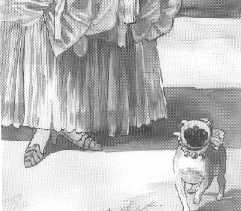
Painting of a pug in the 1600's.
It wasn't until the latter portion of the 1500s and
early 1600s that China began trading with European countries such
as Spain, Portugal, England and Holland. Small dogs presented as gifts returned from the
Orient with the traders, and thus began the rise of the Pug in popularity in Europe.
The Pugs popularity spread throughout Europe,
with the breed known in France
as the Carlin, in Spain as the Dogullo, Mops in Germany and
the Caganlino in Italy.
Before pugs were favorites in America, they were loved in Europe. Rumor
has it that the pugs were favored by Dutch women whom, in there large unheated houses, placed
a pug or two on their laps to keep warm. Pugs were soon favored in France and England in the
later part of the 17th century. The first pug came to America after the Civil War
and was accepted by the American Kennel Club in 1885.
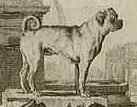
Painting by Goya in Spain, 1785.