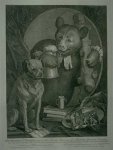

A story published in 1618, in Sir Roger William's "Action in Low Countries", tells of an incident involving a beloved Pug belonging to William the Silent of Holland's House of Orange. It is believed the incident occurred sometime between 1571 and 1573, during a time of war between the Dutch and the Spaniards. the occasion was a surprise Spanish attack on the Dutch camp. The Pug, whose name is believed to be Pompey, awakened his master, before any of his men realized the Spaniards were attacking, by scratching, crying and leaping on Prince William the Silent's face. The Prince avoided capture and the Pug was revered throught the kingdom. This proud little dog became the symbol of Holland's House of Orange.
One hundred years after Prince William the Silent's adventure, his great-grandson, William III and Mary II, ascended the throne of Great Britain (1688). They brought with them the family pets, the symbols of the House of Orange, the beloved Pugs. Each with an orange ribbon tied about it's neck.
In time the Pug Dog became known throughout Europe. Of course, not everyone called it a Pug. Some of the other names it was known by were:
Ha Ba Gou (Old Chinese)
Mops Hond (Dutch)
Mops (Swedish)
Mopsi (Finnish)
Mops Hund (German)
Carlin, Doguin (Old French)
Carlino (Italian)
Doguillo (Spanish)
Dutch Mastiff (English)
Smutmhadra (Irish Gaelic) literally means "stumpy dog"
Moving to the first half of the nineteenth century two strains appear to move dominated the Pug genetic lines. The earliest bloodline was the Morrison. This strain is said to be founded on the blood of royal dogs, presumably those of Queen Charlotte, wife of George III.
The other prominent strain was that of Lord and Lady Willoughby d'Eresby. They imported dogs from either Russia or Hungary, and they were employed to bring about the badly needed improvement in type. The dogs bred by Mr. Morrisonand the Willoghby d'Eresy were of greatest importance from years 1840 onwards. Today it is still common to speak of a Willoghby Pug, a cold fawn color, or a Morrison Pug, a golden apricot shade.
Pugs first came to America shortly after the American Civil War. By 1885 Pugs were being shown throughout the country. By the turn of the century Pugs slowly became less popular as other imported breeds became known and were being seen. The American Kennel club Stud Books show that for the years 1900 through 1920, only a handlful of breeders were registering their Pugs, and some shows had no Pug entries at all.
It was in 1931 that a group of East Coast breeders and exhibitors decded to form a Pug Dog Club of America and on December 1, 1931 the club was formally recognized the the American Kennel Club.


Description:
The Pug has been referred to as "Multo in Parvo" meaning "a lot of dog in a small space." This breed is an even-tempered breed who is playful, outgoing, dignified and possesses great charm.
In terms of appearance, symmetry and general appearance are decidedly square and cobby. A lean, leggy Pug and a dog with short legs and a long body are equally objectionable.
Height:
10-12 inches
Weight:
13-18 lbs
Colors:
The colors are silver, appricot-fawn or black. The silver or apricot-fawn colors should be decided so as to make the contrast complete between the color and the trace and the mask.
Note: There are other colors such as white and brindle, but these are not recognized as acceptable colors by the AKC.
Coat:
The coat is fine, smooth, soft, short and glossy, neither hard nor woolly.
Temperament:
This is an even-tempered breed, exhibiting stability, playfulness, great charm, dignity and an outgoing, loving disposition.
Care and Excersize:
The Pug may require more frequent walking or other exercize than other toy dog breeds. Despite their short hair, Pugs need brushing at least twice a week due to shedding.
Note: PUGS SHED...ALOT!!! If you are looking for a dog that does not shed, then this is NOT the dog for you.
Health Issues:
Skin Problems
Category:
Toy
Registries:
AKC, ANKC, CKC, UKC
Living Environment:
Small enough for apartment living, but still needs frequent exercize.
Note: Pugs are NOT meant to live outside. They can not handle heat or extreme cold/weather conditions. Please also note we will only sell our pugs to people who will be keeping them indoors.


Facial folds:
Those adorable wrinkles and crinkles on a Pugs face are called folds, and in between those folds accumulates a whole hodgepodge of stuff. This stuff gets in there because Pugs spend a lot of time with their faces mashed against the carpet, the ground and of course their food bowls. Add to all this a mix of dried tears and mucous and you've got yourself some stuff in those folds. Your job is to clean those folds out to make sure they don't develop any infections or fungus there. Since all that stuff makes a Pug smell a bit boggy, you'll also be keeping your Pug smelling nice in the process.
Cleaning a Pugs facial folds is pretty easy, as long as he/she cooperates. Start this routine immediately, and your Pug should be cooperative, if not happy about your touching his folds. The only tools you need for this is a Q-tip, a cup of warm water and some Vaseline. Dip the Q-tip in warm water and gently run it in the folds above the nose, and below the eyes. After you've gotten the stuff out, apply a thin layer of Vaseline inside the fold above the nose and presto, you're done. Nothing to it. You can do this once a week, or sooner if your Pug starts to smell.
Nail Clipping:
Newsflash! Pugs nails grow extremely fast. You've got a couple of choices here. You can start learning how to do this yourself from week one, or you can take your Pug someplace to have it done. Vets and groomers will do this for you for a small fee, which is good, but if you're not squeamish, and your Pug is amendable, why not do it yourself?
If you're going to do it yourself, one of the best times to do this is when your Pug is in deep sleep on your lap at night. Puggie may wake up, but he/she won't be motivated enough to put up a struggle. Keep stypic powder in case you cut too far and clip the vein and a Q-tip to apply it. to avoid cutting too far, simply cut the curved part of the nail only and make sure the clipper of the nails is someone in yoru house who has a steady hand.
Clip those nails every 2 weeks, and for yoru dogs comfort and health, be vigilant about this. Nails that grow too long can cause discomfort from your Pug not standing high enough on his paws, and eventually cause bleeding and breakdown of the pasterns which will cause long term discomfort when walking.
Note: You can also file the nail down or take your dog for a 20 minute walk on concrete every day to keep the nails short.
Ear Cleaning:
To do this simple task, get some cotton balls and some hydrogen peroxide. Dip the cotton ball in the hydrogen peroxide and gently clean only the areas of the ear that you can see. Don't dig deeply in there or push the cotton ball into yoru Pugs ear. How often should you do this? Check your Pugs ears for dirt, and clean them as needed. Some Pugs require little cleaning, other neet it more frequently.
Teeth Cleaning:
Taking care of a dogs teeth is one of the most overlooked aspects of dog care. Milk Bones are all well and good for minimal maintenance, but it's a very good idea to clean your dog's teeth fromt ime to time. It's also very easy. Go to yoru local pet store, pick yourself up a toothbrush and soem flavored toothpaste and do some brushing. If you get yoru pug used to this, he/she will welcome the tasty toothpaste and make it easy for you. If you can'tdo it yoru vetwill probably be willing to do it for you, provided you and your Pug are nice to him/her.
Coat Care:
You should brush your Pug at least 2 times a week to keep him looking well kept. Many people brush their Pug every day because it helps rduce the amount of fur in the house, which you'll find everywhere. Even your friends will find your Pugs hair in their house.
All you need here is a brush with stainless steel bristles and a flea comb during flea season. Most Pugs enjoy being brushed so this really doesn't present the difficulties that nail clipping and fold cleaning sometimes does. At any rate, all you really need to do is to brush in the direction the fur grows without pressing down on the brush. Be gentle and use smooth strokes and you'll have yourself one Pug in seventh heaven.
Note: A curry comb works wonders to remove loose hairs as well.
If you're going to use a table to put your Pug on for brushing, make sure you use one hand to keep your Pug in place.
Now that's not too much work in return for having a wonderful little Pug is it?