
Game Schedule
Events
Members
Photos
Myths & Commentary
Contact Us
Fact: Role-playing is only dangerous when taken to an extreme. Anyone who follows the basic rules that are set down in the role-playing guides and who use a bit of common sense will be fine when role-playing.
Myth: Those who role-play don't have a grip on reality.
Fact: The vast majority of gamers are people who enjoy the creative outlet. Role-playing - like creative writing, drawing, singing, or theatre acting - is a hobby that allows a person to leave behind their day-to-day stress for a little while. The tiny number of role-players who don't have a grip on reality are individuals who lacked that grip on reality to start with, and then chose to start role-playing.
Myth: Role-playing makes a person violent.
Fact: Role-playing is a positive and non-violent outlet for stress through creativity. Table-top role-playing games (the type played at PUGG) involve a group of people sitting around a table and telling a story in which they speak as their characters.
Myth: Only losers role-play.
Fact: Many different kinds of people role-play: including students, university professors, and business people. Gaming is for anyone who enjoys it, and its something that people do in their spare time (perhaps with the exception of those who work for gaming companies, and even they have a life outside of role-playing).
(a commentary on role-playing by Jade)
Many misconceptions about gamers exist. What many people don't realize is, most gamers are just regular people who happen to enjoy role-playing in their spare time. They get up in the morning and go to work and school, and a couple of nights a week they sit down with some friends, a few books, and a lot of Mountain Dew (or Dr. Pepper, or Pepsi, or even coffee).
Gaming isn't a cult. In fact, there is no connection between gaming and religion. The stories are made up, not based on real life at all. They don't encourage people to believe - or not believe - in any specific (or nonspecific, for that matter) religious ideas. Some of the games deal with "magic" - some games deal with mages, sorcerers, or spellcasting - but it's all fiction. The books are very specific in stating that all of these things are just part of the story, not things to be carried over to real life.
Gaming isn't violent, either. It's a great way to relax and get your mind off all the things at work and/or school that are stressing you out. You get to become a character for awhile, but when you're done you just go back to your regular life.
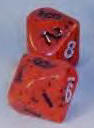
In table-top role-playing, the gamers sit at a table and tell a story that is lead by the Dungeon Master (in D&D - some games refer to the game leader as a Game Master or Storyteller). They through the storyline as their characters, and roll dice (of many different number of sides - anything from four sides to twenty, or sometimes more) as a decision-maker for success at having a character do somthing difficult (spellcasting, sword-fighting, etc.) or to see who's character gets to act first. There are no foam swords or people running around in costumes.
With serious role-players, the biggest complaint one can make against them is that they might occasionally get a bit loud or drink and unhealthy amount of soda or coffee. If you walk into a room full of gamers for the first time, you might hear some unfamiliar terminology (orc, Changeling, Camarilla, cobalt), but that's not a bad thing. It's no more dangerous than computer lingo, it's just that it's only familiar to people who choose to learn it.
I'm not saying that 100 percent of gamers are normal, average people. There are some dangerous and mentally unstable people in the world, and some of them happen to try role-playing. But gaming isn't dangerous, and the people who "freak out" and take it too far are the people who would do that with whatever it was they got involved with. It even states in the White Wolf (Mage: The Ascension, Vampire: The Masquerade, etc.) books that if you can't separate gaming from reality, you need to put the book down and seek professional help.
So, next time you hear someone say they're a gamer, maybe you'll have a better idea what they mean. Just don't ask them about their dice collection unless you have about 15 minutes to spare to listen to them talk about it.