| Goalie Tips |
| NOTE : I am not a professional nor a certified coach. Please take these tips as suggestions. |
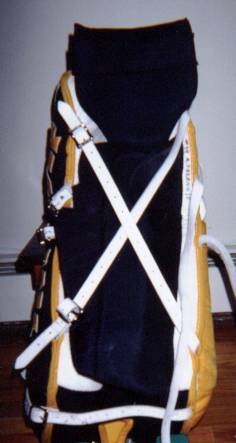
| Breaking In New Goal Pads : To break in the knee rolls of your new pads, try taking the top strap and buckling it to the bottom buckle on the same pad (not the buckle of the strap that goes under the heel of your skate) at about the 6th or 7th hole on the strap.On the same pad, take the bottom strap and buckle it to the top buckle ( this time only to the 3rd hole). The straps should cross and make an "X". This will give you a nice butterfly break in. |
| Playing Breakaways : On a breakaway, I like to come out as far as mid faceoff circle and back in fast to get momentum. If the shooter takes a shot at center net, butterfly. If the shooter goes for a post, get as close as you can to the shooter and either poke check or two pad stack. The closer you are, the lesser the chance of the shooter lifting the puck over you. |
| Playing Screens : When faced with a screen, it is a first priority to never loose sight of the puck. To do this you must extend the inverted "v" stance. Spread your skates further apart than your normal stance, and keep looking around players to keep your eyes on the puck. Once you see (or hear) the shot has been released, go down in the butterfly. With the exaggerated inverted "v" stance, you can drop down into the butterfly much faster. It is also very important to be aggressive in order to be successful at blocking screen shots. Don't stay on the goal line, come out ! Get right behind the players or if you are confident enough in your defensemen, get in front of the players sereening you. |
| Off Ice Training : Here is a simple tip to keep up with your catcher / eye coordination. Get a racquetball ( not a tennis ball or a lacrosse ball ) and stand in your stance facing a wall approx.10 feet away. Throw the ball at the wall approx.18 inches off the ground. The ball will bounce off the wall, and off the ground simulating the angle of a lifted shot. Do about 25 repititions at first and as you get better, increase the number. |
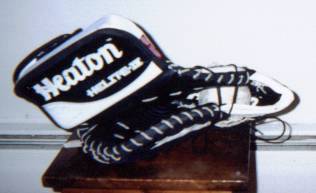
| Breaking In A New Catcher : To break in the stiff pocket of a new carcher, try putting a softball in the pocket and use an extra skate lace to tie the glove closed. Then, just toss it in your bag until the next practice! This is a great way to break in a glove without straining those forearm muscles. Another hint to break in the catcher is to roll the glove along the ice to create a nice "curve" at the finger tip area of the glove. This will ensure your new glove closes tightly so there are no escaping pucks. |
 |
 |
| When To Use The Two-Pad Stack : The two-pad stack is a great tool to have as an option, however I suggest you do not use it too often or it will become predictable and leave you vulnerable. I use the two-pad stack on 2 on 1's, such that I follow the puck carrier and if he/she passes laterally, the sliding aspect of the move allows you to quickly cover most of the far side of the net. I also use this move occationally on breakaways. However, you've got to be careful by waiting until the puckcarrier is close to the net. Failure to do so can result in the shooter geting his/her own rebound and shoot the puck right around you. I have read that the two-pad stack can also be used on other plays tight to the net, such as deflections and rebounds. I personally would not recommend this for the same complication that is possible with the breakaways : a rebound in the back of the net because of being out of position. |
| How To Play Angle Shots : When the puckhandler is coming down on a wing, I first come out to the top of my crease and get square to the puck. Next, I'll look around for other attackers by taking a quick glance to the far side of my net. This is important should you read that the puckhandler is going to pass, you will already be a step ahead by knowing where he or she will pass to. The next thing I do is see how much, if any, defense support I have. If my defense is playing correct position and pressuring the opposing players, I will expect a shot wide of the net. However, if I do not have adequite support, I'll play more aggressive by coming out further and expect a straight on shot or a lateral pass. |
 |
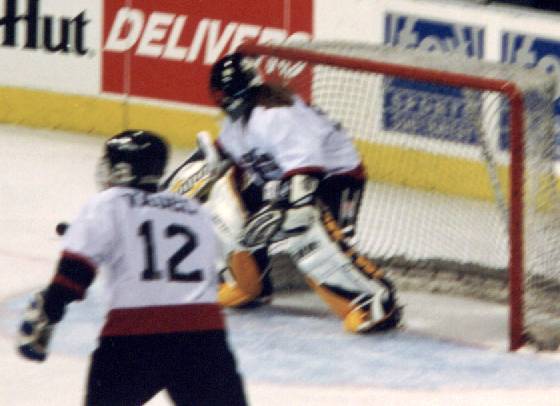
| Playing Wraparounds : When I anticipate an attacker on the wing is going to wraparound, I first make sure that I'm square to the shooter and against the post. I make sure that there are no holes between my equipment and the post. As the attacker moves behind the net, I'll stay in this position. I only turn my head to keep the attacker in sight. It is important not to get caught in the middle of the net looking back and forth. This is very predictable to forwards and most likely they will score on you. It's much easier for the goalie to stay on the near post and move to the far post once the attacker's decision to wraparound has been read. When the wraparound is to my glove side, I use the paddle down technique. Be sure to keep your skate on the glove side up against the post! When the wraparound is to my blocker side, I prefer the sweep check to the paddle down. Whichever method you choose, it is important to keep the knee on the blocker side up against the post while down. Also, be sure to keep your trailing leg pad flared in case the attacker decides to come out more and take a shot at the far side. |
 |
 |