| |
|
|
| |
|
Sri Lanka related
links
An
Overview of Sri Lanka by Ari Withanage
Sri
Lanka library
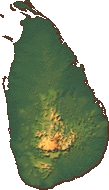
Situation and size
The island of Sri Lanka, the "pearl
of the tropics," has a surface area of about 66'000 km2. It is situated
slightly north of equator off the southeast tip of the Indian subcontinent and
separated from South-India by a very narrow waterway, known as the Palk Strait.
The distance from north to south is 435 km and from west to east at the widest
point 225 km. |
Climate and
traveling season
As Sri Lanka is situated between six and ten degrees north of the equator,
the average temperature is quite high. The average medium temperature fluctuates
between 27° and 29° Celsius. As the island is not very wide, the sea-winds
can exert a moderating influence. The central mountain region has naturally
lower temperatures. The mercury drops 0.5° Celsius for every 100 m . The
mountain resort town of Nuwara Eliya situated at about 2000 m experiences frost
on some nights in December and January and the annual average temperature is below 20° C. In general the relative humidity fluctuates in between 70%
during the day and 90% at night.
The monsoon-winds bring the most showers to Sri Lanka, and there are four rainy
periods, Southwest monsoon showers from May until September, inter-monsoon rains in
October and November, northeast monsoon showers from December until February,
and again inter-monsoon rains in March and April. The best traveling season
for a beach holiday on the southwest coast is from November until April and
for a beach holidays on the east coast is from March until September.
Population/ religions
Sri Lanka has a population of approximately 17 millions, a yearly growth rate
of 1.3% and a population-density of 275 persons per km2. The life expectancy
is for men 67 years and for women 72 years. The population consists of the following
ethnic groups: Singhalese 74%, Tamils of 18%, Moors of 7% and others 1%. From
the religious point of view the population consists of 69% Buddhists (Singhalese),
15% Hindu (Tamils), 8% Muslims (Moors), 7% Christians and 1% others.
Language/ Communication
The two official languages are Singhalese and Tamil, however English is spoken
almost everywhere; even in the most remote areas someone always speaks English.
Economy
When attaining independence (in 1948) Ceylon was purely depend on agriculture
country. Only during the last decade has industrial development grown at an
accelerated pace. The majority of foreign exchange income results from textile
exports, export of agricultural products (tea, copra, rubber), the revenue from
tourism and the exports of jewellery and gems.
Government and administration
At independence Ceylon followed the British system of government and the head
of the government was the prime minister. With the reform of the constitution
in1978 a presidential system was adopted and as in France and the USA all executive
powers were invested in the president who chooses his cabinet of ministers.
The country is divided into provinces, which until a few years ago were centrally
governed. With the introduction of a federal system the provinces have their
own assemblies and government. Presidential elections take place every seven
years by the whole electorate All citizen over 18 years of age have the right
to vote. Sri Lanka's official name is: Democratic Socialist Republic of Sri
Lanka. The capital and seat of the central government and parliament is no longer
Colombo but Sri Jayawardenapura, earlier called Kotte, a small town at the outskirts
of the former capital city Colombo.
Currency
The Sri Lanka Rupee (SLRs) is devided into 100 cents. Coins are minted into domination
of 5, 10, 25 and 50 cents and 1, 2 and 5 rupees. There are notes of 10, 20, 50,
100, 500 and 1000 rupees. 100 rupees = about US $ of 1.65. Todays
Exchange
Rates.
Holidays
There might be no other country in the world with so many holidays as in Sri
Lanka. In addition to all the Sundays all important Christian, Muslims and Hindu
festivals and all Buddhist and national festivals are celebrated. Every full
moon day, called Poya, is a Buddhist holiday . On a Poya day all places of entertainment
as well as all the wine stores remain closed. The sale of alcohol is prohibited!
Including Sundays. Sri Lanka has about 72 holidays per year.
Dining Out
The local eating habits are dominated by curries, which, beside international
dishes, are, in a milder form, regularly served by almost all the hotels to
foreign visitors. In Colombo there is a wide choice of speciality restaurants,
where Chinese, Japanese, Korean, Indian, Lebanese, Thai, French, Italian, German
and Swiss food is available. Some of these restaurants are located in the first-class
hotels.
The prices for food and beverage in the local restaurants are still very reasonable.
In the first-class hotels in Colombo and on the beaches etc., however much higher
prices will be charged. For imported (alcoholic) beverages prices in bars and
restaurants are similar to those in continental Europe.
[
top ] |