



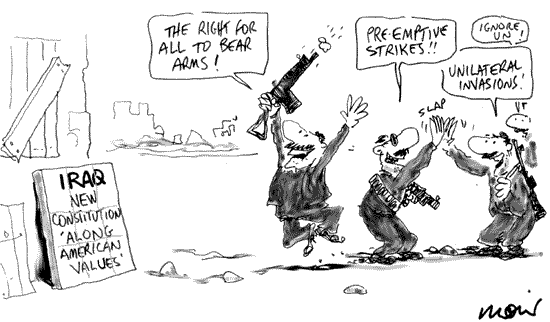
Iraq's referendum on the draft constitution to be held on October 15 has turned into a farce. Last Sunday, the US-backed ruling coalition of Kurdish and Shiite fundamentalist parties amended the country's electoral laws to virtually guarantee a positive result.
Under the transitional law drawn up by US officials in 2003, originally to guarantee the support of Kurdish parties, the referendum would be lost if a two-thirds majority in three provinces voted no. Sunni organisations and parties have been encouraging their supporters to register and to vote against the draft constitution, making it quite possible that the document will be rejected.
Such a result would be a disaster not just for the regime in Baghdad, but for the Bush administration which has sought to legitimise its occupation through the referendum and national elections planned for mid-December. In the event of a defeat, and if the transitional law were followed, it would mean going back to square one: fresh elections, a new government, a rewritten constitution and another referendum, with no guarantee this one would be accepted either.
Martin Navaias, a defence analyst at King's College London, commented to Reuters: "The fact is the consequences of this referendum being rejected are massive; they're just too ghastly to contemplate. If this referendum is rejected, it's an explicit rejection of the whole political process... It cannot be allowed to fail."
It was no surprise therefore that the Iraqi National Assembly voted to blatantly rig the referendum in favour of a yes vote. Under the amended rules, a two-thirds majority of registered voters in three provinces would be required to reject the referendum. In other words, if the turnout did not reach two-thirds or 67 percent, it would be impossible for the draft constitution to be defeated. Interestingly, the same definition was not applied to acceptance of the constitution, which still only required a simple majority of those who vote.
Despite the government's attempts to push the changes through quietly, Sunni leaders reacted angrily and called for a boycott unless the amendments were reversed. Fearful that a low Sunni turnout would further undermine the legitimacy of the vote, UN and US officials criticised the new rules. As a result, the National Assembly voted yesterday to overturn the amendments.
The furore threatened to derail behind-the-scenes efforts by US ambassador Zalmay Khalilzad to engineer a deal to split the Sunni vote. Sunni organisations oppose the federal structure contained in the draft constitution, which would pave the way for the establishment of regional governments in the oil-rich Kurdish north and the Shiite south with extensive powers, including over oil revenues and security forces. The predominantly Sunni central and western provinces would lack resources and influence.
According to an article in the Washington Post, Khalilzad has been attempting to convince Shiite and Kurdish leaders to accept Sunni demands for changes to the constitution. To date, negotiations have stalled, after the ruling coalition refused to discuss any changes to the planned federal structure. "We have no objection to changes that help us to achieve mutual understanding but there is no way that we would agree to change the basic principles of the constitution," Shiite negotiator Ali Debagh declared.
The various sordid manoeuvres make a mockery of the Bush administration's claim that the referendum is another step towards democracy in Iraq. The presence of more than 140,000 US troops and ongoing operations against those opposed to the US occupation makes any democratic vote impossible.
The US military has been carrying out major offensives in the western Anbar province, where the population is overwhelmingly hostile to the American occupation. Around 2,500 American troops, along with Iraqi forces, stormed into the towns of Haditha, Haqlaniya and Barwana on Monday as part of Operation River Gate.
Helicopter gunships and US warplanes conducted pre-dawn strikes on the towns destroying bridges over the Euphrates River and cutting off electricity. US snipers took up positions on rooftops and loudspeakers blared out warnings to residents to stay indoors, as teams of soldiers kicked in doors and arbitrarily detained "terrorist suspects".
A similar offensive codenamed "Operation Iron Fist" began on Saturday in the towns of Sadah, Karabilah and Rumana near the Syrian border. A San Francisco Chronicle article described a pitched battle in Karabilah in which children as young as 11 helped resistance fighters by pointing out US positions. At least five civilians were killed when a US tank fired on a building allegedly containing insurgents.
A New York Times report on Monday, detailing US attempts to control the town of Rawa, pointed to the widespread hostility to the US occupation. Describing the town of 20,000 as a "Baathist stronghold", US officers candidly admitted they had received "little cooperation" from the residents. Since late July, US forces have been hit by two dozen roadside bombs and eight suicide car bombs and have responded with air strikes, random checkpoints and house-to-house searches.
After the latest sweep through the town, US Colonel Stephen Davis and his Iraqi counterpart Colonel Yasser addressed a crowd of 300, angry at the searches and arbitrary detentions. Yasser urged them to vote in the referendum. Davis bluntly warned the residents to expect more reprisals if attacks on US troops continued. "Some of you are concerned about the attack helicopters and mortar fire from the [US] base. I will tell you this: those are the sounds of peace," he declared.
Political uncertainty
Far from being aimed at freeing locals from "foreign terrorists", the object of these US operations is to terrorise and intimidate a population that is opposed to the American presence.
Sunni leaders, who are seeking to exploit popular sentiment to bolster their own position under the occupation, have threatened a boycott if the US offensives are not ended. "If US forces keep attacking Sunni cities, then in three or four day's time we will announce a boycott of the referendum," Saleh al-Mutlak of the Sunni National Dialogue Council stated yesterday.
Despite the US diplomatic and military efforts to ensure a yes vote, the outcome of the referendum is by no means certain. After boycotting national elections in January, Sunni organisations have campaigned extensively for supporters to register and vote against the constitution. According to the New York Times, US officials and private organisations say that registration now exceeds 80 percent in some Sunni areas. "Nobody will be surprised to lose Anbar, and maybe one other province," one Pentagon official told the newspaper, adding: "[But] we're not going to lose three."
Even if the constitution is adopted, the entire process will be widely seen as illegitimate. Senior US commander in Iraq, General George Casey, told the US Congress last week that he believed the referendum would pass. However, when asked if the political situation could worsen after the poll, he declared: "I think that's entirely possible. I mean, as we've looked at this, we've looked for the constitution to be a national compact, and the perception is that it's not, particularly among Sunnis."
Head of US Central Command, General John Abizaid, who also appeared before Congress, declared: "A vote for the constitution doesn't mean we're headed for peace and prosperity. Iraq is going to be a pretty difficult security environment for a while."
Both generals indicated obliquely that the military confronts a Catch-22 dilemma. In his testimony, General Casey said that US troop reductions were needed "to take away one of the elements that fuels the insurgency, that of coalition forces as an occupying force". But he played down his predictions in March and July of this year that there would be "fairly substantial" cuts in troop numbers by the middle of next year, saying that in a period of heightened uncertainty it was "too soon to tell".
Casey admitted that efforts to train Iraqi troops and police to replace US soldiers were running into problems. The size of Iraqi security forces is substantial-about 192,000-but few of them have, as Casey put it, "an independence capability". Only one of the 120 US-trained Iraqi army and police battalions was capable of operating without US forces, down from three in July.
The reason is not hard to fathom. The majority of recruits have joined because the security forces are one of the few available employment options. Many are sympathetic to the armed resistance to the US occupation, if not actual members, and do not want to fight other Iraqis. At the same time, they are widely viewed as US stooges and are regularly the target of insurgent attacks. It is not surprising that most are unwilling to fight unless pushed into battle by their US military "advisers".
The US-led invasion has created a nightmare for the Iraqi people and a quagmire for American troops. Its aim was never to bring peace and democracy to the Iraqi people, but to subjugate the country and its vast oil reserves as part of broader US economic and strategic ambitions in the Middle East. The sham referendum on October 15 cannot disguise the fact that, in pursuit of its goal, Washington is employing the most ruthless methods of repression.
http://www.wsws.org/articles/2005/oct2005/iraq-o06.shtml
Related:
By Greenpeace posted 6 October 05
The truth is out. According to a confidential Pentagon document, the US government's masterplan for total global domination now includes using its nuclear weapons pre-emptively - even in conventional war situations.
A draft of "Doctrine for Joint Nuclear Operations" shows that instead of reducing the role of nuclear weapons as originally promised, the Bush administration is pushing aggressive new policies that are set to become normal US military practice.
The document - the final version of which will go out to all US military commands as 'operational guidance' later this year - was removed from the Pentagon's website earlier this month, prompting a Pentagon spokesman to admit that "even in an unclassified world this is not the kind of thing you want flying around the Internet". Well we think it's exactly the kind of information that people should know about - which is why we've put it up on our website for you to read.
What the document shows is how the threshold for actually using nuclear weapons has been lowered dramatically. For instance, the document seeks to justify pre-emptive nuclear strikes against nations (even those without nuclear weapons) which the US thinks might use chemical or biological weapons against US forces or allies.
It also positions nuclear weapons as just another item in the military's box of tricks, even underscoring the importance of US troops being able to continue functioning in a highly irradiated battle zone. In a chilling finale, "Doctrine for Joint Nuclear Operations" concludes that the United States is legally free to use nuclear weapons pre-emptively if it chooses, "no customary or conventional international law prohibits nations from employing nuclear weapons in armed conflict".
An earlier internal draft of the doctrine was sent to Greenpeace by some friendly soul - it includes suggested edits and comments by all the major military commands (we've also uploaded this version to our website for you). This feuding is interesting, as it reveals strong internal disagreement amongst US military commanders about the new strategy.
The disputes are over the document's enthusiasm for using nuclear weapons in attacks leading to massive civilian casualties. In addition, some commanders expressed extreme doubts over both the legality of the new nuclear doctrine, and that the threats used to justify this new doctrine actually exist. Greenpeace disarmament campaigner Dominick Jenkins said, "These documents should send a shiver down the spine of everyone.
They show that the highest levels of the Pentagon have undergone a major shift in thinking and now view nuclear weapons no longer as a weapon of last resort but a weapon that can and should be used." "This means a US military machine prepared use nuclear weapons first, against non nuclear countries and non military related civilian targets". He continued, "Historically, where US nuclear policy leads the UK generally follows. And with the UK facing a choice of whether to build a new nuclear weapon system in this parliament it is crucial that both MPs and the public seriously examine these documents." "The UK can't allow itself to be dragged down this path.
We must step back from the brink of a new nuclear arms race - by taking Trident off patrol, stopping all preparations to build a new atomic bomb and restarting the multi-lateral disarmament negations which have already helped to eliminate over half the world's nuclear arsenals." Make sure the Pentagon's plans for nuclear war fly around the internet Nuclear warfighting plans concern all of us - they shouldn't be kept secret. Help ensure that these unclassified documents are exposed to plenty of sunlight by sending this article to a few friends.
Send the link to this article to a friend. More Information Download the Doctrine for Joint Nuclear Operations - an unclassified draft of a US nuclear doctrine review that spells out conditions under which US commanders might seek approval to use nuclear weapons.
Download the Comment matrix on Doctrine for Joint Nuclear Operations - Comments from the US military branches to the Doctrine for Joint Nuclear Operations, which outlines how and under what circumstances nuclear weapons might be deployed by the US military. Read the Arms Control Association story - The Role of U.S. Nuclear Weapons: New Doctrine Falls Short of Bush Pledge "Instead of reducing the role of nuclear weapons, the new doctrine reaffirms an aggressive nuclear posture of modernized nuclear weapons maintained on high alert. Conventional forces and missile defenses merely complement instead of replace nuclear weapons."
http://www.greenpeace.org/international/
By Simon Jeffery posted 7 October 05
UK: Laws setting out who can and cannot take part in elections are to be rewritten after the European court of human rights today ruled in favour of giving British prisoners the right to vote.
Ruling in the case of a former prisoner against the United Kingdom, the Strasbourg court said the disenfranchisement of 48,000 convicts in British jails violated the European convention on human rights.
It said that with the exception of the right to liberty, lawfully detained prisoners continued to enjoy all the rights guaranteed in the convention - including political rights and freedom from inhumane and degrading punishment.
Britain is among 13 signatories to the human rights convention who prevent prisoners from voting, according to a government survey. The only exceptions in Britain are those in jail for non-payment of debts, contempt of court or on remand.
A further 14 signatories to the convention limit the right of prisoners to vote, while another 18 impose no restriction at all. The court's ruling could see prisoners across all states belonging to the 46-member Council of Europe, the court's parent body, given the right to vote.
Juliet Lyon, director of the Prison Reform Trust, said the court's ruling confirmed "people are sent to prison to lose their liberty, not their identity or their citizenship".
Speaking for the Tories, the shadow attorney general, Dominic Grieve, said giving convicted murderers and rapists the vote would "bring the law into disrepute and many people will see it as making a mockery of justice".
A spokesman for the Department for Constitutional Affairs said it was giving the judgment urgent consideration and would bring forward proposals in due course.
The former prisoner who brought the challenge, John Hirst, 54, pleaded guilty to manslaughter on the grounds of diminished responsibility after killing his landlady Bronia Burton with an axe.
He was sentenced to discretionary life imprisonment on February 11 1980 and released from Rye Hill prison, Warwickshire, on May 25 2004.
After his application to vote from prison was turned down, Mr Hirst took his case to the high court and lost. A seven-judge chamber of the Strasbourg court backed him, ruling that blocking the right to vote was disproportionate, and awarded him £8,000 in costs and expenses.
The government then appealed to a 17-judge "grand chamber" of the human rights court, arguing that Mr Hirst would be barred from voting even if the law was reformed to restrict the democratic rights of those who had committed only the most serious offences.
Mr Hirst's lawyers argued that blocking the right to vote was inconsistent with the stated rehabilitative aim of prison and that there was no proven link between removal of the vote and prevention of crime.
The court - on a majority ruling of 12-5 - said an article in the convention guaranteeing the "free expression of the opinion of the people in choosing a legislature" was not absolute but in a 21st century democracy the presumption should be in favour of inclusion.
Two of the judges said in an additional written ruling that the ban was applied to those in prison but neglected that a judge's decision to send a defendant to prison or hand down a suspended sentence or fine could depend on his or her health, age and family situation and not just the gravity of the crime.
Now living in Hull, Mr Hirst said his challenge had been about breaking the link between crime and the right to take part in the democratic process.
"The human rights court has agreed with me that the government's position is wrong - it doesn't matter how heinous the crime, everyone is entitled to have the basic human right to vote."
A bar on prisoners voting is made in the 1983 Representation of the People Act but the substance dates back to the 1870 Forfeiture Act, which in turn reflects earlier laws limiting the rights of criminals from the reign of Edward III.
The five dissenters - Judges Wildhaber, Costa, Lorenzen, Kolver and Jebens - said in a joint written opinion that the Strasbourg court should be careful not to assume legislative functions. They said states should have the right to restrict voting based on nationality, age, residence and other factors.
The court was set up in 1950 to hear citizens' complaints under the human rights convention and is independent of the European Union.
