Now Miki�s latest�The Naked Writer�is in print.
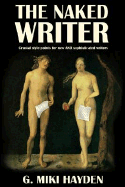
A �style and composition guide,� The Naked Writer,
cuts to the essence of everything all writers ever
needed to know to strengthen their writing of any
type.
Here�s what else Miki had to say when W4W talked to her.
W4W: What led you to write this book?
G. Miki Hayden: Frustration led me. After repeating these pure gold nuggets piecemeal over years of teaching at the Writer�s Digest online school and elsewhere, I wanted to give an integrated set of instructions to newer, as well as experienced, writers once and for all. Every single individual of the many hundreds of students I�ve taught has had at least some of a commonly shared set of difficulties with their writing. I firmly believe that these problems are ubiquitous, and that just about any English speaking person who pens a sentence or two will stumble in one or more predictable areas.
I really believe that all writers, novices or sophisticates, who pick up this book will gain insight into what their writing flaws are and how to fix them. The book will also serve as a compact reference guide for many years to come. I call The Naked Writer �a style and composition book,� and I�ve tried to both elucidate the correct contemporary use of language and punctuation, and show readers how to write readably. I give away all my hard-won writing tips.
W4W: Everyone makes the same mistakes? Why is that?
GMH: Writers don�t make exactly the same mistakes, but they make errors that fall into the same general classifications. This situation comes about, first of all, from a lack of interest in the rules of writing by writers during their early school years. I�ve had many students explain to me that they paid no attention when the material was first taught in elementary or middle school. Now, these students are not only surprised to discover their understanding of the language is less than perfect, but they are desperate to improve.
I have to add that even good students missed a few things that either weren�t taught or were presented on days the writers were absent from class, physically or mentally.
W4W: Can people learn the rules of language once they�re out of school?
GMH: Although learning at an earlier point would be preferable, we can always build from where we are. I didn�t know as much as I do now, myself, when I began teaching a few years ago. I�ve become a better writer while looking more deeply into the mechanics involved.
But I don�t expect those who reads the book to learn everything all in one mighty inhalation. The Naked Writer contains material that will instruct writers for years to come. We don�t always have to know the rules; we simply have to know enough to look up the guidelines.
W4W: What�s the worst writing flaw of newer writers?
GMH: Both newer and more experienced writers fail to optimize their use of words. Most people write inefficiently, using both passive and static phrases. Writing more actively in a dynamic format isn�t that difficult. We simply need to bring these things to mind. I give both examples of weak writing and exercises for readers to build some word use muscle.
W4W: What other writing problems do you emphasize?
GMH: I try to help people structure their sentences more optimally. Writers ought to know how to combine sentences for compact writing, but also how to break up sentences that go on too long or try to accomplish too much in one construction.
W4W: What about punctuation?
GMH: We really have very few punctuation marks to employ in our writing, so the fact that we don�t have a good grasp of these essential tools is absurd. Yet most of us don�t know even a good percentage of the rules. I was that way, once, too, so I�m not looking down at people who don�t know. I�ve set forth the accepted guidelines comprehensively, and, to help with the rhythm of the writing�yes, writing has a rhythm to it�I explain the effect each mark has on the writing�s sound.
W4W: The title�The Naked Writer�is provocative. What does it mean?
GMH: I admit the publisher wanted the title�and the cover with a classic Renaissance painting of Adam and Eve�but both can be can be considered appropriate. We do have to stand before our readers naked in all our failings and our errors, so let�s try to put a little polish on and show our assets in a better light. My original title was: Every Writer�s Easy Guide to an Admirable Contemporary Writing Style. That�s what I think this book is in its essence, but perhaps The Naked Writer is a more commercial title.
finis