Comparison of the universes of
Tolkien (The Lord of the Rings), Asimov (The Foundation) and
Roddenberry (Star Trek)
By Bruno Van de Casteele
What is it I like about
Tolkien’s The Lord of the Rings? Or, what is it I like about
Tolkien’s stories in general? What is it I like about
Asimov's best-selling series "Foundation"? What is it I
like about Star Trek? Or, putting all these questions in one,
what is it I like about created universes in literature
and television?
This question already answers
itself. At first sight, a 1000+ pages epic book, 7
science-fiction books, and weekly shows and multi-billion dollar
movies don’t have much in common. But they do. All three
reveal an appealing new universe or Earth, with own rules, magic
and science. All three became very popular and stayed in the
spotlight, even when it’s authors had died. All three were
created by a single man, who worked out his ideas, where others
could easily follow the fantasy, and even make new adaptations on
the subject. I will look upon all three, describing their
‘fathers’, pointing out many similarities, and two
strange differences.
Similarities
Creators
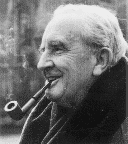 John Ronald
Reuel Tolkien (1892-1973)
was in many aspects the forerunner of the other two. He
didn’t write real science fiction, but his created world can
be considered one. Although it has many similarities with our
world, it isn’t (see later). The adventures of Middle-Earth
as we don’t know it, were all created in his mind, and typed
out with two (!) fingers on an old typewriter, because he
couldn’t afford to let it be typed out. Almost ten years
were spend writing The Lord, with advises from his son, who he
wrote many letters. In one for instance, he asked him if he could
use She-lob (=Female Spider) for the monster that almost caught
Frodo at the end. No doubt he was helped a lot by relatives and
friends (his club "The Inklings", who read and reread
his stories, corrected them, and pointed out contradictions. But
the main credit goes to him, because he created the new
world. Few have done it so thoroughly and successfully as he did.
He thought of many details, and he even gave instructions to
translators on how to translate (or not) the different
expressions. As a scholar in English languages, he knew very well
the North-European myths and based his stories upon them. The
different city names in the Shire and surroundings were actually
based on the Celtic or Gothic language. Bree or Chetwood, for
instance, are Celtic names; the names of the Buckland hobbits
were Welsh (Berilac) and Peregrin was a Gothic one. He even put
the evolution of the Celtic language in his work. The older
language of the Celts was represented in the Bree-man and the
Stoors, while that from the core-Shire is more recent Gothic. The
language of the Rohirrim, the horse-men, is more (Anglo-) Saxon,
making clear that it is another part of Middle-Earth. He even
went further in describing the linguistic landscape of his world.
The book, being written from the hobbits’ point of view,
refers to the English language, and the hobbits did understand
many words of the Rohirric (Old English), but the language itself
remained beyond their understanding (Return of the King, V, 3). "He
[Merry] could not piece the words together" (p823)
John Ronald
Reuel Tolkien (1892-1973)
was in many aspects the forerunner of the other two. He
didn’t write real science fiction, but his created world can
be considered one. Although it has many similarities with our
world, it isn’t (see later). The adventures of Middle-Earth
as we don’t know it, were all created in his mind, and typed
out with two (!) fingers on an old typewriter, because he
couldn’t afford to let it be typed out. Almost ten years
were spend writing The Lord, with advises from his son, who he
wrote many letters. In one for instance, he asked him if he could
use She-lob (=Female Spider) for the monster that almost caught
Frodo at the end. No doubt he was helped a lot by relatives and
friends (his club "The Inklings", who read and reread
his stories, corrected them, and pointed out contradictions. But
the main credit goes to him, because he created the new
world. Few have done it so thoroughly and successfully as he did.
He thought of many details, and he even gave instructions to
translators on how to translate (or not) the different
expressions. As a scholar in English languages, he knew very well
the North-European myths and based his stories upon them. The
different city names in the Shire and surroundings were actually
based on the Celtic or Gothic language. Bree or Chetwood, for
instance, are Celtic names; the names of the Buckland hobbits
were Welsh (Berilac) and Peregrin was a Gothic one. He even put
the evolution of the Celtic language in his work. The older
language of the Celts was represented in the Bree-man and the
Stoors, while that from the core-Shire is more recent Gothic. The
language of the Rohirrim, the horse-men, is more (Anglo-) Saxon,
making clear that it is another part of Middle-Earth. He even
went further in describing the linguistic landscape of his world.
The book, being written from the hobbits’ point of view,
refers to the English language, and the hobbits did understand
many words of the Rohirric (Old English), but the language itself
remained beyond their understanding (Return of the King, V, 3). "He
[Merry] could not piece the words together" (p823)
He didn’t stop on real
languages; he even invented them for his books. All were
nonsense, "but really possible, with consistent roots,
sound laws and inflexions, into which he poured all his
imaginative and philological powers" (Obituary, in Scholar,
p12). I especially appreciated the Elves’ language, with
proto-Elvish, and the languages Sindarin and Quanya deduced from
it (linguistically realistic!). When he developed Adunaic, the
language of the lost Númenor in 1946, it was said to be his
fifteenth invented language!
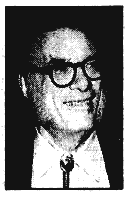 Isaac
Asimov (1920?-1992) is
considered to be the greatest science-fiction author in the
world. In the ’40, he started writing stories just for fun,
and tried (many times in vain) to sell them to sci-fi magazines.
His first check, 50$ for the story "Superneutron", was
the start for million-selling best sellers, and translations in
almost every common spoken language. In total, he wrote more
than 500 books. How odd must this have been for the man whose
stories were initially rejected!
Isaac
Asimov (1920?-1992) is
considered to be the greatest science-fiction author in the
world. In the ’40, he started writing stories just for fun,
and tried (many times in vain) to sell them to sci-fi magazines.
His first check, 50$ for the story "Superneutron", was
the start for million-selling best sellers, and translations in
almost every common spoken language. In total, he wrote more
than 500 books. How odd must this have been for the man whose
stories were initially rejected!
He created the most famous robots
(Cutie, Daneel,…) ever, with advanced positronic brains. But
he didn’t lose sight of humans. As he wrote five small
stories about a Foundation, he created the most selling literary
series ever. The Foundation was about humans far, far in the
future. They were trying to bridge the gap between the First and
Second Galactic Empire, helped by the mysterious
thought-analysers (I do not use the word readers, because they
sometimes have to search in the buried shelters of the brain, and
because they can change people’s minds.). Those ‘Second
Foundationers’ have developed the psychohistory, invented by
Hari Seldon. It is a way of predicting the future of galactic
populations by mathematical formulas.
The size of his books increasing
with each new one, he appealed to his readers with futuristic,
but o so human stories. Herein lies the greatest strength of his
stories, he never lost sight of the human behaviour. His
characters weren’t (at least not always) the ever-good,
never making a mistake people we sometimes see in Star Trek. It
all seems so realistic, it could happen.
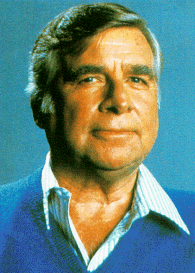 Gene
Roddenberry (1921-1991)
is the strangest man of all three. Having a commercial purpose of
creating a cheap sci-fi series, with recurring characters every
week, he created a myth, a "voyage that still
continues" (promotion title of Star Trek: Voyager).
Initially rejected, Roddenberry held on, and started a
‘boom’ in television history. While on regular network,
the show had only some ten thousand fans. The success of Star
Trek started only when it went into syndication. The so-called
Trekkie-meetings appeared all over the USA, and, starting from
the series, multi-billion dollar selling movies were made. This
is actually the first series to have gone into movies. (X-Files
are the second one to have accomplished this.) Sometimes, weekly
shows were spawned from a successful movie (Highlander, for
instance), but never a series had reversed the process in
Hollywood. The merchandising of Star Trek is one of the biggest
in history, with novelizations, additional novels, videos,
CD-ROM’s, blueprints, puppets, posters, etc. It is
regrettable, but it clearly states the popularity of Star Trek
for all ages.
Gene
Roddenberry (1921-1991)
is the strangest man of all three. Having a commercial purpose of
creating a cheap sci-fi series, with recurring characters every
week, he created a myth, a "voyage that still
continues" (promotion title of Star Trek: Voyager).
Initially rejected, Roddenberry held on, and started a
‘boom’ in television history. While on regular network,
the show had only some ten thousand fans. The success of Star
Trek started only when it went into syndication. The so-called
Trekkie-meetings appeared all over the USA, and, starting from
the series, multi-billion dollar selling movies were made. This
is actually the first series to have gone into movies. (X-Files
are the second one to have accomplished this.) Sometimes, weekly
shows were spawned from a successful movie (Highlander, for
instance), but never a series had reversed the process in
Hollywood. The merchandising of Star Trek is one of the biggest
in history, with novelizations, additional novels, videos,
CD-ROM’s, blueprints, puppets, posters, etc. It is
regrettable, but it clearly states the popularity of Star Trek
for all ages.
 But the real success of Star Trek has to be
credited to all the writers, not only Roddenberry. He provided
good ‘Gene’s, and numerous other wrote and filmed
stories for Star Trek. Without Roddenberry, the series would
never have been created, no doubt, but the other writers made it
a real success. Without DC Fontana, J.A. Lawrencen, Brannon
Braga, Samuel Peeples, David Gerrold and many others, Star Trek
and its spin-offs would never have become so successful. Even the
actors joined in! Leonard Nimoy (Spock) invented the Vulcan
method of greeting, holding your hand in a ‘V’ pattern,
and he also worked out the ‘nerve pinch’, to make his
character less violent. He wrote the sixth movie, directed and
produced it and played a major part in it. Talking about profit!
Shatner did it too, in the fifth movie, but that one was actually
very BAD. Roddenberry himself spoiled the first three seasons of
The Next Generation. He wanted every episode to have a moral in
it, and many times it feels too cliché or designed. I especially
remember ‘Skin of Evil’, where Tasha Yar dies (actually
written out of the show) and all the others look at a visual
testament of her, telling about all the good things and so…
I mean, there is only so much boredom a human can take.
But the real success of Star Trek has to be
credited to all the writers, not only Roddenberry. He provided
good ‘Gene’s, and numerous other wrote and filmed
stories for Star Trek. Without Roddenberry, the series would
never have been created, no doubt, but the other writers made it
a real success. Without DC Fontana, J.A. Lawrencen, Brannon
Braga, Samuel Peeples, David Gerrold and many others, Star Trek
and its spin-offs would never have become so successful. Even the
actors joined in! Leonard Nimoy (Spock) invented the Vulcan
method of greeting, holding your hand in a ‘V’ pattern,
and he also worked out the ‘nerve pinch’, to make his
character less violent. He wrote the sixth movie, directed and
produced it and played a major part in it. Talking about profit!
Shatner did it too, in the fifth movie, but that one was actually
very BAD. Roddenberry himself spoiled the first three seasons of
The Next Generation. He wanted every episode to have a moral in
it, and many times it feels too cliché or designed. I especially
remember ‘Skin of Evil’, where Tasha Yar dies (actually
written out of the show) and all the others look at a visual
testament of her, telling about all the good things and so…
I mean, there is only so much boredom a human can take.
The basic idea came from
Roddenberry, but others worked it out. But that doesn’t
change anything about the myth of Star Trek. It created an
audience for science fiction with familiar humans. Before Star
Trek, there wasn’t so much interest in this genre and in
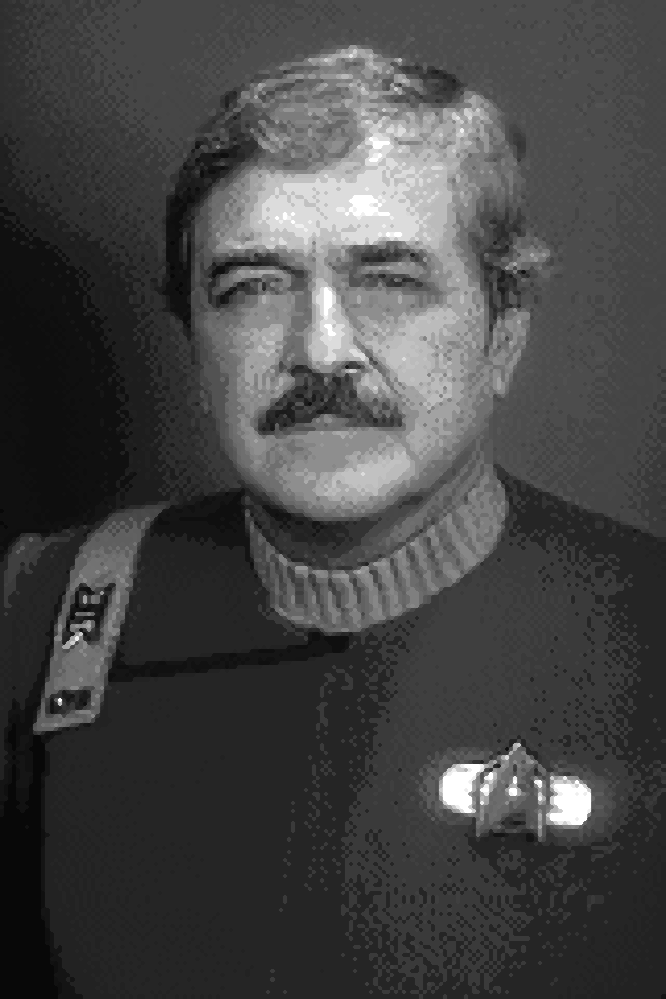
science. That’s the real power of Star Trek. A fine anecdote
proves this: in the seventies, nearly 50% of the students
applying for engineering in the USA said it was because of
‘Scotty’.
A funnier anecdote: a burglar stood up and said, after he was
convicted: "Scotty, beam me up!" It didn’t work,
off course…
Timelines
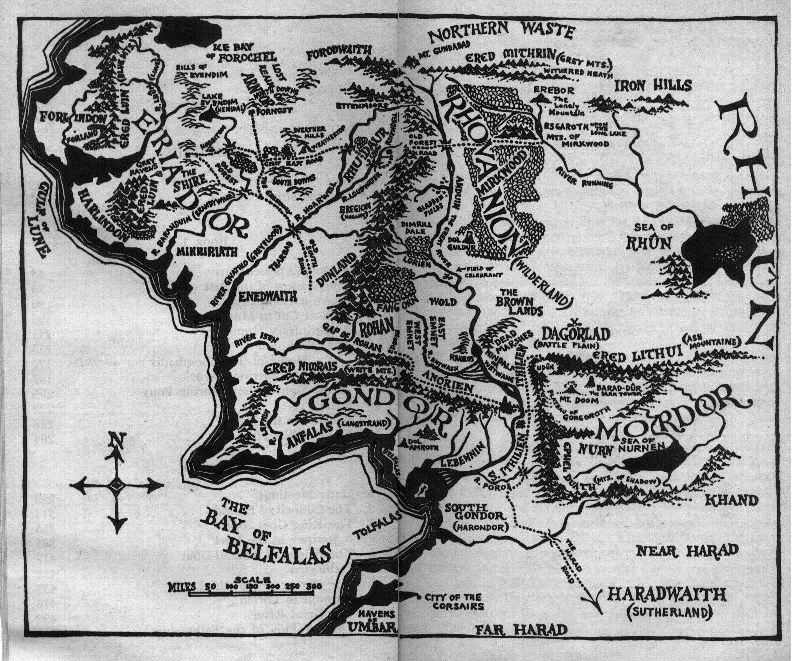 It is very
clear that The Lord of
the Rings cannot have happened in our timeline. According to
Tolkien, we are now in the Sixth or Seventh Age (he doesn’t
really care). But Tolkien didn’t want to mess up human
history. The location is very well Earth, and seems very
familiar. That’s why it’s so appealing, we could
actually place ourselves in the story. Tolkien, writing from the
hobbit’s point of view, even forces us into it. That’s
the strength of the story, and it also counts for the other two,
it is on the one hand familiar, and on the other hand it is
exotic. Who doesn’t want to live in such times?
It is very
clear that The Lord of
the Rings cannot have happened in our timeline. According to
Tolkien, we are now in the Sixth or Seventh Age (he doesn’t
really care). But Tolkien didn’t want to mess up human
history. The location is very well Earth, and seems very
familiar. That’s why it’s so appealing, we could
actually place ourselves in the story. Tolkien, writing from the
hobbit’s point of view, even forces us into it. That’s
the strength of the story, and it also counts for the other two,
it is on the one hand familiar, and on the other hand it is
exotic. Who doesn’t want to live in such times?
The Lord of the Rings refers to
those heroic Middle Ages, and, in the Silmarilion, there are
numerous references with the northern myths. Isn’t there a
Tacitus or a Rousseau in all of us?
Going into details, Middle-Earth
actually does resemble much Western Europe. In one of his
letters, he wrote "if Hobbiton and Rivendell are taken
(as intended) to be about the latitude of Oxford, then Minas
Thirith, 600 miles south, is at about the latitude of Florence.
The Mouths of Anduin and the ancient city of Pelargir are at
about the latitude of ancient Troy." (Letters, #294).
That doesn’t change a bit about the quality of the book.
Even if you don’t get the different hints, you could still
enjoy the story. But it speaks for the geniality of Tolkien to
have put it in.
Star Trek refers more to the future as it may become, and
that’s appealing too. The technological improvements, the
philosophical way of thinking (Prime Directive), the new weapons
and enemies really make "Space the Final Frontier". All
those who want to explore, have new adventures, and also those
who are just dreaming of it, are tempted by the adventures
of Kirk and his crew. I think that refers to almost the entire
human population. Who isn’t sometimes unhappy with his
present situation, and wants to escape, be it in the future or
the past?
But Star Trek couldn’t have
happened in our timeline and will not. The scientific advances
are too immense for just three or four centuries, even when
considering the exponential effect of inventions. More, the Star
Trek timeline diverges from ours in 1966, when the first stories
aired. It was then necessary to have episodes that referred to
the very near future. There was for instance the Enterprise
passing by in 1969, destroying a newly launched space platform
with nuclear missiles. Well? Near the end of this century, NASA
should have developed and launched at least six Voyagers and 5
sleeper ships, where the crew is frozen in. Unless Congress
increases the funds of NASA with 2000%, I don’t think NASA
would achieve such enormous technological triumphs. My all-time
(sic) favourite is the Eugenics War, said to have ended in 1996
(?). By the way, this is ignored by many writers, for instance
the novel ‘Ghost Ship’ of The Next Generation by Diane
Carey (yes, curse her). You have to remain consistent with the
others. Otherwise you’re not a good writer.
Star Trek also offers many
explanations for events in the past. In 1908, the Vulcans are
said to have destroyed a comet fragment in Siberia, to save Earth
population. The murders ascribed to Jack The Ripper were by an
alien creature, Redjac, who lived on the fears of his female
victims ("Wolf In The Fold"). That is well invented,
and adds an interesting dimension to the stories.
The link with Earth is
nevertheless obvious. Starfleet HeadQuarter is in San Francisco
Earth, and most personages are born on Earth. When the Borg
attack UFP-space in "Best Of Both Worlds" and
"First Contact", they head for Earth. They are
destroyed only minutes from Earth, and this adds to the
identification effect - and the success - of Star Trek.
The Foundation series is more complex. It is so far in the future
it could happen. 12000 years of Galactic Empire, added to the
process of second colonisation (2000 years?), added to the
development of the worlds as Aurora (600 years? More?), and we
come to a total of 15000 years, or even more. This is certainly
after the invention of the hyperspacedrive (according to Asimov
around 2100, but too early, same reason as Star Trek), and the
adventures of Seldon happen around 20 000 AD. And yet, the
characters seem so human, it is as if we see ourselves acting.
Earth may have been destroyed, but who cares, we’ve got the
whole galaxy for ourselves. Hyperspacedrive is, as warpdrive,
theoretically possible, so this adds much to the credit of
Asimov. These adventures are the most likely to happen, or at
least the civilisation mentioned. Who doesn’t want to have "the
galaxy as a playground" (Q, numerous times in TNG)?
Maybe the quote of Kirk in "The Ultimate Computer" and
"The Undiscovered Country" is more appropriate here: "All
I ask is a tall ship and a star to steer her by…"
Humans
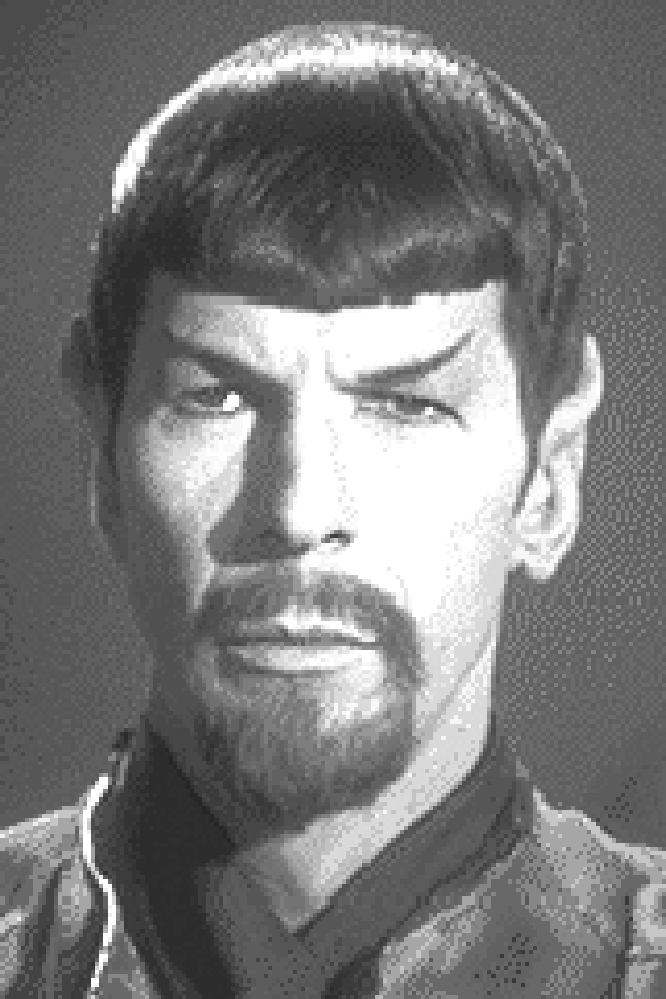 Considering
the fact that the Lord Of
The Rings is written from the hobbits’ point of view, and
that England was meant by the Shire, one can easily accept that
hobbits are us, humans. The hobbits are a parody on human
materialism (Bilbo Baggins). Yet there is still hope for us,
because Frodo does want to leave everything behind to destroy the
One Ring. Interesting detail: hobbits are believed to have
pointed ears, as the Elves. Spock also has pointed ears, making
him hobbit alike, and by the same token, more human than he ever
would have admitted…
Considering
the fact that the Lord Of
The Rings is written from the hobbits’ point of view, and
that England was meant by the Shire, one can easily accept that
hobbits are us, humans. The hobbits are a parody on human
materialism (Bilbo Baggins). Yet there is still hope for us,
because Frodo does want to leave everything behind to destroy the
One Ring. Interesting detail: hobbits are believed to have
pointed ears, as the Elves. Spock also has pointed ears, making
him hobbit alike, and by the same token, more human than he ever
would have admitted…
The humans mentioned are also
human, but in a lesser degree. They represent archaic behaviour
(Steward of Gondor) or ones for the future. The latter ones (like
Faramir) demand their place in history. They (=we) have got
it…
The humans in the Foundation are simply human, no problem there.
Interesting however is the "Mule". Indeed, natural
mutations could occur when speaking in terms of ten thousand
years. It is an interesting find of Asimov. The whole scientific
Second Foundation must be mobilised to battle such a natural
phenomenon. Nature just isn’t so predictable. On top of
that, the humans in the Foundation, as in The Lord, are on the
verge of entering a new Era. Difficulties have yet to be
overcome, but the progressive and optimistic undertone cannot be
missed, in both stories.
In Star Trek, all species are in fact humans. The theory is that
a humanoid genetic code was spread throughout this part of the
galaxy ("The Chase"). Of course, this is only to
compensate for the anatomy of the actors. The new episodes of
Voyager, however, are said to have computer-generated species in
them.
Every species represents a
characteristic of today’s humans. Ferengi’s are the
businessmen always wanting to make profit, Klingons are violent
and always want to fight, Bajorans are considered the losers of
the Galaxy, etc.
Of course it is inevitable to have
such human figures in all three. The writers are human, and part
of the success is the identifiable behaviour of the characters.
Even ‘Watership’s Down’ is about very human hares.
Languages
The matter of languages with Tolkien has already been dealt with.
Let me stress another time that it was an immense achievement for
one person. Let me also point out the differences in style
between, for example, Aragorn, the King of Gondor and Eowyn,
Rohan. The latter speaks very formal, old English, and the former
changes his language to Eowyn’s (Return Of The King, V, 2).
He only speaks modern English when he is Strider. It resembles
his evolution, from Wanderer to King.
Tolkien’s characters speak
English, but he considered himself only the traducer of the
Baggins’ books. He adapted them into English, with all the
relative links to other languages. At least, that’s the
theory…
Asimov has his Galactic Standard. No information is given however
from which language it has been derived. That it hasn’t much
common with our language, is proved in "Foundation and
Earth", where such a simple word as "Aurora"
isn’t understood anymore by Trevize. The word
"god" doesn’t exist either in this language
("Forward the Foundation"). Of course, after 20 000
years and spread across some thousand light-years, it is logical
that languages have evolved so much, that we cannot understand
them anymore. That makes the story more realistic. (See also
Merry who couldn’t understand the Rohirric; it’s
parallel.)
Star Trek is American, and it featured English. The other
languages were simply ‘translated’ by a Universal
Translator, monitoring the brain patterns and rewording them in
the listener’s speech. A simple invention to make the story
more fluent. There was no time to create translation problems in
an episode. The only language fully worked out, by fans, is
Klingon, and it’s typically heard on
‘Trekkie’-meetings. Complete dictionaries, grammatical
compendiums, evening courses, … exist for this language.
Writers needing it in their
stories work out some other languages. Written Ferengi, for
instance, is based on flow charts, written Vulcan is more like
musical notes, and numerous other examples exist.
Empaths
The Foundation clearly has its empaths, the whole story is based
around it. The Second Federationers acquire, after years of
studying (or by birth if you only consider "Forward the
Foundation"), the ability to read and alter minds, and to
communicate telepathically. They picture the brain as a 3-D
graphic, and can thus attain even the deepest regions of it.
Star Trek also has its empaths. Betazoids as the Troi family
are the most known, but Vulcans also have a limited ability to
read minds, when there not physically connected to a person.
Deanna Troi (TNG) has the most difficulties with her ability,
because she’s also half human. She cannot fully filter out
all the people’s thoughts, and suffers under the constant
bombardment she cannot control. Telepathical communication has
not fully developed. All this is excellently worked out in
"Ghost Ship" by Mariah Carey (well, don’t curse
her…). A special species are the empathic metamorphs
("The Perfect Mate"). They are able to fully understand
the needs of their partner, and adapt themselves to match
perfectly with them.
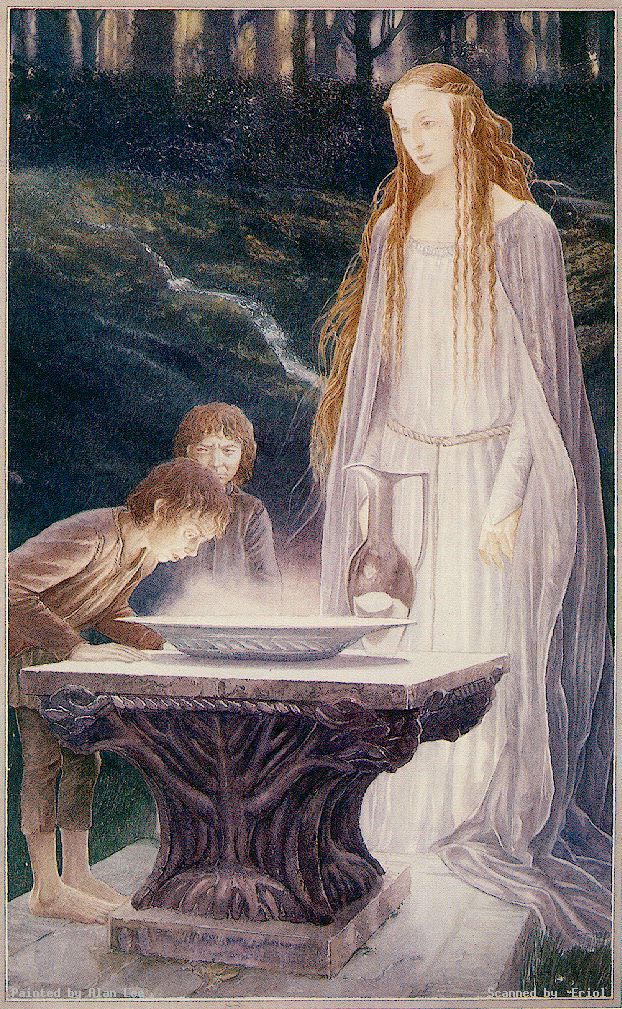
It may not seem clear, but Tolkien has also put empaths in his
story. The great Elf-woman Galadriel says, after Frodo looked in
her mirror and saw The Eye: "I know what it was you saw,
for that is also in my mind." (p 384) That can be
explained as Galadriel already thinking about The Eye. But the
Mirror, as pointed out in the chapter, is individual and
different to every one. And it would be illogical not to adjudge
such a capacity to these magic creatures.
Next Generation
 All three have a ‘Next Generation’ with
new personages, but in the same universe. The volume of all three
Next Generations is much larger than the Original one’s. In
fact, Tolkien’s Lord of the Rings is an original an sich.
In these new adventures, the old characters return from time to
time, because of continuity. Tolkien’s link is of course
Bilbo and the Ring (also a character), in Star Trek half the crew
returns (with some tricks, such as ultra-stretched lifespans and
Transporter Stasis) in the Next Generation, and Hari Seldon
returns many times in the adventures of the Federation (as a
hologram).
All three have a ‘Next Generation’ with
new personages, but in the same universe. The volume of all three
Next Generations is much larger than the Original one’s. In
fact, Tolkien’s Lord of the Rings is an original an sich.
In these new adventures, the old characters return from time to
time, because of continuity. Tolkien’s link is of course
Bilbo and the Ring (also a character), in Star Trek half the crew
returns (with some tricks, such as ultra-stretched lifespans and
Transporter Stasis) in the Next Generation, and Hari Seldon
returns many times in the adventures of the Federation (as a
hologram).
That’s one of the
peculiarities of the stories. One can easily add new stories to
the existing ones. With Star Trek it is obvious. Tolkien himself
has written verses about Tom Bombadil, and a "Genesis",
the First Age. The two last books of the Foundation series are
not a Next Generation, which was in the fifth and sixth one, but
in fact a Previous Generation. In ‘Robots and Empire’
he combined the First Galactic Empire and his famous robots,
which is a pleasing fact indeed.
But he doesn’t remain
consistent. The descriptions of Trantor in "The
Foundation" on the one hand and "Prelude On
Foundation" and "Forward The Foundation" on the
other, differ much. The seventh book is even apocryphal when
considering the career of Seldon. He, Prime Minister? That is too
contradictory to the first book.
Tolkien, on the contrary, changed
his ‘Original’ book, "The Hobbit", to let it
match with his "Lord Of The Rings". The chapter about
Gollum and the obtaining of the Ring by Bilbo Baggins was
extensively rewritten. He didn’t want to leave errors to be
laughed about, his work has too much quality for it.
Creating a universe means leaving
space that others can fill in with their fantasies. One can
easily create stories about the young Faramir, or about Mayor
Branno, or about Captain Sulu. About the latter, it is rumoured
that a new spin-off, featuring Captain Sulu and the Excelsior
will be made.
The conditions for new stories are
that they have a good plot (of course!), that they interact with
the original story and universe, and if possible explain more
about it. The most important thing is that you remain CONSISTENT
(yes, Diane Carey…) with the created universe and the ideas
from the creator. It is only a pity that copyrights remain on
those matters. You cannot step outside with your new stories,
unless you pay. Tolkien has never put a copyright on
Middle-Earth, but in Star Trek books, there are more ®’s
stamped behind Enterprise and Starfleet than you could ever
imagine.
Time Measuring
To express that their story was
indeed a little bit different from our world, all three
introduced new systems of time measuring.
Tolkien has invented the Hobbitons’ calendar. It bears a
strong resemblance to ours, with only the length of the months
slightly shorter than ours. That explains why the Fellowship is
still able to sleep outside end October, because it is, for us,
only the beginning of October. You can still have some beautiful
nights at that time.
Asimov retained the length of the year and the day. Only the starting
point differs. There’s one when the great emperor Agis I
comes to the throne, and another one when the First Foundation is
founded.
 Roddenberry
also kept the normal
calendar, but invented a new one, with stardates, for official
use in logs. At first it was to place Star Trek somewhere in the
future, without the restriction of being pinpointed to one
specific date. Afterwards, when the writers wanted to make
references to our time, Star Trek was placed in the second half
of the 23rd century, but there is still doubt about
the exact date. One says it’s 2266, the other 2260 and so
on. Many errors remained, because there isn’t a (sufficing)
rule of how stardates increase. Roddenberry never wanted to go
into detail. The most researched rule now is a rate of five
stardates per day for the old series, but Okuda, the counsellor
for Paramount, denies this, saying that it’s 1 unit per day.
There is a difference between the official and
‘fan’-circuit.
Roddenberry
also kept the normal
calendar, but invented a new one, with stardates, for official
use in logs. At first it was to place Star Trek somewhere in the
future, without the restriction of being pinpointed to one
specific date. Afterwards, when the writers wanted to make
references to our time, Star Trek was placed in the second half
of the 23rd century, but there is still doubt about
the exact date. One says it’s 2266, the other 2260 and so
on. Many errors remained, because there isn’t a (sufficing)
rule of how stardates increase. Roddenberry never wanted to go
into detail. The most researched rule now is a rate of five
stardates per day for the old series, but Okuda, the counsellor
for Paramount, denies this, saying that it’s 1 unit per day.
There is a difference between the official and
‘fan’-circuit.
Gold
It is only a detail, but the three
universes have a material that has more value than gold. It
states that the universe is different from ours. In the stories
of Asimov, it is not really a material, but the whole science and
more specific psychohistory has more value than any other object.
It ensures the survival of mankind. In Star Trek, where gold can
be artificially reproduced, latinum has more value, because it
cannot be reproduced and is even rarer. It does, however, bare
much resemblance to gold, and the name is no doubt deducted from platinum.
Tolkien created mithril
(remark the correspondence with Mithrandir, Gandalf). The
mail of Bilbo, and later Frodo, is made of it, and it is even so
rare, that this armour costs more as the Shire (England)! It does
have its qualities, because it protects Frodo very well when
stabbed by a Black Rider.
Slogans
All three have a basic
‘poem’ or saying which excellently summarises the
entire story.
Asimov’s Foundation doesn’t really have a slogan, but
whenever robots appear, his famous Three (or Four) Laws of
Robotics are used and put into practice.
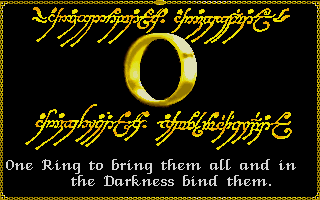
Tolkien tells about all the magic Rings that are in our world in
only one poem. It is gradually worked out; the Elven Rings
aren’t even fully explained until the end, although one can
easily guess that Gandalf has the Third.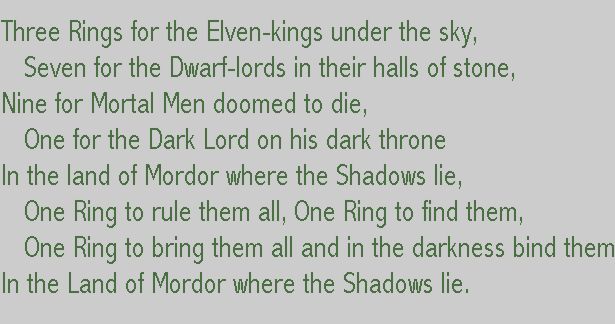
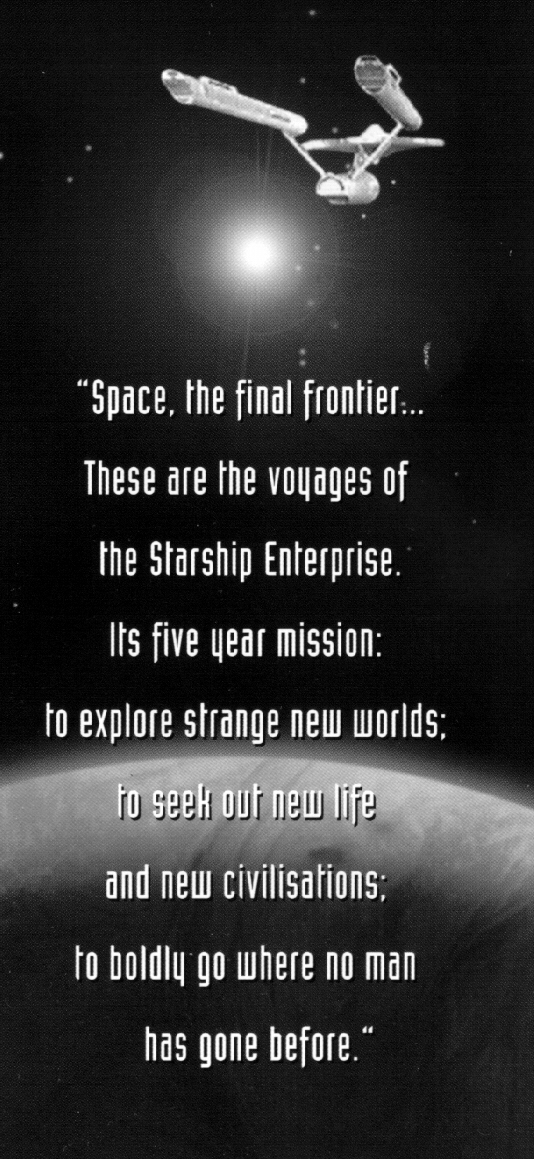
The central theme of Star Trek is actually a combination of
different orders ("To explore strange new worlds")
and general feelings ("Space, the Final Frontier").
It is slightly adapted for the Next Generation.
Fans
One striking similarity between
all three is the phenomenon of dedicated fans, spread across the
world but united in a common universe.
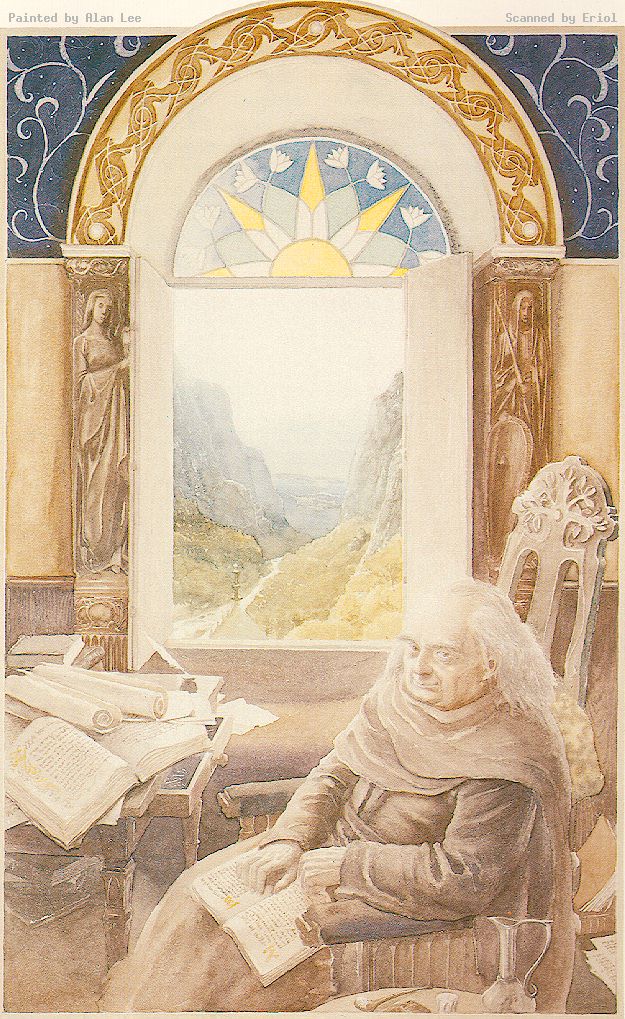
The world of Tolkien seduces many. His powerful language
encourages everyone to feel involved in the story. You can
fantasise about the world, live your own adventures in it. Or you
can scientifically study the book for linguistic matters, such as
the beautiful poems or the developed languages. You can draw
pictures of the characters and share it with everyone (like the
illustrations, made by Lee). Maybe you can write a spin-off, or a
parody, but that would be disgraceful towards Tolkien. And you
can always discuss certain matters with everyone who’s
interested in the subject.
The Foundation doesn’t have such energetic fans. Main reason is
the poorer language of Asimov when compared to Tolkien. It is
hard to find gadgets of the Foundation in shops. Nevertheless,
you can always discuss the scientific advances or other
theoretical subjects, or the mistakes Asimov made in his books
(especially in the last ones).
 And then
there is Star Trek. You
can immediately divide the fans in three groups. The first ones
are the ‘real’ Trekkies, who will watch every episode,
consider everything true, will buy almost everything there is to
be found on the subject, will attend Trekkie-meetings and even
dress themselves up in the uniforms. Sometimes they even want to
change place with a character in the Star Trek universe. Then
there are the ‘snafu’s’, for the greater part
(semi-) scientists, who will discuss the theoretical existence of
the exotic science or who will point out major errors against
Physics. A special part of this group looks for consistent errors
in the shows (favourite writer: Diane Carey. Curse the
woman…). They can still enjoy Star Trek, but they can be
very irritating for others with their constant remarks. The last
and biggest group is the one of normal fans, who will enjoy Trek,
but nevertheless stay sceptical. Sometimes they even don’t
want to admit they actually like watching Star Trek. They
are the healthiest group of all three, because they still
consider Star Trek still as what it in reality is, namely
television.
And then
there is Star Trek. You
can immediately divide the fans in three groups. The first ones
are the ‘real’ Trekkies, who will watch every episode,
consider everything true, will buy almost everything there is to
be found on the subject, will attend Trekkie-meetings and even
dress themselves up in the uniforms. Sometimes they even want to
change place with a character in the Star Trek universe. Then
there are the ‘snafu’s’, for the greater part
(semi-) scientists, who will discuss the theoretical existence of
the exotic science or who will point out major errors against
Physics. A special part of this group looks for consistent errors
in the shows (favourite writer: Diane Carey. Curse the
woman…). They can still enjoy Star Trek, but they can be
very irritating for others with their constant remarks. The last
and biggest group is the one of normal fans, who will enjoy Trek,
but nevertheless stay sceptical. Sometimes they even don’t
want to admit they actually like watching Star Trek. They
are the healthiest group of all three, because they still
consider Star Trek still as what it in reality is, namely
television.
Differences
Subject
Star Trek and the Foundation are
both based on science fiction. They are based on science, but new
innovations, more or less possible, were added. That extra
element is the feeding ground for the success of both series.
It’s the escape of our ‘simple’, but nevertheless
fairly similar world. Star Trek paved the way for science fiction
on TV. It was not the first (there was for instance
‘UFO’) but at the time the cheapest yet most
intriguing. The weekly returning characters became symbols. And
without Star Trek, there would never have been "Star
Wars", "Space: Above and Beyond" or "The
X-Files".
Tolkien has written an epic book, with many referrals to the
North-European myths. It’s a return to the heroic medieval
world, where a given word is a given word, where your name is
believed to be your real name, and where you could show your
strength by sword-fighting, instead of pressing buttons of
nuclear missiles. The little rivalry between Legolas and Gimli
proves this. Add to this some mythical creatures that come to
help the humans, like Dwarfs or Elves, and you have splendid
ingredients for a story.
Medium
This one’s the main
difference between all three. This is the knife with which you
can divide quality from good and enjoyable stories.
Star Trek was and still is a TV-production, the only purpose
being to attract spectators. The lack of them was the main reason
why The Original Series were cancelled in late 1969. But over the
years it outgrew this medium. The first movie was made 1979, and
after this one, seven more came, with the last one only hitting
the box office some months ago. Spin-offs were made, starting
with The Next Generation in 1986, Deep Space Nine in 1991 and
Voyager in 1993. Plans for another spin-off and a ninth movie are
made. Star Trek definitely needs visual effects to appeal
viewers. No doubt the newest series and films are more popular
because of the more sophisticated special effects. Books are less
qualified for this. You cannot describe a ship on 5 or 6 pages,
because it slows down the action too much. And that is the main
characteristic of Star Trek: Something is happening on that
little screen! Sometimes the personages change mentally, for
instance the android Data acquires emotions and dreams, but all
too often they appear in black and white. They do have their
human doubts, love, jealousy, yet they may seem idiots for
schooled viewers. Nevertheless, Star Trek is more than
adventures simply translated into space. There are certain
philosophical achievements worth mentioning, such as the Prime
Directive, which states no interference with other races,
especially when they have not developed warp drive – yet.
There is another problem with Star
Trek. The themes run out after some hundred episodes. The aspect
of women-dominated society and a species that leeches organs from
the poor humans appeared in TOS, "Spock’s Brain",
but the former also in TNG’s "Justice" and the
latter in Voyager species Vedaks. This re-use is not per
definition bad, but most of the time it is.
 Asimov mainly wrote
action, but he wanted to
pass a message to his readers. He didn’t do it as obvious as
Gene Roddenberry did it, yet he warned for instance for the
nuclear destruction of Earth ("Foundation and Earth").
He was engaged socially, and wrote many essays on environmental
(mis-) use. Books are very handy to pass such messages, because
you can reproduce thoughts of personages to stress your own
opinion. Asimov is not bad in describing scenes, for instance
battle scenes, the measuring-staff for good writers. He even made
humorist remarks. In "Foundation and Empire" for
instance, he describes the battle with ships approaching from
under the solar system. This ingenious tactical manoeuvre was
"against all standard rules of warfare". That’s
the reason space battles are most of the time not written out in
Star Trek novels (by writers as Diane Carey…).
Asimov mainly wrote
action, but he wanted to
pass a message to his readers. He didn’t do it as obvious as
Gene Roddenberry did it, yet he warned for instance for the
nuclear destruction of Earth ("Foundation and Earth").
He was engaged socially, and wrote many essays on environmental
(mis-) use. Books are very handy to pass such messages, because
you can reproduce thoughts of personages to stress your own
opinion. Asimov is not bad in describing scenes, for instance
battle scenes, the measuring-staff for good writers. He even made
humorist remarks. In "Foundation and Empire" for
instance, he describes the battle with ships approaching from
under the solar system. This ingenious tactical manoeuvre was
"against all standard rules of warfare". That’s
the reason space battles are most of the time not written out in
Star Trek novels (by writers as Diane Carey…).
And this is where Tolkien towers above the others. He was a complete
writer. His poems are the work of a genius. Untranslatable, and
even sometimes on purpose archaic, these verses are written by a
real poet. Professor Shippey identified five separate
metrical devises in Bilbo’s Song of Earendil. No one has
ever made so much a literary masterpiece, with a good plot,
extensive descriptions of characters and battlefields. Making a
movie from this book would be very difficult and expensive. An
animated movie was made, but many aspects were left out. The
poetic elements may at first sight slow down the story, but add
more to the atmosphere. What can I say more? Tolkien is until now
the only writer for which I’ve given up large parts of my
night’s rest. So make sure you read this book during
holidays. And yet, now that I’ve read it thrice, twice in
Dutch and once in English, I do want to read it again. You need
several lectures to fully catch the story and the remarkable
details. Isn’t that the best proof that, although all three
have created universes, Tolkien’s one is the best? He did
alone and in fifteen years what took Asimov fifty years and Star
Trek many producers and writers.