|
|
 |
|
 |
|
|
|
|
|
 |
| The
Kenwood TM-V7A 146/440 MHz FM Transceiver
From
CQ Magazine, June 1997, by Doug DeMaw, W1FB
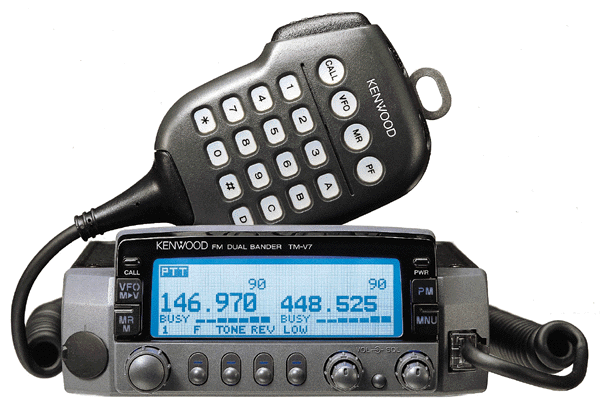
I was astonished to note the small size of the TM-V7A FM transceiver when I took it from its box. It's difficult to comprehend so many features contained in a cabinet scarcely larger than a pocket-book edition of Webster's dictionary. Not only is it a two-band transceiver, but it puts out a maximum of 50 watts on 2 meters and 35 watts on 440 MHz. I am especially impressed with the digital readout face which occupies approximately two thirds of the panel space (1" ´ 31/4"). Frequency and menu commands are clearly displayed in white on a blue LCD background. Various manually initiated commands are displayed in the readout window, too. I was pleased to observe how easy it is to read the displayed information when operating mobile, even during daylight hours. This is a vast improvement over the earlier black LCD numbers and letters on a gray background, particularly those with small display characters. Another human-engineering advancement is the placement of the built-in speaker. The TM-V7A speaker grille is on the top cover of the box. This a significant improvement over the older rigs with their speakers pointing downward toward the floor from the bottom of the cabinet. The audio output is easy to understand despite the ambient noise that accompanies mobile operation. A large extruded heat sink at the rear of the cabinet ensures that the RF power transistors have adequate cooling. This is aided by a fan that is activated by a sensor when additional cooling is required. The fan operates quietly and is barely audible when it is engaged. More Features The control head can be removed easily by pressing a latching lever at the top-rear of the panel module. Accessory cables are available (13 or 23 feet) for remoting the main assembly. This feature should appeal to amateurs who have vehicles with limited driver-compartment space. Another accessory is the VS-3 voice synthesizer. This is an essential option for visually impaired amateurs. Memory channels galore are available in the TM-V7A unit. There are 280 memory channels (180 alpha numeric). The operator simultaneously can read frequency, seven-digit alphanumeric name, and the memory channel number. I found programming an easy matter compared to my experiences with some other transceivers. All manner of data-such as frequency offset, display settings, and DTSS codes-may be stored. Visual scanning allows the user to observe the band activity (graphically) close to the selected operating frequency. Amateurs who are pilots may wish to obtain a TM-V7A that also receives from 118 to 135.995 MHz (AM). The AM mode is selected automatically when dialing up any frequency within the foregoing commercial range. The back-lighted microphone has the touchtone pad on the same side that the operator speaks into. This offers the advantage of not accidentally pressing the pads while gripping the microphone. It eliminates the need to turn the microphone over to access the pads. The rear of the microphone has a slide switch that locks all of the microphone keys other than the PTT and DTMF key pad (if equipped with same). UP/DOWN buttons are located at the top of the microphone. One press of either button moves the frequency up or down by one step. Holding down either button causes continuous frequency change until the button is released. The microphone can also be used to control ON/OFF, power changes, volume, etc. The microphone attaches to the transceiver with a snap-in phone-style modular six-circuit plug. Removal is quick and easy when one wants to lock the microphone in the glove compartment for security reasons. Receiver Features The TM-V7A receiver is a double-conversion superheterodyne with IFs at 38.85 MHz and 450 kHz for 2 meter operation. The IFs are at 45.05 MHz and 455 kHz during 70 cm use. The 12 dB SINAD is 0.16 µV or less for excellent sensitivity. Squelch sensitivity is 0.1 µV or less. The IF selectivity is 12 kHz at the Ð6 dB points on the response curve. It is 28 kHz or less at the Ð60 dB points on the curve. This ensures good channel separation during receive. Audio output is rated at 2 watts (not measured by reviewer). Two jacks are available at the rear of the transceiver for attaching 8 ohm external speakers (models SP-50B or SP-41). An LCD bar-graph S-meter is used with this transceiver. The visual scan mode graphically displays VFO or memory frequencies close to the operating frequency. Nearby active frequencies appear as vertical bars on the graph. The taller the bar, the greater the signal strength. A cursor at the bottom of the graph allows the user to move to any one of the displayed frequencies to monitor it. The center frequency on the display is the one chosen by the operator. The microphone UP/DOWN buttons or VFO tuning control may be used to move about in the visual scan graph. In essence, the system functions like a panoramic adapter. VFO or memory scan is also a feature of the TM-V7A. Scanning can be programmed to cover only a selected portion of either band (i.e., 1 MHz). In the default mode all of each band is scanned. CTCSS (continuous tone-coded squelch system) uses a subaudible tone to control the squelch (the encoding and decoding functions are built in). This allows the receiver to ignore routine signals and respond to only those signals that contain the access tone chosen by the operators. This function can be carried further by utilizing the DTSS (dual tone squelch system). This involves using a three-digit multi-tone burst to open the squelch. There are up to 1000 three-digit codes available for this purpose. This function may be used for paging. The PAGE command allows the user to call one or several stations at one time, provided they use the same code. The caller can be identified by his code, which pops up on the LCD display. The additional options related to CTCSS, DTSS, and PAGE are numerous and too detailed to include in this review. Transmitter Features Three output power levels are available with the TM-V7A. They are selectable by toggling a front-panel pushbutton. The medium (M) and low (L) power designators are displayed on the readout face. Maximum power occurs when neither L nor M is displayed. On 2 meters the available levels are 5, 10, and 50 watts. During 70 cm operation they are 5, 10, and 35 watts. Maximum deviation on transmit is less than plus/minus 5 kHz. Reactance modulation is used. Spurious emissions are listed as Ð60 dB or less (not measured by reviewer). Audio distortion at 60% modulation is specified as 3% or less. The microphone impedance is 600 ohms. An SO-239 antenna jack is located at the rear of the transceiver. Due to the DC current required during mobile operation, it is necessary to connect the power cable directly to the terminals on the vehicle battery. The user is advised to avoid powering the transceiver from the cigarette lighter. The power cable supplied with the TM-V7A for standard mobile or fixed-station operation is 7 feet 3 inches long. The cable has a fuse in each conductor (two). The recommended current rating for an AC-operated power supply (at 50 watts) is 12 A. Substantially less current is required for 5 or 10 watt operation (three or four amps should suffice). Regulated operating voltages from +12 to +13.8 are suitable. Although the TM-V7A is SWR protected, never transmit with the antenna shorted or disconnected! Damage could occur. Other Functions It is important to recognize that the TM-V7A is essentially a menu-driven transceiver, despite a wide range of manual commands that can be used. Modern amateur equipment embraces the menu-driven concept. It should be an easy matter for the owner to become familiar with programming the transceiver, especially if he or she has computer experience. The first instructions in the manual explain in simple steps how to access a local repeater without using the menu system. Many pages of programming information, with illustrated steps, are contained in the manual for those who want to utilize the menu system. Needless to say, the TM-V7A accommodates packet operation. All the user need do is connect the transceiver to a PC and TNC, and then select a 1200 or 9600 baud rate, depending upon the TNC being used. An RS-232C cable and a 6-pin mini DIN plug (optional PG-5A) are needed for packet interface. Auxiliary functions available with the transceiver are time-out timer (TOT), automatic power off (APO), automatic band change (A.B.C.), selective display blanking, and keypad direct entry. The owner may also take advantage of the programmable VFO feature, transceiver lock, squelch hang time, and advanced intercept point (AIP). The latter function disables the receiver preamplifier to increase the overall dynamic range. This is particularly useful when it is necessary to reduce intermod distortion products caused by strong local signals, especially in urban areas. In-depth explanations of these unique features, along with treatment of the standard ones, are provided in the operator's manual. The manual contains 93 pages of information that is presented in plain language. Summary Comments The transceiver is 2.15"H ´ 5.51"W ´ 8.09"D (54.5 ´ 140 ´ 205.5 mm). The unit weighs 2.6 lbs. (1.2 kg). The main cabinet (sans removable head) is 11/2 inches high. The front of the box and removable head are dark gray. The rest of the enclosure is black. Two primary models are available. They are the TM-V7A (144/440 MHz) for use in the USA, and the TM-V7A (144/430 MHz model) for general use. Accessories supplied with the transceiver are a microphone, DC power cable, 15 A fuse, mounting bracket and screws, instruction manual, and warranty card. Software for programming the TM-VA channels and reading them back is available for use with WIN 96 and WIN NT (Applied Computing Systems, Inc., 120 Longview Dr., P.O. Box 936, Los Alamos, NM 87544 [505-672-4003]). I obtained an advanced copy of the program (EZ Clone) for testing with the TM-7A and found it to be excellent for the purpose. The package includes an RS-232 adapter cable for the TM-V7A, and sells for $40. There is much more one could say about the TM-V7A, but page space is limited for detailing the many features and functions associated with state-of-the-art amateur equipment. I have attempted to highlight those features and procedures of primary interest to potential owners. More information is available on the world wide web at http://www.kenwood.net. The manufacturer is Kenwood Corp., P.O. Box 22745, Long Beach, CA 90801-5745 (310-639-5300). Typical price class is $570. |
 |