|
|
 |
|
 |
|
|
|
|
|
 |
| Kenwood's
TM-261A 2 Meter Mobile
From
CQ-VHF Magazine, March 1998 by Rich Moseson, W2YU
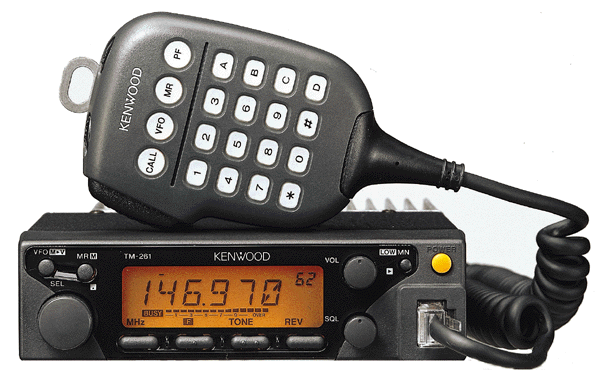
"What does this radio do that others like it don't?" That's the key question I try to answer whenever I write a review. And for several months now, I've been trying without success to answer that question about Kenwood's TM-261A. And then it struck me-the answer is "nothing"-and that's why I like the radio so much! This is the sort of radio that sets a standard, the sort of radio to which others will be compared: "What does the Whatzit-2000 do that the TM-261 doesn't?" A Little of Everything The Kenwood TM-261A is a 50-watt, single-band 2-meter FM transceiver, suitable for mobile use or base operation (with a 12-volt power supply). It has 63 memory channels (62 regular and one "call channel"), each of which will store frequency, offset, CTCSS tone, DTSS tone (more on this later), and an alphanumeric tag. It gives you a choice of three power levels, 50 (High), 10 (Medium) and 5 (Low) watts, but does not let you store power settings in memory (the European version, the TM-261E, runs 10, 1, and .5 watts and transmits only on 144 to 146 MHz). There are also 10 DTMF (touch-tone) memories for making autopatch calls and an easy-to-read backlit display (see Photo A). This radio also has expanded receive coverage, starting with the 118- to 136- MHz (AM) aircraft band. It automatically switches over to FM at 136 MHz and monitors everything between 136 and 174 MHz, including public service and NOAA Weather Radio at 162 MHz (you may manually select AM on any frequency, but it's for receive only). There are also several scanning options, plus a variety of ways to customize the radio to your operating style and preferences. Versatility and flexibility are hallmarks of this radio. And just about everything makes sense, both inside and out. Layout of parts and workmanship are straightforward and neat (see Photos B and C), and the sequences of programming keystrokes for the various functions are clear and sensible. Easy to Use Two of the things I like most about the TM-261A are the intuitive nature of its programming and its ease of use. If you want to operate simplex on 145.52 or to use a repeater with a standard offset and no CTCSS ("PL") tone, you can do I right away, even before you read the manual. This is thanks to factory-default settings of a 600-kHz "split" and a feature called automatic repeater offset, or ARO. Using this feature, the radio will automatically pick the offset direct (plus, minus, or simplex), based on the most common practice for the receive frequency you've chosen. If the radio "isn't sure, " it will default to simplex and you'll have to pick the offset manually. Making programming changes is easy. To store a memory channel, for example, you just dial up the receive frequency you want, make sure the CTCSS tone is set correctly (also easy, but you will have to read the manual to learn how to do it), then press the F key and turn the main dial to the number of the memory in which you want to store this frequency. Next, press MR (for Memory Recall) and hold it in for a second. A "+/-" appears on the screen and you can then dial in the transmit frequency. Finally, press MR again and all of your information is stored. Once you get the hang of it, it's quick and easy. Several other factors contribute to he TM-261A's ease of use. For example, when you're tuning through the memories, the radio beeps each time you change frequencies (unless you've shut off the beeps). But when you come all the way around to channel 1, the beep has a different tone. Same with the power control. Medium and low power have one tone when you switch to them; high power has a different one. These varying beep tones allow some extent of "eyes-free" operating, letting you change memories or power levels without taking your eyes off the road. (It's also a great help for the visually impaired ham.) "PF" the Magic Button Another excellent feature of this radio is a mic button labeled PF. It stands for Programmable Function, and you can pick one of several options for what it will do. The default setting is the "MHz" function, which lets you tune the VFO in 1-MHz increments. I set up mine to all direct keypad entry o frequencies. And, if you read the manual carefully, you'll learn that PF's companion keys on the microphone, marked VFO and MR, are also programmable. If the VFO and memory recall functions don't suit your needs, you may reprogram these keys to do a variety of other things (you'll have to read the manual for specifics). Yet another example of the TM-261A's flexibility is giving the operator a choice of frequency steps. You can choose 5, 12.5, 10, 15, 20, or 25 kHz per click of the tuning dial. Why is this important? First of all, half of the U.S. uses 15-kHz repeater spacing on 2 meters, and the other half uses 20-kHz spacing. Many rigs offer 15- or 20-kHz tuning steps, but not both. So is you're in the wrong part of the country for that radio, you're stuck using 5-kHz steps. With the TM-261, you can tune from one repeater frequency to the next with a single click, no matter where in the U.S. you are. Secondly, some satellites, such as AO-27, operate on an Ôin-between" frequency, such as 145.9875 MHz. Even the "standard" 5-kHz step won't get you there, but the 12.5-kHz step can (just make sure you're on an "even" frequency, such as 145.9750, before switching to the 12.5-kHz setting). Additional Features The TM-261A has just about every feature you can thing of for a single-band FM rig, so I can't list them all here. Among my favorites are alphanumeric labeling of memory channels, which lets you program in a club name or repeater location (see Photo D) if remembering frequencies isn't your thing; direct selection of CTCSS frequencies (CTCSSS, by the way, stands for Continuous Tone-Coded Squelch System, but is more commonly referred to by Motorola's trademarked name for it, "PL," which stands for Private Line¨); a variety of scanning options; and three different types of tone options-CTCSS, DTMF, and DTSS. DTMF stands for Dual-Tone Multi-Frequency which was first made popular by AT&T in its Touch-Tone¨ push-button phones. Of course, the most common ham use of DTMF tones is for making phone calls via repeater autopatch systems. The TM-261A makes this easy for you by offering 10 special DTMF memories (separate from the frequency memories), each of which can hold up to 16 digits. These autodialer memories let you make autopatch calls with the minimum of distraction from tasks, like driving down the highway. The manual doesn't spell out what DTSS means, but it looks like it should stand for Dual Tone Selective Signaling. When DTSS is activated, your radio remains squelched until a pre-programmed, three-digit DTMF code is received. This means you can keep your radio turned on in the office or kitchen and not be bothered by the normal chit-chat, but when someone specifically wants to call you (and knows you code), he or she can punch in your DTSS code and your radio "wakes up and talks to you." DTSS can also be used for group calls, such as for emergency callups. The radio also offer three selectable delay times (350, 550, or 750 milliseconds) to make sure the tones are properly relayed by repeaters that may have long key-up times. In addition, if you get the optional CTCSS tone decoder (the encoder is standard), you can combine CTCSS and DTSS to keep your radio squelched util a signed containing the correct CTCSS tone and the right three-digit DTMF combination is received. Hot Under the Collar I have yet to find the perfect radio (but I'm still looking), and even the TM-261, which is basically an excellent unit, has a few flaws. The two most noticeable ones are heat buildup and a super-sensitive SWR protection circuit. As in any of today's 50-watt radios, which are smaller than my 10-watt radio of 15 years ago, power creates heat and heat has to be dissipated somewhere. Nearly half of the TM-261's body is heat-sink (see Photo E), and, when you're operating at high power for more than, say a half-hour, even in a normal QSO, the radio gets really hot. For
instance, my commute to the CQ VHF office is about an hour. If I'm talking
to people all along have the way using a repeater that requires high power,
I need to shut down the radio five to 10 minutes before I arrive at the
office, or I'll risk burning my hand when I disconnect it to take it inside
with me (I like to be sure I have it for the return trip).
The
super-sensitive SWR circuit has driven me crazy. First of all, this is
a good circuit to have: it shuts down the transmitter in the face of a
high SWR rather than risk damage to the final amplifier transistor. But
it seems that nearly any variation in the SWR of the antenna system will
set it off.
At
first, I though it was a problem with the radio, but over the course of
several months, I talked to three different people at Kenwood about it,
and they all agreed that is has to be an SWR problem. I've gone through
three antennas and a variety of feedlines, have had the problem both at
home and in the car, and still run into it occasionally. It seems to be
totally unpredictable. The only component of the antenna system that has
been unchanged throughout is the coax "pigtail" coming out of the back
of the radio (see Photo E again) and connecting to an SO-239, to which
you then connect your feedline. And I haven't been able to test the SWR
on that little piece of cable.
The
radio is also very sensitive to its own RF field. If your antenna is directly
overhead and you're running on high power, you're likely to get a vibrating
kind of sound when you key up, and you'll find that the transmitter never
really came on. If this happens, reduce power and the problem should go
away. For a permanent solution, try mounting the antenna as far from the
radio as possible.
My
final gripe is that the default frequency on which the radio powers up
in 144.000 MHz. The inexperienced operator who turns on the radio for the
first time and keys up the mic could conceivably end up in trouble from
the start-the frequencies between 144.000 and 144.100 MHz are reserved
(in the FCC rules) for CW only, and modulating an FM signal at 144.000
will result in out-of-band signals, since the modulation will take the
frequency both up and down from the center (which is what's on the display).
A default power-up frequency in the middle of the band at, say, 146.000
MHz is a safer option.
All
in All
Despite
its few quirks, the TM-261A is an excellent radio packed with useful features.
As long as you keep the rig and antenna well separated and maintain a low
SWR, it should provide years of excellent service. |
 |
|