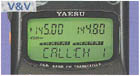
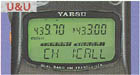
| USER
HELP DISPLAY |
| Pre-programmed
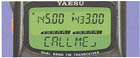
User-Help messages guide you through most operational function selections
and settings with simple descriptions of functions and keystrokes - even
informing you which type of battery pack is attached. |
|
|
| SPECTRUM
SCOPE |
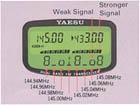
| View station signal strength
and activity above and below a selected channel - simply turn the DIAL
to center a signal of interest on the scope and press the PTT to operate!
You may also view groups of programmed memories for activity. |
|
|
| DTMF
PAGING |
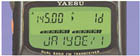
| Selective DTMF calling
and private paging features allow you to quietly monitor until calls directed
to you (stations in groups you select) are received. Ten code memories
are available to store the 3-digit ID code of frequently called stations
or groups you wish to monitor (one is reserved to store your personal ID
code). An additional code memory always stores the last 3-digit DTMF code
received. Upon receiving a page, you can have a ringer alert you in one
of three ways - with a default melody, a user-composed (programmed) melody
or have the FT-51R's CW annunciator decode and play back the ID in Morse
Code (1, 3 or 5 times). You can also enable the panel lamp to come on when
a page is received. Answer-Back and Page-Forwarding modes confirm your
page was successfully received while you were away from your FT-51R by
automatically signalling the calling station. |
| DTMF
MESSAGE PAGING |
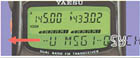
| In
addition, DTMF messages up to twelve characters long can be sent to other
stations. A memory bank stores up to 10 outgoing messages and up to 9 received
messages. You can use the factory-programmed outgoing messages or program
your own message. Received messages are displayed and automatically stored
for later retrieval. For autopatch operation, a 10-memory, 15-digit DTMF
autodialer stores frequently-called numbers for playback. The DTMF autodial
memories can also be tagged with alphanumeric names. |
|
|
| DTMF
CW DECODER w/MORSE CODE PLAYBACK |
| For
both DTMF paging and DTMF Message Operation, the FT-51R can be set to decode
DTMF number sequences and play back the received message or paging ID in
Morse Code - great when you-re in the next room or can't take your eyes
off the road while driving! |
| DUAL
IN-BAND RECEIVE |
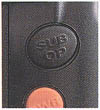 The
FT-51R includes dual simultaneous reception of two frequencies, either
on different bands, or on the same band, allowing mixed VHF & UHF or
UHF & UHF reception. Toggling operation and settings between VHF and
UHF is now quick and easy with a press of the "Sub-Op" button. Also included
on some versions is extended 420-470 MHz and 118-180 MHz receiver coverage
with AM receive capability (for 118-137 MHz Air Band transmissions). The
FT-51R includes dual simultaneous reception of two frequencies, either
on different bands, or on the same band, allowing mixed VHF & UHF or
UHF & UHF reception. Toggling operation and settings between VHF and
UHF is now quick and easy with a press of the "Sub-Op" button. Also included
on some versions is extended 420-470 MHz and 118-180 MHz receiver coverage
with AM receive capability (for 118-137 MHz Air Band transmissions). |
|
|
| FULL-DUPLEX
MODE & RECEIVER MUTING |
| Improved
cross-band and full-duplex operation with "Duplex" mode and automatic sub-receiver
muting allows enhanced telephone-style cross-band full-duplex operation
- great for use with personal telephone autopatch units. Cellular-style
separation of microphone element and internal speaker allows telephone
handset style operation for privacy. |
| EASY
OPERATION & PROGRAMMING |
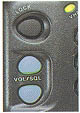 A
single knob for volume and push-buttons for squelch control simplify
handling and operation. The VFOs and memories are completely programmable
from the front 20 key keyboard, which can be used to control scanning,
independent TX/RX frequencies, programmable offsets, sub-band limits for
band scanning, selectable scan skip for busy channels, selectable scan
resume modes. priority monitoring and dual instant recall Call channels.
Seven standard channel step sizes can be selected; and I MHz steps are
always available for fast QSY. A
single knob for volume and push-buttons for squelch control simplify
handling and operation. The VFOs and memories are completely programmable
from the front 20 key keyboard, which can be used to control scanning,
independent TX/RX frequencies, programmable offsets, sub-band limits for
band scanning, selectable scan skip for busy channels, selectable scan
resume modes. priority monitoring and dual instant recall Call channels.
Seven standard channel step sizes can be selected; and I MHz steps are
always available for fast QSY. |
|
| 120
MEMORY CHANNELS |
 In
addition to twin independent VFOs, each band has 60 general-purpose memories
(55 general-purpose along with 5 special memories used for bandscanning
limits and the Call channel). Memories can be tagged with an 8-character
alphanumeric name which can be displayed instead of the frequency (memory
capacity is reduced to 80 with 40 memories per band with alpha-numeric
mode enabled). In
addition to twin independent VFOs, each band has 60 general-purpose memories
(55 general-purpose along with 5 special memories used for bandscanning
limits and the Call channel). Memories can be tagged with an 8-character
alphanumeric name which can be displayed instead of the frequency (memory
capacity is reduced to 80 with 40 memories per band with alpha-numeric
mode enabled).
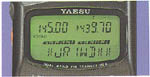
Searching for station activity has
never been easier with VFO, memory and programmed-limit (sub-band) scanning
and the new spectrum scope feature. Select all or only those memories you
want to be scanned. When activity is found, scanning can be set to halt,
resume after five seconds, or resume when the station stops transmitting.
The Scan Lamp can also be enabled to come on when scanning stops on activity. |
 |
| LARGE
BACKLIT LCD & ILLUMINATED KEYPAD |
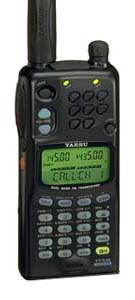
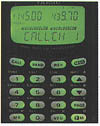 The
LCD and translucent keypad have selectable backlighting modes and provide
dual 5 digit frequency readouts and indications for most programmable functions,
plus relative signal strength and power output reading on separate bargraph
meters. The upper display shows operating frequency and most programmable
functions. The lower display scrolls User-Help menu and DTMF paging messages,
and also doubles as the Spectrum Scope display for viewing channel activity. The
LCD and translucent keypad have selectable backlighting modes and provide
dual 5 digit frequency readouts and indications for most programmable functions,
plus relative signal strength and power output reading on separate bargraph
meters. The upper display shows operating frequency and most programmable
functions. The lower display scrolls User-Help menu and DTMF paging messages,
and also doubles as the Spectrum Scope display for viewing channel activity. |
| HIGH-EFFICIENCY
RF DESIGN |
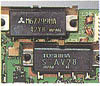 New
MOSFET RF Power Amplifier module technology enables full power output with
only a 9.6 volt battery (or PA-10A DC Power Adapter). A wide range of power
saving features ensures maximum operating time. Five selectable TX power
levels, with an economy-low level (20mW) for maximum battery life during
short range communication plus the TX Save function dynamically monitors
received signal strength and reduces RF power accordingly, ensuring you're
not wasting extra power to maintain communications! New
MOSFET RF Power Amplifier module technology enables full power output with
only a 9.6 volt battery (or PA-10A DC Power Adapter). A wide range of power
saving features ensures maximum operating time. Five selectable TX power
levels, with an economy-low level (20mW) for maximum battery life during
short range communication plus the TX Save function dynamically monitors
received signal strength and reduces RF power accordingly, ensuring you're
not wasting extra power to maintain communications! |
| POWER-SAVING
FEATURES |
| Unique features extending
operating time include Yaesu's enhanced ABS (Automatic Battery Saver),
which memorises operating history and optimises the save duration accordingly,
TX Save automatically reduces transmit power during periods of high receive
signal strength. Yaesu's selectable 10, 20, or 30 minute APO (Automatic
Power Off) to turn off the radio after a period of inactivity. The battery
voltage can be displayed on the LCD and you can monitor battery voltage
drop while you transmit. In addition, LCD and keypad lamp have selectable
continuous or 5-second illumination. |
| MISCELLANEOUS |
| The built-in CTCSS (Continuous
Tome-Coded Squelch System) provides 39 subaudible tones which can be stored
in each memory independently. ATS (Auto Tone Search) allows you to identify
subaudible tones being used by other stations. The CTCSS Bell feature can
be set to ring when the tone squelch opens.
Automatic Repeater Shift (ARS) can
be enabled to set standard repeater shift automatically when tuned to repeater
sub-bands (except Australian versions). The FT-51R can also be configured
as a one-way or bi-directional cross-band repeater.
The keypad serves as a DTMF encoder
during transmissions and the DTMF Autodialer stores up to ten of your favourite
numbers in memory (up to 15 digits each). A 1750 Hz tone burst generator
is provided in European versions (in place of squelch override in other
versions).
Multi-combination transceiver lock
lets you disable controls of your choice - PTT, keypad buttons, dial knob
or volume control.
The FT-51R is compatible with most
options for the FT-11R/FT-41R series.
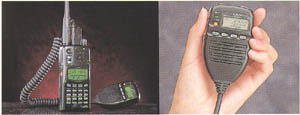
The MH-29A2B Hand Speaker/Mic &
Display is available as an option, providing a remote LCD (display) and
duplicating most-used front panel keys (including a user-programmable key). |
 |
|
|
SPECIFICATIONS
|
| GENERAL |
| Frequency Range: |
2-m: 144-146
MHz or 144-148 MHz |
|
70-cm: 430-440
MHz or 430-450 MHz |
| Channel Steps: |
5, 10, 12.5,
15, 20, 25 & 50 kHz |
| Repeater Shift: |
2-m: ±600
kHz (programmable) |
|
70-cm: ±1.6,
±5.0 or ±7.6 MHz (programmable) |
| Emission Type: |
F2, F3 |
| Supply Voltage: |
4.0 to 12 V
DC |
| Current Consumption: |
| Auto Power
Off |
| Stand-by (Saver
On) |
| Stand-by (Saver
Off) |
| Receive |
| TX (@ 9.6
V DC) |
|
| 2-m |
70-cm |
| 200 µA |
200 µA |
| 16.9 mA |
16.3 mA (34 mA dual-RX) |
| 52 mA |
49 mA (85 mA dual-RX) |
| 195
mA |
| < 1.6 A |
<1.9A |
|
| Antenna (BNC
jack): |
YHA-55 rubber
flexible |
| Case Size (WHD): |
57 x 123 x
26.5 mm (w/FNB-31) |
| Weight (approx.): |
330 g w/FNB-31
& antenna |
|
| RECEIVER |
| Circuit Type: |
Double-conversion
superheterodyne |
| IFs: |
2-m: 45.05
MHz & 455 kHz |
|
70-cm: 58.525
MHz & 455 kHz |
| Sensitivity: |
2-m: < 0.158
µV |
| (for 12 dB
SINAD) |
70-cm: <
0.180 µV |
| Adjacent Channel
Selectivity: |
2-m: > 65 dB |
|
70-cm: > 60
dB |
| Intermodulation |
2-m: > 65 dB |
|
70-cm: > 60
dB |
| AF Output: |
0.2 W @ 8-Ohms
for 10% THD |
| TRANSMITTER |
| RF Output: |
2-m: 5.0/3.0/1.5/0.5/0.02
W |
|
70-cm: 5.0/2.5/1.5/0.5/0.02
W |
| Frequency Stability: |
better than
±5 ppm |
| Modulation
System: |
Variable Reactance |
| Maximum Deviation: |
±5 kHz |
| FM Noise (@
1kHz): |
better than
-40 dB @ 1 kHz |
| Spurious Emission: |
> 60 dB or
better |
| AF Distortion
(@ 1 kHz): |
< 5% w/3.5
kHz deviation |
| Microphone
Type: |
2-k Ohm condenser |
|
| Specifications subject
to change without notice or obligation. |
|