| DIGITAL SIGNAL PROCESSING |
| PAPER NO. 1 |
 |
 |
 |
|
|
IC-308 DIGITAL SIGNAL PROCESSING (B.Tech 6th/7th Semester,2121) Time : 3 Hours Maximum Marks : 60 NOTE:- This paper consist of Three Sections. Section A is compulsory. Do any Four questions from Section B and any two questions from Section C Section-A Marks : 20 1(a) What is the property by which shaft-invariant system is characterized? (b) Define the terrm Stability and Causality. (c) Find the inverse z-transform of 1/(1-az-1). (d) Prove the shifting property as applicable to z-tranfsforms. (e) Define the Hamm window used for design of FIR filters. (f) When the Chirp-z transform alorithm is used? (g) List the assumptions concerning the effect of quantization of products. (h) What is the nature of noise taken while designing IIR digital filters? (i) Determine whether the system is Causal T[x(n)] = ex(n). (j) If x1(n) and x2(n) are two perodic sequences of period N with DFS X1(k) and X2(k) resp, determine the sequence x3(n) for which the DFS is X1(k) X2(k). Section-B Marks:5 Each 2. Consider a two dimensional linear shaft-invarient system with input x(m, n) output, y(m, n) and unit-sample response h (m, n) show that if x(m, n) and h(m, n) are both separable then y(m, n) will also be seprable. 3. Consider a linear shaft-invariant system with impulse response h(n) and input x(n) given by h(n)=an, n>=0. h(n)=0, n<0 x(n)=1, o<=n<=(N-1) x(n)=0, otherwise. 4. A finite impulse response filter has frequancy response filter has frequency H(ejw) = |H(ejw)|e-jwno. Where n0 is not necessarily an integer. Let N be the length of the unit sample response. Unit -impulse response is completely specified by N samples of H(ejw) taken at w=2πk/N, k=0,1,.......N-1. Write a general expression for h(n) in terms of the H(k). (Do not assume n0=0). Sketch h(n) for the case n0=(N-1)/2=7 and n0=N/2=15/2 for H~(k) defined as : 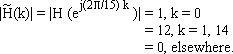   Section-C Marks : 10 Each 7. Giving the basic design formula or Butterworth approximations design a digital filter using bilinear transformation. 8. Give tha analysis of Quantization effects in Fixwd point FFT algrothims. 9. Discuss Decimation-in-frequency FFT algrothims. |
| 1 |