| COMMUNICATION SIGNALS AND SYSTEMS |
| PAPER NO. 2 |
 |
 |
 |
|
| PUT ON: Dec, 2K2 |
|
EC-202 COMMUNICATION SIGNALS AND SYSTEMS (B.Tech 4th Semester,2122) Time : 3 Hours Maximum Marks : 60 NOTE:- This paper consist of Three Sections. Section A is compulsory. Do any Four questions from Section B and any two questions from Section C Section-A Marks : 20 1(a) Describe briefly the forms of noise to which a transistor is prone. (b) Write Fourier transform of Dirac delta function. (c) What is an ergodic process? Explain. (d) Differentiate between joint and conditional probability. (e) Explain various properties of probability density function. (f) Define S/N ratio and Noise Figure of a receiver. (g) Draw a Normalized Gaussian Distribution function. (h) Define Convolution theorm. What are their applications? (i) Draw the waveform of a sine function. (j) What is necessary and sufficient condition for Causality in filters? Explain. Section-B Marks:5 Each 2. Find Fourier transform of a rectangular pulse. 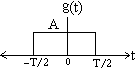 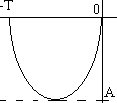 f(x) = x e-x(x)/2 x >= 0 = 0 x < 0 find: (a) P (0.5< x <=2) Probability (b) P (0.5 <= x < 2). 5. A reciever connected to an antenna whose resistance is 50 ω has an equilent noise temperature resistance of 30 ω Calculate the receivers noise figure in decibels and its equalent noise temperature. 6. Specify the sampling rate and sampling interval (Nyquist) for each of the signals. (a) sin2C (200 t) (b) sin2C (100 t) + sin C (100 t). Section-C Marks : 10 Each 7. Explain various properties of Fourier Transform and prove Time Shifting Property. 8. The joint probability density of the random variables X and Y is f(x,y) = x e-x(y+1) in the range of 0 <= x <= ∞ and 0 <= y <= ∞ and f(x,y) = 0 otherwise. (a) Find f(x) and f(y) the probability density of X independent of Y and probability density of Y independent of X. (b) Are the rendom variables dependent or independent ? 9. Write short notes on any two of the following: (a) Gaussian noise (b) Low Pass filters (c) Matched filters. |
| <<PREVIOUS 1 2 3 4 NEXT>> |