| APPLIED MATHEMATICS-3 |
| PAPER NO. 3 |
 |
 |
 |
|
|
AM-201 APPLIED MATHEMATICS-III (B.Tech 3rd Semester,5001) Time : 3 Hours Maximum Marks : 60 NOTE:- This paper consist of Three Sections. Section A is compulsory. Do any Four questions from Section B and any two questions from Section C Section-A Marks : 20 1(a) Find the locus represented by | z - 2 i | = 2. (b) If f(z) = x2 + i y2, find the points in the z plane where f'(z) is defined. Also find its value at these points. (c) Distinguish between the zeros and poles of a function w = f(z). Can an analytic function have zeros and poles ? (d) Define Jn(x) and write the differential equation which has Jn(x) as its solution. What are the values of Jo(x) and J1(x) ? (e) State Rodrigue's formula and use it to evaluate P2(x). (f) Eliminate arbitary functions f and g from u = f(x + i y) + g(x - iy) and classify the resulting partial differential equation. (g) Define Fourier sine-cosine over the interval -π to π. Is it possible to write this series for the constant f(x) = 2 over this interval. (h) Define Laplace transform. If f(s) is the Laplace transform of f(t) then what is the laplace transform of  (i) Write the partial differeantial equation which governs the steady state distribution of temperature inside a circular plate whose both faces are insulated and the circumference is kept at steady temperature f(θ). Also write its boundary conditions and initial conditions if any. Section-B Marks:5 Each 2. Derive necessary form of C.R. equations for a function w = f(z) to be analytic. Also find the image of the circle | z - 1 | = 1 in w plane under the mapping w = z2. 3. Show that with usual notions xnJn(x) is the solution of 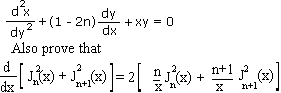 4. Solve the following partial differential equations: (a) (y + z) p + (z + x) q = x + y (b) 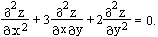 5. Given that c is a constant, show that it is possible to write:  6. (a) Find the Laplace transform of f(t) = t/T, 0 < t <=T = 1 , t > T (b) Find the inverse Laplace transform of (s + 2)/(s-2)3 Section-C Marks : 10 Each 7. (a) Evaluate 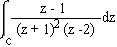 where c is | z - 2 | = 2. (b) Use method of contour integration to evaluate:  8. (a) Prove that with usual notations:  (b) Use method of Laplace transform to solve the differential equation : (D2 + 5D + 6)x = t et given that x=2, dx/dt = 1, at t = 0. 9. Use method of seperation of variables to solve the wave equation and use this solution to obtain the diflection u(x,t) of a vibrating string of length l whose end points are fixed and the string is given zero initial velocity and initial deflection: f(x) = 2kx/l; 0 < x < l/2 = (2k/l)(l-x); l/2 < x < l. |
| <<PREVIOUS 1 2 3 |
| SIMILAR PAPERS:- Mathematics-3 for CSE |