
Click on any picture for a larger
image

|
||||||||||||||||||
|
Click on any picture for a larger
image
|
||||||||||||||||||
| It
is my belief that all the cardboard houses we have seen thus far were made by
a single Japanese company. The doors and windows, methods of construction, -
just the look and style of everything about them tells me this is so. The name
of that Company is something I would dearly love to know! Recently, the name
"BLUME" has appeared on some boxes and packaging containing some smaller
postwar houses of the same style, construction, doors and windows as the grander
examples from the '30's, - almost assuredly made by the same people. Whether
this is a brand name or a company name is not known. If it is the company name,
however, they might still be found - and found to still be in business, like
The Stanley Company of Japan which made so many of the now-collectible Christmas
lights prewar. If so, like Stanley - they are probably doing something quite
different today. Stanley now makes a very broad line of L.E.D.s, hi-tech computer
and electronic instrument displays. Though seemingly very different, I don't
think the COMPOS were made by someone else. Contemporaries of the 1930's cardboard
houses, they are quite a different thing. Yet, the type of windows and the basic
invention of the hole-in-the-back for string lights are there, so it could be
the same company again, possibly a company that also made other paper novelties
and compo incense-burners that were popular in the dimestores throughtout the
year. |
||||||||||||||||||
|
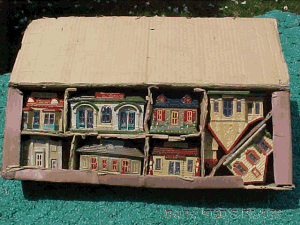
COMPOS,
or "composition" houses are actually gypsum, or plaster-of-paris reinforced
with a little fiber for strength, though you could hardly call them strong!
This boxed set of the basic 8 village pieces is over 60 years old, brand new,
and there is no company name on the box, which is completely plain and unadorned
except for the price: 98 cts.! and the ubiquitous "Made in Japan."
|
|||||||||||||||||
|
|
|
|
|
|
|
|
|
|
|
|
|
|
|
|
|
|
|