| Q | |||
|
STING
Ex-police goes sacred
Published in PRESS Magazine November/December 2003
Composer, singer, musician, actor, activist – Sting has won universal acclaim in all these roles, but defies any easy labeling as he crosses cultural lines and cuts through the barriers between "high" and "pop" art -- a Sting hallmark ever since his own beginnings. Husband and father of six, masterful guitarist and bassist, a devoted Yoga practitioner, and now a writer who'll publish his memoirs in 2004, he's made a career out of pushing music’s boundaries to its limit with his uninhibited artistry.
The idol of millions of rock fans, Sting first became a music icon during his years as lead singer of The Police. After the band broke up in 1984, Sting began an equally successful solo career, blending a mix of rock, jazz, and pop music. Now, 29 years and 12 solo albums later, with numerous awards including 16 Grammys, an Emmy, a Golden Globe, several other outstanding musical achievement awards from prestigious award-giving bodies, an honorary Doctorate of Music degree from Northumbria University, an honorary degree from Berklee College of Music, not to mention several humanitarian awards, talented singer-songwriter Sting continues to bring listeners through amazingly breathtaking aural experiences with his beautiful musical arrangements and probing themes.
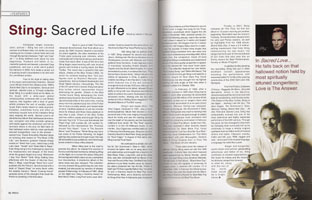
True to his style of taking risks in his music and surprising listeners, Sacred Love, Sting’s brand new release since 1999’s Brand New Day is no exception. Sensual and spiritual, Sacred Love, a 12-track collection finds Sting in a soulful mood as he takes on his music with a wide-open global consciousness combined with a cool British reserve, that together with a slew of guest artists produce the sort of worldly, soulful music that's rarely heard on radio anymore. The result is an album that is a sophisticated mix of pop, jazz, funk and world music. Complex, sometimes funny and often an extremely musical look at the maladies Sting sees warping the world, Sacred Love is an adventurous album that addresses terrorism, war, corruption and other societal upheaval and reacts against the emotional void left by terrorism where in the end, he falls back on that hallowed notion held by most spiritually attuned songwriters: love is the answer – sacred love. And he gets this message across with his brilliant song writing, and smooth vocals. Guest Anoushka Shankar plays an amazing sitar weave on “The Book of My Life”, and flamenco guitarist Vicente Amigo excels on “Send Your Love”, which has a mild Latin beat. "Inside" and "Dead Man's Rope," finds Sting rising to the challenge by capturing the helplessness and despair of the times while the gospel-tinged love song "Whenever I Say Your Name" finds Sting trading lines effectively with the Queen of Hip-hop Soul, Mary J. Blige. Lead Single “Send Your Love" pulsates like the Police’s Synchronicity with a dash of "Desert Rose" for extra flavor while the sleekly trance-y "Never Coming Home" samples some of the strengths that made the Police so arresting in the first place.
For a man focused on the future, Sting seems to draw more freely upon his past with heart and soul. Sacred or profane, that's hard not to love.
The Son of a Milkman
Born Gordon Matthew Sumner on the 2nd of October, 1951 in the town of Wallsend, Northumberland, England, a working class district of Newcastle-upon-Tyne, Sting, as he would be known to the world, was the eldest of four children, who grew up in the harsh climate and harsh economy of the depressed, unemployment-racked North-east. His own family though, was never poor as his father's steady job as a milkman led to them owning a small dairy in later years.
As a student, Sting acquired a grant-aided place at an otherwise fee-paying Catholic grammar school though gave himself no chance of the outstanding academic achievement he was capable of. Neither did he give himself the chance to fulfill a potentially promising athletic career when he could finish "only" third in the 100 yard sprint National Junior Championship. Apparently, it seemed as if it was no use to him if he couldn't be number one.
Still, he displayed a natural gift for music at an early age, playing and making up his own songs from the time he picked up an uncle's discarded guitar at eight or nine. He spent his formative years listening intently to artists and styles as diverse as The Beatles, Stax, Tamla, Bob Dylan, Thelonious Monk and Charlie Mingus. Inspired equally by jazz and the Beatles, it was this combination of eclectic tastes that would prove prophetic when he would form the Police in his twenties and would soon led them to a position of global preeminence in the 1970's and '80's.
The first band he saw live was in 1965. Sting was fourteen. Playing were The 1965 edition of The Graham Bond Organization, featuring his early bass hero Jack Bruce (later of Cream) and the second, coincidentally, was Zoot Money's Big Roll Band with one Andy Summers on guitar, though Sting was unimpressed at the time. The following year, a friend gave him his first bass, homemade and crude, but nonetheless an introduction to the instrument. About two years later, at 17, Sting started to get paid as a musician while touring the world as a musical performer on the Princess Cruise luxury-vacation line.
In 1969, he qualified for a university place in the Midlands but was so uninspired by what he found that he returned to Newcastle and his parents' home within a month. Drifting a couple of years through unskilled labor on a building site, a bit of bus conducting and a brief shot at a career in tax collection, he tried to make ends meet as a construction worker, bus conductor and income tax clerk. Then, in 1971, Sting at last began to sort himself out. He trained as a school teacher at St. Paul's Roman Catholic First School in Cramlington, England where he taught English and enjoyed the stage-like aspects of the classroom, though outside the classroom, he was also a football (soccer) coach.
Humble Beginnings
It was also during this time that Sting began to take his music out of the bedroom and started playing for several jazz bands. He began playing bass for a college rock group called Earthrise and also eventually joined The Ronnie Pierson Trio and the River City Jazz Band. He also became a member of The Phoenix Jazzmen – a jazz band where all the members had a nickname. It was while he was with this band that he received what would be his famed nickname, Sting. Apparently, when he came to a rehearsal one day in a waspish yellow-and-black striped soccer sweater, trombone player Gordon Solomon remarked that Sting looked like a bee, which led to him being called "Stinger", a nickname which eventually became that perfect nickname "Sting." Game to tackle anything from Coltrane to The Beatles with bozzy gusto, Sting also played for the ramshackle but locally beloved Newcastle Big Band. Eventually, in 1974, with three friends, he formed Last Exit. Two years later, with Last Exit still playing local pub residencies, in May 1976 he married Frances Tomelty, a fast-rising actress he'd met while playing bass for a rock musical at a Newcastle theatre 18 months earlier. In October of that same year, their first child, Joe, was born. Where as all this could have implied a settling-down phase for most people, Sting had other plans in mind. He quit his job as a teacher so that he could move his family down to London with Last Exit and make it big. Unfortunately, 1976 was a hard year for a generation of would-be British rockers who had prepared themselves well and spent their youth learning to "really play" so when the opportunity knocked, they would be ready and fully qualified for stardom, because along came punk and with that, the Sex Pistols, and that old world turned upside down as pop entered one of it's periodic and purgative "rebellious" phases. Hard-won craftsmanship would soon be surplus to requirements. Attitude was what you needed. Although Last Exit had a fanatical following of 300-400 on Tyneside and Sting's songwriting had secured a modest publishing contract with Virgin, there was no sign of a record deal anywhere. Sting, then 25, initially unraveled by this new phenomenon, anxiously took stock. Across town, indeed quite unaware of one another's existence, Stewart Copeland, then 24 did the same thing.
The Police
Stewart Copeland had the drum seat in a famous but worn-out Progressive rock group called Curved Air, whose only hit single, Back Street Luv, dated from 1971 and whose undiminished reputation as live performers guaranteed no more than a lot of work for little reward. After Curved Air’s last gig at students' party just before Christmas '76 and finally calling it a day, Stewart with singer Sonja Kristina ended up at another local collage, listening to the second half of Last Exit's set. Stewart didn't think much of the group, but after watching Sting play for a few minutes at a local college, he got interested and asked local rock journalist Phil Sutcliffe for an introduction.
Seeing quite a lot of the punk vanguard, Stewart was contemplating on forming a new band in the same vein. He contacted Sting and thought he'd persuaded him to come to London -- not knowing that was what he'd planned already, as Last Exit’s farewell-to-Newcastle gig was already booked even before Sting met Stewart Copeland. On February 12, 1977, Stewart and Sting together with 24-year-old guitarist Henri Padovani, a Corsican with a beard, long hair and three chords, recorded the first Police single, “Fallout”, a Copeland composition.
Wheeling and dealing frantically, Stewart offered himself and Sting to New York punk/groupie artiste Cherry Vanilla - as band members, that is - in exchange for the support spot on her British tour. In early March, they did their first-ever gig at the Stowaway club in Newport, South Wales and The Police got £15 a night between them. Their set of 13 songs, mostly written by Stewart, took about 20 minutes to blitz through. They completed the tour and a jaunt around Holland and France, supporting another act, Wayne Country, then looked for some gigs on their own account. But the gloomy truth was that nobody liked them because reasonably enough, nobody believed in them -- they were too old, they were too musicianly, they were quite plainly not the real thing.
|
|||
| S | |||