| Q | |||
|
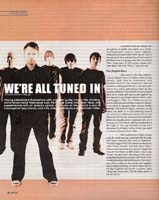
WE'RE ALL TUNED IN Don't turn that dial! Read about famed English band, Radiohead. Published in PRESS Magazine June 2003
Having established themselves with a tuneful guitar rock in the nineties, world-famed band Radiohead took the risk of doing what they liked, end experimented with an eclectic variety of sounds as they found a way to fuse together jazz chords, rock riffs, classical textures and electronic noise.
A band that does not identify with one genre but glides over music as a whole, Radiohead has passion, heart, intensity, intelligence and personality in their sound. Now, a decade later in the music business, Radiohead has definitely come a long way since their first album Pablo Honey back in 1993 as they release their sixth album Hail to the Thief on June this year.
Way back in the late eighties, Raidohead vocalist and guitarist Thomas Edward Yorke, guitarist Ed O’Brien, drummer Philip James Selway, bassist Colin Charles Greenwood, and guitarist and keyboardist Jonathan Richard Guy Greenwood were all students at Abingdon School, a private boys' school in Abingdon, a small, picturesque town on the outskirts of Oxford. Forming what would later be known to the world as Radiohead, their five-man band titled On a Friday was bound together by their interest in Joy Division and the Smiths. After several gigs in 1987, On a Friday was put on hold as the boys pursued their academic careers in an effort to appease their already frantic parents. Music, however, as all artists could attest to, is not something anyone could put a lid on. While some do it for fame, and others do it for fortune, there are those incredibly gifted and equally driven musicians who do it because it’s in the blood. And nothing is farther from the truth for the five members of then disbanded On A Friday, as they finally regrouped in Oxford in the summer of 1991.
Gaining a deal with EMI Records before changing their name to Radiohead, after a Talking Heads song, the band earned their first commercial broadcast when "Prove Yourself", from their debut album, Pablo Honey, was voted Gary Davies' "Happening Track Of The Week" on BBC Radio 1. But it was “Creep,” the alternative rock song of 1993, that catapulted Radiohead’s success when it became a worldwide hit. With Thom Edwards crooning the song’s self-loathing lyrics, “I’m a creep, I’m a weirdo, I don’t belong here,” that stretch over driven guitars as the sounds swirl together before simply exploding, the band made it into the UK Top 10 and the US Top 40. In no time, Pablo Honey was announced a Top 30 debut album at the US Top 40.
In March 1995, Radiohead’s second album, The Bends was released. The hypnotic “High and Dry,” “Fake Plastic Trees,” and “Street Spirit (Fade Out)” were some of notable tracks from the album. By the end of 1995, The Bends earned Radiohead a BRIT Awards nomination for best band of the year. In 1996, Radiohead was nominated for an MTV Video Music Award for Breakthrough Video for the song “Just” and the haunting “Talk Show Host” was included in the Romeo and Juliet Soundtrack.
Two years later, Radiohead caught a wave of generational anxiety as they released OK Computer, the album that won the band their first Grammy Award in 1998 for Best Alternative Rock Performance (Airbag / How Am I Driving?). They also received a Grammy Award Nomination for Album of the Year and when the nominations for the 1998 Brit Awards were announced, the front-runners included Radiohead with 3 nominations for Best Group, Best Album for OK Computer and Best Single for "Paranoid Android" which was also nominated for an MTV Video Music Award for Breakthrough Video.
Their next album took tree years to record, but in 2000, Kid A was released shocking all Radiohead listeners as the band once again pushed limits and delivered an album with a highly electronic set. The band won another Grammy Award for Best Alternative Album and were nominated for Album of the Year and Best Music Video Long Form (Meeting People Is Easy). Hitting #1 on the LP charts and certified gold by the end of the month, Kid A placed at Billboard 200’s number 1.
Barely eight months later, in 2001 the equally challenging Amnesiac followed, once again earning the band a Grammy Award Nomination for Best Alternative Music Album. Now, once again, Radiohead pushes forward with their music as audiences wait in anticipation for the release of the band’s 6th album, Hail to the Thief as they prepare themselves to discover yet again how Radiohead’s music has evolved as it continues to be an aural delight.
Attempting to sum up the mood of the time as all their previous albums did, Jonathon explains that the album’s title Hail to the Thief “…is kind of a conflict between the two thing. “This record,” he says it’s about feeling like, you know, looking forward to escape from it and/or kind of shouting about it.” “I think that’s why we ended up calling it Hail to the Thief really because it was basically the rise of the of the doublethink and the rise of general intolerance and the madness and feeling very much like individuals were totally out of control of the situation,” Thom says in a breath. “That somehow it was a manifestation of something not really human like a cloud like entering the next Dark Ages or Middle Ages.”
Hail to the Thief had been had been in the works for just under a year. In a span of several months, Radiohead came up with this 14-track album that is as emotionally, mentally and spiritually honest as their previous ones which make for the character and the make-up of each record. “The music is totally sort of quite bright then if not bright then energetic and positive and the performance and our whole sort of attitude and everything are sort of like that,” says Thom of the music in the album. “It has that shininess, which is a happy sound, I think relatively speaking for us. But lyrically it comes from a different place. The force of the music gave me license to explore all these things.”
Described by the band to be “quite a vocal-led record,” Hail to the Thief presents a new-sounding Thom Yorke, as the vocalist takes on a more experimental approach to the various capacities of the human voice as a musical instrument and ironically ends up refinding his voice while producing a really rich but relaxed sound.
‘There, There,’ the first single to be released from Hail to the Thief was the longest recorded song in the album. Ironically, it almost didn’t make it to the album. “It made me cry when we finished it, actually,” shares Thom. “It’s just there one day and I think that’s why I cried when I heard the mix because it was like I was so shocked that it was there I thought we’d lost it or whatever and it was really important to me and it was right there one day so and that sort of feeling can sustain me then for months, you know, I’m not bothered about anything else for months. Anything else I can just about cope because you know because we found it and there it was. I think that’s why it’s the first single as well.”
An album described by Philip to be to “grounded so much more in the performance” than their previous albums, Hail to the Thief opens with “2+2=5” which according to Thom is “in the true Radiohead style, totally misleading” as it opposes the overall atmosphere of their last album.
In the past, huge rock bands are known to sport certain hair styles and come up with their own lingo. Radiohead members, however, remain to be the group of smart English guys they were when they first started, who are in their late twenties and early thirties, with three of the members married, two of whom have kids. And while success may drive others to push aside non-career concerns, Radiohead front man Thom shows how success could be as much of a family affair with the beautiful, stunning “Sail to the Moon.”
Sail to the Moon I sailed the moon I spoke too soon And how much did it cost? I was dropped from A moonbeam And sailed on shooting stars
Maybe you'll Be president But know right from wrong Or in the flood You'll build an Ark And sail us to the moon Sail us to the moon Sail to the moon
“It was written for my little boy,” muses Thom. which I’ve decided to be honest about, because it’s fairly obvious I suppose,” he says. "And it’s just a very personal song, I think.” Collin shares, “’Sail to the Moon’ is the kind of song which when you hear the demo of it you could just put that on the record and everyone would swoon. It’s a real case of ‘Don’t walk on the grass, don’t step on the flowers’ when you’re playing it,” continues the band’s bassist. “So you really just try and like play as little as possible to get in the way of the tracks. It’s got that great James Bond sort of ‘Moonraker’ vibe to it when they switched the gravity machine off in the studio and everyone’s sort of floating around with the curly, coily leads like tethering you to your amplifiers and stuff. It’s brilliant,” gushes Collin, obviously very passionate about the song.
|
|||
| S | |||