| Q | |||
|
THE STRINGS OF PAT METHENY a A feature on music legend Pat Metheny and how he redefined jazz
Published in PRESS Magazine November 2003
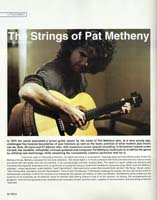
In 1975 the world welcomed the lyrical guitar player by the name of Pat Metheny who, at a very young age challenged the musical boundaries of jazz listeners as well as the basic premise of what modern jazz music can be. Now, 28 years and 27 albums later, with numerous music awards including 14 Grammies tucked under his belt, the versatile, influential, 14-Grammy Award winning virtuoso guitarist and composer Pat Metheny continues to re-define the genre by utilizing new technology while remaining to be the consistently creative performer that he is.
True to his style of challenging listeners, his latest recording is no exception. Steering away from the refined luster of the Pat Metheny Group, Pat Metheny released his first solo collection, One Quiet Night, a 12-track collection that finds one man and one voice at home and alone with one guitar and one mic, in an unsurprisingly intimate, hushed affair. The result is a quiet, subtle yet stunning and extremely moving aural experience from an artist who is constantly trying to extend the limitations of popular song. While most are Metheny originals – some improvised, some familiar (“Last Train Home”), there are some covers that include Keith Jarrett's 'My Song", Norah Jones' "Don't Know Why" and Gerry and the Pacemakers' “Ferry Cross The Mersey”. Effortlessly drawing the listener into his own sound world of kaleidoscopic musings in which his musical voice transports the senses into realms of other-worldliness, Pat Metheny give audiences the essence of his musicality as he explored tunes for himself while letting listeners drop in on the session. As always, the arrangements are gorgeous, the chord progressions meditative and musically honest, and the music, capable of communication and provoking emotional response.
But of course, that’s all just part of the Pat Metheny trademark.
Born Patrick Bruce Metheny to a musical family on the 12th of August, 1954 in the town of Lee’s Summit in Kansas City, Missouri, guitarist and composer Pat Metheny, as he would be known to the world years later, has been exposed to music literally all his life. Since his birth, whether it was jazz, classic music, or Big Bands of the time, like the Glen Miller’s and Harry James’s, music was a permanent part in the Methenys’ family life.
It was eventually older brother Mike’s excellent trumpet playing that piqued Pat’s interest for music. By the age of 8, fascinated by John Coltrane’s music, he started playing the trumpet and at age 10 began to take lessons from his brother’s teacher, who was the Director of the High School Band of Lee’s Summit. Pat, however, upon realizing at an early age that he was not naturally gifted a trumpet player as his brother, switched to what was, at that time, the icon of youth culture all over the world -- the guitar. At age 12, thanks mostly to the Beatles, which also originated his love for the guitar, Pat bought a small acoustic guitar (a Trivia) and after winning his father’s resistance, and with his mother’s help, later received a Gibson ES-140 T 3/4 as a present.
The first thing he learned was the theme from Peter Gunn, followed by “The Girl from Ipanema.” It didn’t take long before the jazz bug bit Pat as he took an instant liking to the Miles Davis records that his brother brought home.
There was no stopping Pat Metheny from that time on.
Soon after he learned the basics, at age 12, he started "The Beat Bombs", his first band with four friends. By the age 14, Pat was playing gigs in the Kansas City Jazz Clubs where he got the chance to jam with some of the best musicians in town like Gary Sivils, Tommy Ruskin and Julie Turner, as he received valuable on-the-bandstand experience from people who have had an effect on his music to this very day. At that same age, after witnessing Wes Montgomery’s performance during the Kansas City Jazz Festival, Pat Metheny was taken by the desire to devote himself to jazz guitar. Exclusively listening only to jazz music for the next four years, Pat Metheny found himself passionately studying "Big Names" like Grant Green, Jim Raney, Kenny Burrel, Jim Hall, and Wes Montgomery, which eventually led to the development of his own distinct style of lyricism that found favor among the New Age audience.
At age 15, with the “New Sound Trio” group, Pat Metheny debuted as a jazz musician. He gained immense experience from playing pieces by Wes Mongomery and Sonny Rollins, writing jingles and performing on TV shows, playing in circus bands, playing as supporting guitar for various singers and in theatre musicals, but above all, playing "opening" pieces in some jam sessions along with "big" artists stopping over in Kansas City including Herbie Hancock whom he got to play with during one of these sessions when he was 16.
After Pat Metheny graduated from Kansas City High School in 1972, "finally" being able to do without playing in the school band, he went to Miami University, Florida, where together with an excellent Department of Economics, there was also a very good Jazz one. It was here where Pat met a few musicians who would play an important role in his musical evolution and in the birth of the Pat Metheny Group itself. These included Steve Morse, Andy West, Will Lee, Michael Walden, Jaco Pastorius, Hiram Bullock, Rod Morgenstein, and Mark Colby. However, in 1973, after just a little over a year in the university, Pat left his university course and participated in the academic arena as a music educator in order to teach at the new course of electric guitar started by Miami University to compete with the one at Berklee College in Boston. At the age of 18, Pat was the youngest teacher ever at the University of Miami. At 19 he duplicated that feat at Berklee College Of Music, where he also became the youngest teacher ever at the said university and where in 1996, more than twenty years later, he received an honorary doctorate. Gaining further experience with more jam sessions, he performed more frequently and slowly became better known in the world of Jazz music.
In 1974, at the Wichita Festival, Pat Metheny, at age 19, first burst onto the international jazz scene when he played together with vibraphone great, Gary Burton’s for the first time. His three-year stay with the band led to the Pat being featured on three of the vibraphonist’s ECM albums – Ring, Dreams So Real and Passengers – as he contributed some fluid Wes Montgomery-influenced guitar patterns and displayed what would soon become his trademarked playing style that blends the loose and flexible articulation with rhythmic and harmonic sensibility – a way of playing and improvising that was modern in conception but grounded deeply in the jazz tradition of melody, swing, and the blues. It was then that Manfred Eicher of ECM Records, upon seeing his potential, initiated a partnership that lasted for 10 exceptional albums. Regularly topping jazz record charts and even making regular appearances in the pop album charts, Pat Metheny, along with Keith Jarrett, became ECM's biggest-selling artist.
Reinventing the traditional “jazz guitar” sound for a new generation of players, Metheny, in 1975, released his first album Bright Size Life, with his friends of his own trio, Jaco Pastorius and Bob Moses. An album that received favorable response from the American press, Bright Size Life introduced Metheny’s engaging compositions and unique instrumental conception and since then, he has been considered as one of the most innovative jazz musicians and composers who is not afraid of embracing other genres.
In 1977 Metheny along with brilliant keyboard player Lyle Mays, whom he met at the University of Miami, started the Pat Metheny Group, one of the most acclaimed and influential musical ensembles of the past quarter century with a rock band format that produced album after album of melodious jazz/rock. Since then, Metheny has been part of a writing team with Lyle Mays for more than twenty years. Over the years, the PMG has seen many musicians come and go, but these two remain constant along with bassist Steve Rodby. One of the longest running bands in contemporary jazz that are still together, the Pat Metheny Group is the only group in history to win seven consecutive Grammy awards for seven consecutive releases. Twenty years later since they formed, the Pat Metheny Group released their eleventh studio album, Speaking of Now in 2001, where their sound has evolved to a new level though they continue to surprise and delight listeners with the unexpected yet always endless promise of imagination and pure melody that was invoked from the first notes of their first record. Metheny has also been a musical pioneer in the realm of electronic music. Fascinated by the musical possibilities of the guitar synthesizer or synclavier, Metheny was one of the very first jazz musicians to treat the synthesizer as a serious musical instrument, and years before MIDI technology was invented, Metheny was already using the Synclavier as a composing tool. Metheny had also been instrumental in the development of several new kinds of guitars including the soprano acoustic guitar, the 42-string Pikasso guitar, Ibanez1s PM-100 jazz guitar, and a variety of other custom instruments. Over the course of more than 25 years as a recording artist and since the release of his first album and the Pat Metheny Group, guitarist Pat Metheny has created an expansively impressive body of work. Releasing album after album that every time brilliantly documents another aspect of his unique and nearly uncategorizable musical journey, Metheny exhibits an insatiable creative energy with exceptional versatility that allows him to participate in just about every avenue of modern music-making that the early 21st century might offer a musician.
Over the years, Metheny’s body of work includes compositions for solo guitar, small ensembles, electric and acoustic instruments, large orchestras, and ballet pieces, with settings ranging from modern jazz to rock to classica, as well as a series of highly influential trio recordings, award winning solo albums, scores for hit Hollywood motion pictures, duets with major artists such as Charlie Haden and Jim Hall, and collaborations with other significant figures in modern music such as Ornette Coleman, Steve Reich and many others.
page 1 l next page >> |
|||
| S | |||