|
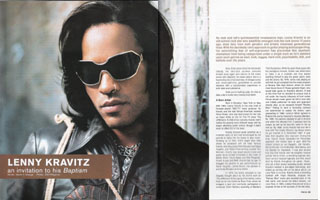
LENNY KRAVITZ ::
AN INVITATION
TO HIS BAPTISM
The rockstar, his lifestyle and his latest release, Baptism
Published in PRESS
Magazine
July
2004
As
rock and roll’s quintessential renaissance man, Lenny Kravitz is an old-school
rock star who stealthily emerged onto the rock scene 15 years ago, drew fans
from both genders and briskly traversed generational lines. With his decidedly
retro approach to guitar playing and songwriting, his astonishing feat of
self-expression has prevented this aesthetic chameleon from being categorized
under a single style as he's dabbled upon such genres as soul, funk, reggae,
hard rock, psychedelic, folk, and ballads over the years.
Now, three years since his
last studio release, the retro-rock soulman reinvents himself once again returns
to the music scene with Baptism, his latest album that is a fascinating
mix of old and new, of vintage Lenny and Lenny-right-now, guaranteed to provide
listeners with a transcendent experience in both style and substance.
Grab you’re bathing suits, it’s time to take a dip in some very rocking holy
water.
A Born Artist
Born in Brooklyn, New York
on May 26th 1964, Lenny Kravitz is the only child of Russian-Jewish NBC-TV news
producer Sy Kravitz and the late African-American actress Roxie Roker, who was
best known for her role as Helen Willis on the hit '70s TV show The
Jeffersons. A child of two cultures, Kravitz didn't realize his parents were
different races until he began attending grade school, though it didn't seem to
affect him in the least.
Kravitz showed great
potential as a musician early on and was encouraged by his parents to delve into
his desire to play music. Growing up on New York's Upper East Side where he
socialized with his folks' famous friends, including poets Nikki Giovanni and
Maya Angelou, and Nobel Prize-winning novelist Toni Morrison, Kravitz was raised
around music and easily found himself immersed in the music of Bobby Short,
Count Basie and Ella Fitzgerald. Drawn to jazz and R&B, Kravitz had, by age 10
dragged his parents to see performances by Sarah Vaughan, James Brown, the
Jackson 5, and Duke Ellington among others.
In 1974, the family
relocated to Los Angeles brought about by his mom’s work on The
Jeffersons.
At the urging of his
mother, Lenny tried out for the California Boys Choir where he snagged a spot
and eventually participated in conductor Zubin Mehta's recording of Mahler's
Third Symphony. While he spent three years with the prestigious chorale, Kravitz
was determined to make it as a musician and thus started teaching himself to
play the guitar, piano, bass and the drums. By 1978, Lenny was playing so well
that he got accepted into the music program at Beverly Hills High School, where
he would meet future Guns N' Roses guitarist Slash, who would later guest on
Kravitz's albums. It was at this time that he decided to pursue rock & roll
under the heavily influence of funk rocker Prince whose music genre he fell in
love with and initially patterned his style and approach directly after, as he
renamed himself "Romeo Blue." Failing to land a recording contract but
determined to realize his dream, upon graduating in 1982, Lenny’s father agreed
to finance the young musician’s musical attempts. By 1985, his parents decided
to get a divorce and while this affected him, it seemed that his career, as well
as his love life, were on the up and up. By 1986, Lenny Kravitz met and fell in
love with The Cosby Show's Lisa Bonet whom he got married to in November 1987. A
year later, their daughter, Zoe, was born. During this time, Kravitz wisely
discarded his Prince-like approach and looked back to such '60s/'70s classic
rockers as Led Zeppelin, Jimi Hendrix, Stevie Wonder, Curtis Mayfield, Bob
Marley, and the Beatles for inspiration. It was also around this time that
Kravitz met his longtime musical partner Henry Hirsch, a recording engineer who
liked Lenny's musical ingenuity and who would stick by Kravitz throughout his
career. Hirsch, who ran a New Jersey recording studio, shared Kravitz's interest
in pre-digital technology, and ended up working with on his debut album Let
Love Rule. In no time, Kravitz inked a recording contract with Virgin
Records, dropped the "Romeo Blue" name and reverted back to his real name, and
issued his debut release, Let Love Rule, in 1989, a debut that proved to
be a surprise hit due to the success of the title track, which became a hit
single. While things were looking up for Lenny’s career, his marriage, on the
other hand was on the rocks. In 1991, four years after they married, the couple
split up and in 1993, the divorce was finalized, an event that had a lasting
impact on Kravitz reflected by many of his songs.
A pioneer of a return to
basic recording, Kravitz’s talents as musician and producer have been heavily in
demand since Let Love Rule, leading to production credits that include
part of the Superfly II soundtrack, Madonna's "Justify My Love," for which has
partial composing credit as he demonstrated his ability to write in different
styles, and an album with French singer Vanessa Paradis. Kravitz’s appeal also
reached his peers, evident in his collaborative efforts with noted artists in
the music community. In 2002, Kravitz played guitar on the song "Guns & Roses,"
from Jay-Z's The Blueprint 2: The Gift and the Curse. He recently
recorded the song "Show Me Your Soul" with P. Diddy, Loon and Pharrell of the
Neptunes, for a single that celebrated their celebrity and also appears on the
song "Maybe" of the new N.E.R.D album, Fly or Die.
One of the preeminent rock
musicians of our time, Kravitz has, thus far, released six albums under Virgin
Records, all of which have been certified either platinum or multi-platinum.
Hitting first with Let Love Rule (1989), this was followed by the
stronger Mama Said (1991), the rocking Are You Gonna Go My Way
(1993), the kaleidoscopic Circus (1995), the ecclectic 5(1998), the
international smash Greatest Hits (2000) and intimate Lenny
(2001).
Achieving tremendous
critical acclaim and commercial success with a succession of outstanding
groundbreaking album releases, Kravitz also has, from 1999 to 2002, won an
astounding four consecutive Grammy Awards, setting a record for the most wins in
the “Best Male Rock Vocal Performance” category for his singles “Dig In”
(2002), “Again,” (2001), “American Woman” (2000), and “Fly Away” (1999).
Representing one of the most successful stretches of recognition for any
musician in the awards ceremony's history, never before in Grammy history has an
artist won four consecutive awards in this category. In 2003, Kravitz received
his fifth Grammy nomination in the category for “If I Could Fall In Love” off
his album, Lenny, and was also was honored that same year with his first
American Music Award for Favorite Male Artist.
Lenny Kravitz is Reborn in
Baptism
 Now, after a lengthy
absence, Lenny Kravitz recently released his highly anticipated seventh studio
album last May on Virgin Records. Aptly titled Baptism, his first record
in three years is a blistering, 13-track take-notice effort from start to finish
that aims to establish an artistic rebirth as the sensual soul-rocker opens a
new chapter in his life that comes complete with an album cover representing a
spiritual and musical renewal that shows Kravitz with his eyes closed, lying
half-submerged in a sea of blood (or possibly red paint), naked apart from a
strategically placed guitar slung across his chest. Now, after a lengthy
absence, Lenny Kravitz recently released his highly anticipated seventh studio
album last May on Virgin Records. Aptly titled Baptism, his first record
in three years is a blistering, 13-track take-notice effort from start to finish
that aims to establish an artistic rebirth as the sensual soul-rocker opens a
new chapter in his life that comes complete with an album cover representing a
spiritual and musical renewal that shows Kravitz with his eyes closed, lying
half-submerged in a sea of blood (or possibly red paint), naked apart from a
strategically placed guitar slung across his chest.
An album originally
intended to be a colorful, '70s-style funk album, the course of the record
changed after the 39-year-old rocker visited his old hometown of New York City
in the fall of 2003 where he was reminded of an earlier time in his life when he
was a burgeoning musician. Finding nostalgic comfort in that trip, he
rediscovered his form and returned to the simplicity of his musical genesis. As
a result, he started writing new songs on a friend's acoustic guitar before
heading back to his Miami studio and exploring those songs from which a simple,
more straightforward album with a bunch of more guitar-laden rock-oriented songs
emerged.
A bit of a one-man show,
Kravitz, for Baptism, wrote (or co-wrote), produced, arranged and
performed all the tracks on the album from singing lead and background vocals to
playing majority of the instruments (save for string sections and saxophones),
from every thumping bass line, to every lofty drum kick and rocketing electric
and acoustic guitar riff, where at times he adds on percussion in the form of
timpani, woodblock and hand claps on some tracks or uses a keyboard, a Moog and
Mellotron on others. While much Baptism follows Kravitz's trademark
retro-rocking style that captures the elements of ‘60s and '70s-inspired soul,
rock and funk and fusing them into a powerful musical revelation that gives it a
modern twist, there is also a certain freshness about the album, evident in the
number of different styles present in it and the album’s irrepressible sense of
spontaneity and urgency and its undeniable ‘live’ feel.
An introspective album that
crosses the often-opposing forces of romance, religion and career, Baptism
finds Kravitz getting down and personal in this album where a great deal of
soul-searching takes place, as he writes tunes that feel like a diary of a
post-rock star where even some of the harder-edged songs are more soulful,
intimate and reflective than usual.
Baptism
kicks off in typically
strutting fashion with the edgy and psychedelic opener “Minister of Rock n Roll”
which marries a techno beat with Kravitz's amazing vocal power. Other potent
rockers on the album also include the lusty "Lady," inspired by Kravitz's
relationship with Kidman is another solid
page 1
l
next page >>
|