|
CRASH COURSE
ON EXISTING MUSIC GENRES ::
DANCE & ELECTRONICA
<< back
l
page 2
HOUSE
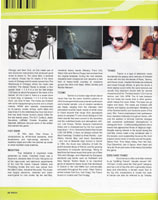 The daddy of all dance
music genres, House music just happened in the mid '80s in Chicago and New York,
as DJs made use of new electronic instruments that produced good music to dance
to. Ten years later, it seemed so natural. House has its origins in the disco
music of Chicago and its name comes from The Warehouse in
Chicago,
where the music was invented. The classic House is simple: a four quarter beat:
1 2 3 4 in a not too fast tempo (120 bpm) at about the speed of the heart of the
dancer. On the 2 and 4, there is a snare drum or hand clap; in between 1 2 3 4
of the bass drum, you hear hi hats. The tracks are finished with some
happy/swinging sounds and a simple melody. Whilst also typically characterised
by its pianos, vocals, strings, synth stabs and bass lines it is the relentless
four-four kick drum that has been house music's raison d'être for the last
twenty years. The KLF, Coldcut, Jesse Saunders, Leftfield, Frankie Knuckles and
Marshall Jefferson are just some of the artists/DJs behind this genre. The daddy of all dance
music genres, House music just happened in the mid '80s in Chicago and New York,
as DJs made use of new electronic instruments that produced good music to dance
to. Ten years later, it seemed so natural. House has its origins in the disco
music of Chicago and its name comes from The Warehouse in
Chicago,
where the music was invented. The classic House is simple: a four quarter beat:
1 2 3 4 in a not too fast tempo (120 bpm) at about the speed of the heart of the
dancer. On the 2 and 4, there is a snare drum or hand clap; in between 1 2 3 4
of the bass drum, you hear hi hats. The tracks are finished with some
happy/swinging sounds and a simple melody. Whilst also typically characterised
by its pianos, vocals, strings, synth stabs and bass lines it is the relentless
four-four kick drum that has been house music's raison d'être for the last
twenty years. The KLF, Coldcut, Jesse Saunders, Leftfield, Frankie Knuckles and
Marshall Jefferson are just some of the artists/DJs behind this genre.
FAST HOUSE
At 150+ bpm, Fast House is characterized by off-the-beat basslines, short
breakdowns and high-energy elements in repetitive styles and often has pitched
up vocals or small modified vocal snatches.
INDUSTRIAL
True Industrial is
organized noise presented as music. Industrial music was a dissonant, abrasive
style of music that grew out of the tape-music and electronic experiments of the
mid-'70s bands Cabaret Voltaire and Throbbing Gristle (the term was coined from
the latter's label, Industrial Records). The music was largely electronic,
distorted and rather avant-garde for rock circles. By the mid-'80s, industrial
dance bands Ministry, Front 242, Nitzer Ebb and Skinny Puppy had evolved from
the original template. During the next decade, industrial went overground and
became a new kind of heavy-metal courtesy of crossover groups like Nine Inch
Nails, White Zombie and Marilyn Manson.
TECHNO
Techno is a harder edge
driven dance music that has the same rhythmic patterns as other house genres but
uses a harder synthesizer and a harder sample. Lots of creative variations are
made, ranging from the intensely hard percussive sounds made mostly of white
noise to found sounds that range from apocalyptic sirens to sampled TV and movie
dialogue to the disco sounds that were around in the seventies and the undefined
beats and atmospheric chill-out. Like House, Techno features mechanical beats
and is characterized by the four quarter bass drum: 1 2 3 4. Somewhat faster
than House (126-130 BPM), it does not always contain the disco handclap. Created
by three friends - Juan Atkins, Derrick May, and Kevin Saunderson - who met at
Belleville High School in Detroit in 1984, the music was reflective of both the
post-industrial decay of Detroit, and the growing importance of computer
technology. Taking its lead from the house music that came out of New York and
Chicago, and influenced by European electronic pop bands such as Kraftwerk and
Gary Numan Techno Music is an important genre of electronic dance music that
developed in Detroit in the mid-1980s but commercially successful throughout the
world. Other Techno artists include Carl Cox, Carl Craig, The Future Sound of
London and The Prodigy
TRANCE
Trance is a type of
electronic music that blends the spacey sonic textures of Ambient music with the
fast drumbeats of Rave, Techno, and House music. Usually the beats are subdued
and mixed through effects, to give the drums a more spacey sound while the sonic
textures are usually long keyboard chords held for several measures at a time.
The basic beat is 1 2 3 4, hence techno, and 140+ BPM. The hi hats between the
four beats are louder than in other genres, which makes the music hotter. The
bass can go higher and lower. The tracks are finished with dreamy and spacey
soundscapes. Breaking out of the German techno and hardcore scene of the early
'90s, Trance emphasized brief synthesizer lines repeated endlessly throughout
tracks, with only the addition of minimal rhythmic changes and occasional
synthesizer atmospherics to distinguish them -- in effect putting listeners into
a trance that approached those of religious origin. Despite waning interest in
the sound during the mid-'90s, trance made a big comeback later in the decade,
even supplanting house as the most popular dance music of choice around the
globe. Aphex Twin, Timo Maas, Moby, Paul Van Dyk, Paul Oakenfold, Jam & Spoon,
Atom Heart and Tony de Vit are just some of the many DJs behind this genre.
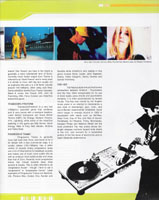 EURO/HARD TRANCE EURO/HARD TRANCE
Euro trance is often and
often refered to as "Uplifting Trance". Usually around 140-145 bpm, it falls
under the “feel good” category and has a lot of big rifts with a generally heavy
bass and oftentimes, a female vocal. Due to the big rifts, breakdowns & vocals
this style of trance can also be referred to as "cheesy trance" (the "trance"
you hear in the charts is generally a more commercial form of Euro). Currently
much harder edged Euro Trance is referred to as "Hard Trance" and in many ways
it is similar to Euro, with big (but usually not so euphoric) rifts and a is a
bit faster (usually around 145-150bpm), often using acid lines. Some artist/DJs
behind Euro
Trance Cascade, Blank &
Jones, Kai Triacid, ATB, John 00 Flemming, K90, Ferry Corsten are Artist/DJs
behind the genre.
TRANCECORE/FREEFORM
Trancecore/Freeform is a
very fast (160bpm+) specialist genre that combines acid & euro trance with a
hardcore bassline. Label behind trancecore are Great British Techno (GBT), Nu
Energy, Stompin Choons, XY2, Lightning, while some of the Artist/DJs dabbling in
this genre are Billy Bunter, Kevin Energy, Helix & Fury, Rob Vanden, M-Zone and
Tekno Dred.
PROGRESSIVE TRANCE
Progressive Trance is
generally more laid back than Euro, and tends to be a lot deeper with a less
commercial edge. It is usually slower (130-140bpm), has a wider variety of
sounds (many progressive tunes use a lot of tribal techno & breakbeat sounds)
and makes use of much more subtle rifts as well as employs more subtle builds
and drops than that of Euro. Recently much progressive trance has moved towards
deep tribal sounds & breaks. This is often referred to as "progressive house" -
though I tend to call it "progressive" or "progressive trance". Label examples
of Progressive Trance are Bedrock, UG, Phuture Wax, Coded, Eve, Sander and
Guerilla while Artist/DJ’s who dabble in this genre include Steve Lawler, John
Digweed, Sasha, Pablo Gargano, Danny Howles and Sander Kleinberg
TRIP-HOP
Trip Hop is a style of music that hovers somewhere between Ambient - Psychedelic
and Hip Hop. Most recognizable for its use of down beats, jazzy chords and
psychedelic samples, it is often accompanied by female vocals. Trip-Hop was
coined by the English music press in an attempt to characterize a new style of
downtempo, jazz-, funk-, and soul-inflected experimental breakbeat music which
began to emerge around in 1993 in association with labels such as Mo'Wax, Ninja
Tune, Cup of Tea, and Wall of Sound. Portishead, DJ Shadow, Tricky, Morcheeba,
Sneaker Pimps and Massive Attack are the most prominent Trip Hop artists whose
full-length releases routinely topped indie charts in the
U.K. and account for a substantial portion of the first wave of electronica acts
to reach Stateside audiences.
© Valerie
V. Mayuga, 2005
<< back
l
page 2
|