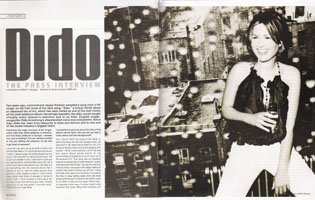
DIDO: THE NON-ANGEL’S LIFE
FOR RENT
There's more to Dido
than Eminem and Rosswell
Published in PRESS
Magazine
October 2003
Two
years ago, controversial rapper Eminem sampled a song from a UK singer on the
first verse of his dark song, "Stan," a lyrical rhyme about an obsessed fan of
his, which has been hailed as one of the best tracks off his multi-platinum
album. Hauntingly beautiful, the silky vocals caught virtually every listener’s
attention and in no time, English singer-songwriter Dido Armstrong's disembodied
voice was everywhere. Since then, Dido has risen from obscurity to fame and
fortune and is now one of the music industry's biggest stars.
Known
for her ethreal and misty voice and her emotionally intense and passionate
music, Dido has proven over time that she is more than just back-up vocal
material. Her voice, her music, her honest songwriting and her genuine passion
for her craft is a breath of fresh air from the pop artists that now are all
over the place. Four years ago, her trip-hop-laden pop created waves among
critics and audiences alike as her debut album No Angel became the
world's biggest selling record of 2001, is said to have generated an income of
£12 million.
Born
Dido Florian Cloud de Bounevialle Armstrong on December 25, 1971, in London,
England, pop chanteuse Dido (pronounced DYE-doe) was named after a character in
Virgil's Aeneid, the founder and queen of Carthage. The daughter of a literary
agent and a poet (Dido's mother used to write poems as a hobby), she grew up
living in a book-filled Islington house without the luxury of television.
Musically gifted even as a child, Dido started off playing music just five years
later. Singing, humming, and tooting away on a recorder she had stolen around
the house, Dido showed the early potential to be a musical prodigy. True enough,
barely six years of age, she traveled the European continent as a child prodigy
playing the recorder. By the time she turned six, her innate talent at playing
instruments became even clearer, and she was accepted at the London’s Guildhall
School of Music in London, England where, by the age of ten, she had already
mastered piano, violin and the aforementioned recorder. Eventually, as a teen,
Dido traveled around the United Kingdom performing with her classical music
ensemble. It was also at this point that she began exploring other musical
options aside from the ones falling under the classical genre. She started
listening to her brother’s record collection and started sneaking some of them,
from the ones by punk-rock band The Clash to pop group Duran Duran. At 16, she
fell in love with the music of jazz legend Ella Fitzgerald. Originally only
interested in playing musical instruments, her deep passion for music coupled by
the influence of her brother's eclectic record collection and the sultry Ella,
Dido began singing with different bands around London.
When
her tour with a British classical ensemble ended, she accepted a publishing job
and worked as a literary agent by day and a part-time law student by night. In
1995, her brother, Faithless mastermind, noted DJ and dance music producer Rollo
Armstrong, founded the trip-hop outfit Faithless. Not to tune out on the music
pulsing through her veins, Dido was interested in recording an album, but was
afraid to ask her brother for a break with his band. Thus, she spent time
loitering around the Faithless studio in hopes that she would be asked to
contribute her vocals to his band. Her persistence paid off and she ended up
contributing backing vocals to several tracks on her brother’s band. On the
Faithless’ 1996 debut, Reverence, Dido lent her rapturous vocals to
“Flowerstand Man”, which received favorable reviews. Over the next couple of
years, Dido toured the world with Faithless, which sold an excellent five
million copies of their album worldwide. An experience very different from her
classical days, Dido loved the lifestyle – meeting all kinds of new people and
gaining excellent exposure. At the same time, Dido began working on solo
material, developing a lushly ethereal sound combining elements of acoustic pop
and electronica and recorded demos of her own songs whenever she was back in
London.
Despite her brother’s advice to steer clear of the music business and keep her
day job, Dido, not intending to give up singing, pursued the idea of a solo
career and continued to record her own demo while performing with Faithless. In
1999, when Rollo sold his small label, Cheeky, to Arista for £3m, Dido, as part
of Cheeky’s roster, came along for the ride and proved that she has a good
enough voice to do something other than backup singing in her brothers
ethno-techno group.
The
success of Faithless' debut album Reverence, helped propel Dido's solo
career. Apparently, Arista records heard some of Dido’s demos, including “My
Lovers Gone,” at the beginning of 1997. Her classical training coupled with that
certain breathy quality to her voice made record producers take notice. On that
same year, while on touring hiatus with Faithless, she was invited to meet with
über-producer Clive Davis, the man responsible for finding talent like Janis
Joplin, Whitney Houston, Bruce Sprinsteen and Santana. The meeting led to an
audition which led to a recording contract, which eventually led to the release
of Dido’s debut LP No Angel in mid-1999.
Ironically, while it was her brother who initially dissuaded her from singing,
Rollo Armstrong was one of the producers of No Angel, together with Dido
herself, Rick Nowels and techno-scientist Youth. An album as beautifully
melancholic as Mary Shelley's Frankenstein set to a trip-hop symphony, Dido
revealed in her gentle instrumentation, moving songwriting and cracked-crystal
voice the power and intensity of human emotion. The pain of love was especially
highlighted in her music. But she also sings that spurned love can also reveal
inner strength. An album of mid-tempo ballads, No Angel proved to be a
unique sound experience for those looking for wonderful, deep modern music where
the songs played out beautifully in that quiet zone between slumber and
consciousness, where life opens all doors and the music can flow freely.
However, though No Angel proved to be an album that touches the soul with
its wonderful craftsmanship, had already sold 1 million copies and was released
to critical appreciation, it received little public attention.
Enter
controversial rap superstar, Eminem. While Dido continued to promote her work-
performing in clubs, she also contributed her song "Thank You" to the soundtrack
of the film, Sliding Doors which starred Gwyneth Paltrow. The song caught
the attention of one rather influential individual – none other than rap star
Eminem. Using samples from Dido's "Thank You," in Eminem’s song “Stan,” released
on November 2000, the song was a runaway success and catapulted Dido’s fame to
meteoric heights as she also appeared as his wife in the song’s video. While
Dido has an established fan base in her native England, Eminem’s “Stan” really
did increase her profile in the United States as it opened the door for her and
provided her with instant exposure to a large audience. “Thank You” was used
once again for the HBO film If These Walls Could Talk 2.
 Then
there’s that popular Warner Brothers teen science fiction drama
Roswell,
about aliens on earth coping with high school life, where Dido’s “Here With Me”
became the hit series’ theme song. Then
there’s that popular Warner Brothers teen science fiction drama
Roswell,
about aliens on earth coping with high school life, where Dido’s “Here With Me”
became the hit series’ theme song.
With
an appearance alongside Eminem on Saturday Night Live, as well as solo
appearances on talk shows such as Late Night With Conan O'Brien, The Tonight
Show with Jay Leno and The Late Late Show With Craig Kilborn and intense
American airplay, Dido became part of the mainstream music scene. In no time,
Dido’s songs were receiving airplay and her album and star began to rise. People
began to notice that there was more to Dido’s No Angel than just that
song from which Eminem took samples from. And when audiences started to listen
closer, Dido got rave reviews not only from critics, but fans as well. But the
end of 2001, No Angel was named the world's biggest selling record of the
year, is said to have generated an income of £12 million
Amazingly, not only has No Angel contributed to Dido’s success, but her
success has substantially boosted the value of British record sales in the first
financial quarter of 2001, pushing the sale of CD albums over the £1 billion
mark for the first time. Apparently, it's long-players like Dido's No Angel,
which has been in the UK album charts for over 31 weeks in 2001 that have
contributed to high sales for both CDs and vinyl.
Despite the title of her first album, No Angel, Dido definitely has one
of the most angelic voices around. The combination of Dido's haunting and
distinctive voice, soft acoustic guitars and great song writing, with a dash of
electronica, has proved to be a big hit with fans around the world. A refreshing
change from all the recycled pop music going around, it’s a breath of fresh air
to listen to an artist with a different creative approach. With songs that are
smooth, and lyrically sophisticated tributes to love and life, her music screams
of emotion.
No
doubt about it, Dido is here to stay. With her gorgeous, dusky voice sailing
like a siren over songs are disturbing, yet beautiful songs, her brand of lush
love songs set to trip-hop beats and surreal atmospheres remain hauntingly
mysterious. Though she has been endlessly compared to the likes of Sarah
McLachlan, Fiona Apple, Sinead O' Connor, Tracey Thorn (Everything But The
Girl), Beth Gibbons (Portishead), Brianna Corrigan (Beautiful South), and Beth
Hirsch (female vocal on Air's 'Moon Safari'), Dido's own unique style shines
through brightly in her music and her unique voice and mastery of the subtleties
of lyrics have set her apart from a crowded musical field.
With well-written songs
tackling love and defiance sung in uplifting beautiful vocals, No Angel
is an album that provided listeners with a certain emotional high with every
listen. Smoothly blending electronic trip-hop with folk and acoustic music,
Dido’s No Angel does not fit easily into one genre, but rather, melts
multiple genres to form her own unique place in today's music. The result is
something that touches the soul.
page1
l
continue >>
|