ARPANet: The First Internet


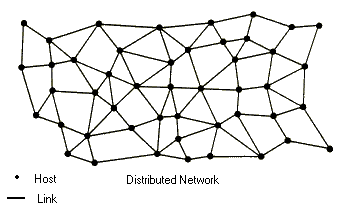
      Have you ever wondered how the technological monster known as "The Internet" came to be?  It wasn�t magic.  It all started in the midst of the Cold War.  In 1957, the Soviets launched Sputnik, the first orbital satellite, which scared the Americans.  They formed an agency called ARPA, or Advanced Research Projects Agency.  One of the projects of this agency was to develop a data network that would allow distant military organizations to stay in communication, even if some of the network had been knocked out by an attack.  For this to work, a distributed switching network would need to be developed, where equipment could route messages around breaks in the network.  This was the birth of ARPANet, the earliest form of the present day Internet.
(Courtesy of CyberGeography. http://www.cybergeography.org/atlas/historical.html)

      Although ARPA was created by the Military, it was not oriented just to the Military, but rather with an emphasis towards research.  Dr. JCR Licklider was assigned to research how to utilize computers. He had an interest in connecting communities together and having computers help people communicate with each other.  Helping people communicate became the fundamental advance of ARPANet.  The first step in creating the network was to find a way for all the different types of computers to talk to each other.  This was done by the Interface Message Processor (IMP), which was a minicomputer outside the regular computers, which handled the interface to the ARPANet network.  This way, computers on the network had only to be compatible with the IMP, and not all other computers on the network.  The IMP also functioned as a router or switch, sending data on it�s way across the network.  The company Bolt Beranek and Newman (BBN) were awarded the contract to develop the IMP.  The specification for the IMP, #1822, was released in April 1969 by Bob Kahn at BBN.

      The second step was to develop the protocol by which hosts would communicate with each other over the network.  It was developed as a Network Control Program, and the host computer would connect to the network through the program.  The primary function of the NCP is to establish connections, break connections, switch connections, and control flow.  Several layers of more complex protocols were built into this program as time went on, such as File Transfer Protocol and Telnet.

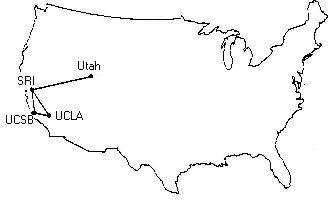
      ARPANet started with 4 nodes.  They were located at the University of California Los Angeles (UCLA), SRI, the University of California Santa Barbara (UCSB), and the University of Utah (UTAH).  These sites were chosen because they were major research centres, and were also already actively part of the research and development into ARPANet.  When attached to the network, each would provide information to users to read.  UCLA�s Network Measurement Centre was connected, as was SRI�s Network Information Centre, UCSB�s Culler-Fried interactive mathematics, and UTAH�s graphics.  UCLA was node 1, and was first to receive an IMP, because it was the site that would measure the network�s activity.  In 1969, when it was first activated, ARPANet looked like this:

(Courtesy of ARPANet Maps. http://som.csudh.edu/cis/lpress/history/arpamaps/)

      After ARPANet was activated, it gained popularity and spread very quickly.  Within 2 years, it spread across the country to connect to such famous Institutions as MIT, Harvard, and Stanford.  More and more people used the network to get information from computers at distant Universities.  A problem arose, however.  The Interface Message Processor (IMP) was becoming dated, and could not handle the new size of ARPANet.  It was built only to support 4 local hosts, and connect to 5 other IMP�s on the network.  A great demand to connect more local hosts, along with the expanding network, forced BBN to develop a new IMP.  The new model was more integrated, lighter, cheaper, and easier to maintain.  It was also a Terminal, which allowed 63 Teletypes to connect to it.  It was therefore called a Terminal Interface Message Processor, and called a TIP.  After the IMP problem was solved, another cropped up.  There was no standard way to transfer files over ARPANet.  A group of researchers got together and spent six months creating the protocol, and came up with the File Transfer Protocol, or FTP.  Files could now be transferred over ARPANET from computer to computer.

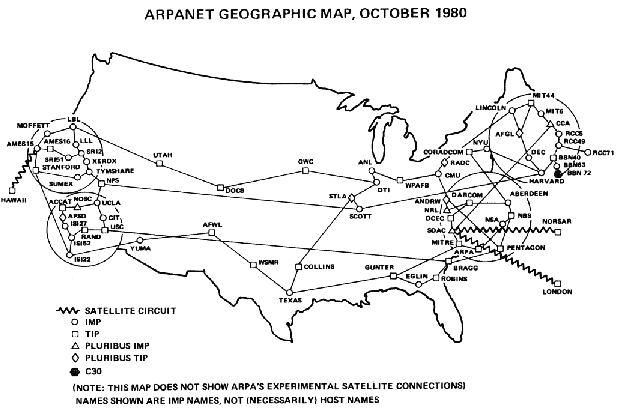
      After ARPANet was established, researchers wanted to connect it to other networks such as SATNet and packet radio.  For this to happen, a "Protocol for Packet Network Inter-communication" would need to be developed.  In the spring of 1973, Vint Cerf and Bob Kahn drew up the idea and worked out a proposal to submit to the International Network Working Group.  The way this protocol would work is that a message would be grouped into small envelopes or "packets", which would be addressed to go to a certain location.  It wouldn�t matter what was on the inside of the packet, just that it get to the specified location.  Built in also was a system that would resend a packet if it did not reach it�s intended location.  This was called the Transmission-Control Protocol.  By 1977, Vint Cerf was program manager of SATNet and packet radio and all research projects surrounding them, which were together called the ARPA Internet, because they were a network of networks.  He first demonstrated in July 1977 that information could be sent across all three networks using TCP.  His demonstration sent a packet 150,400 km from San Francisco Bay to London and back to the University of Southern California without losing even 1 bit of information.  By 1977, ARPANet had grown to include a large number of institutions in the US, as well as connections to Norway, Britain, and Hawaii.  In 1978 it was decided that the two parts of TCP would be split up into TCP and IP (Internet Protocol).  The TCP part would be in charge of forming the information into packets at the sending location, and reconstituting them again at the end location.  The IP would be in charge of addressing the packet and making sure it got to the intended location.  TCP/IP, as it would be called, did not come into full use until January 1st 1983.  This would be the official birth of the modern day Internet.  By October 1980, ARPANet had grown to include large portions of America and connections to other continents as well.

(Courtesy of ARPANet Maps. http://som.csudh.edu/cis/lpress/history/arpamaps/)

      At this point, many other countries and regions were building their own networks.  Europe built the EUNet (European Unix Network) in 1982, Japan created the JUNet (Japan Unix Network) in 1984, and the National Science Foundation created the NSFNet.  NSFNet had a backbone of 56 kbps, and established 5 supercomputing centres, which caused an explosion of connections.  There were many things that could be done on the Internet.  Network News Transfer Protocol (NNTP) made it possible for Newsgroups to form, where people could post messages and communicate.  Simple Mail Transfer Protocol (SMTP) allowed people to send E-mail messages to each other.  Through the 1980�s, many more new networks began forming, such as CSNet (Computer Science Research Network), BITnet (Because it�s time network), SPAN (Space Physics Analysis Network), and CDNet (Canadian Network).  After the creation of NSFNet, the Internet began to become more about commercialism than about research, and NSFNet had far more computers and was much faster; so many people began switching over.  ARPANet was unable to keep up with the advances and funding of NSFNet, and began to sink into obscurity when NSFNet upgraded it�s backbone to a T1.  The inevitable day came in 1989, when it was decided to pull the plug on the 22-year-old network.  The last computers were disconnected and then connected to NSFNet.  This was the end of the first Internet.  Researcher Danny Cohen said in a speech:

"In the beginning ARPA created the ARPANet.

And the ARPANet was without form and void.

And darkness was upon the deep.

And the spirit of ARPA moved upon the face of the network and ARPA said, �Let there be a protocol,� and there was a protocol. And ARPA saw that it was good.

And ARPA said, �Let there be more protocols,� and it was so. And ARPA saw that it was good.

And ARPA said, �Let there be more networks,� and it was so."

(Cohen, 1989)


--


Bibliography


-Back-

Hosted by www.Geocities.ws

1